
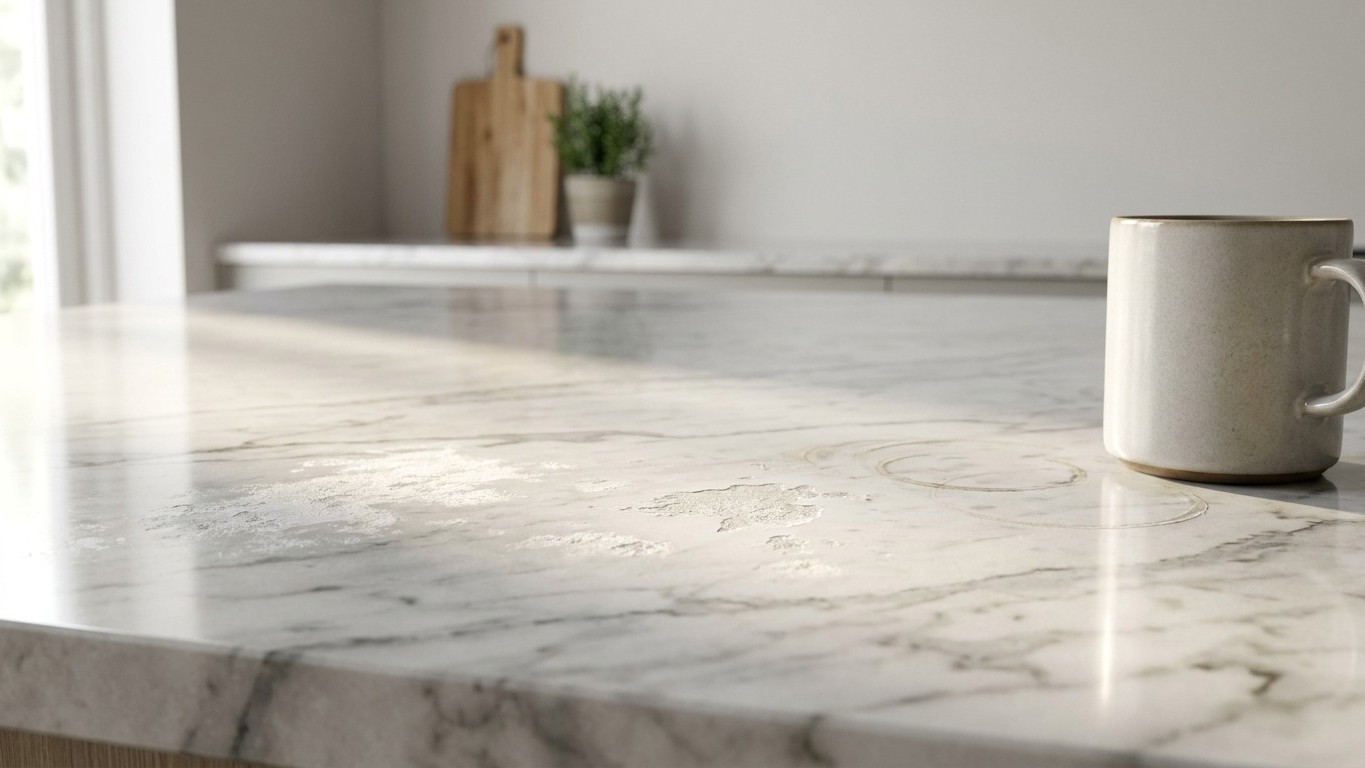
That cloudy halo raking across the marble wasn’t dirt, and no amount of scrubbing was going to lift it. Under direct light the countertop had looked fine the night before. But sideways morning light is unforgiving on polished stone, and it revealed a scatter of dull, slightly rough patches exactly where the lemon half had swiped. The juice hadn’t cleaned the surface. It had eaten it.
Key takeaways
- A single splash of lemon juice can begin etching marble in just 30 seconds—faster than most people realize
- The damage only becomes visible under raking light because etching scatters light differently than a polished surface
- Sealing marble won’t prevent this chemical reaction, despite what marketing claims suggest
The chemistry that ruins a good countertop
Marble is limestone that got squeezed and heated over millions of years, but at its core it’s still calcium carbonate, the same mineral in chalk and eggshells. Marble is composed primarily of calcite, calcium carbonate, and calcite is a mineral that dissolves readily when it contacts acids. Lemon juice is loaded with citric acid, and the moment it touches that stone, an acid-base reaction kicks off. When an acidic liquid like lemon juice, vinegar, wine, tomato sauce, coffee, or soda contacts marble, it triggers an acid-base reaction, and the acid dissolves a microscopic layer of calcite from the stone surface.
What makes this genuinely surprising is the speed. This isn’t a slow chemical process that takes days to show itself. The speed of this damage surprises most homeowners: a splash of lemon juice can begin etching within 30 seconds, and wine left sitting creates visible marks in under two minutes. A distracted minute wiping down a countertop, phone buzzing, kid yelling from another room, and the damage is already locked in. One stone care blog frames it almost as a warning label: the longer an acidic liquid sits on marble, the deeper the etch, and a lemon juice splash wiped up in under 5 seconds may cause minimal or no visible etching, while the same splash left for 30 seconds may leave a clearly visible dull spot.
Why it only shows up in raking light
This is the part that trips up most people, including plenty of new marble owners who assume they’re dealing with a stain. They’re not the same thing, and the distinction matters for how you fix it. Etching removes microscopic layers of marble, changing both texture and appearance, while staining penetrates the stone and discolors it without affecting the surface finish. A polished marble surface gets its mirror shine from an extremely flat, orderly arrangement of calcite crystals at the surface. Acid disrupts that arrangement at a microscopic level, and the result scatters light instead of reflecting it cleanly. This dissolution creates a rougher texture that scatters light differently, producing that characteristic dull or whitish spot.
That’s exactly why the damage was invisible under the kitchen’s overhead light and glaringly obvious the next morning. Straight-on lighting bounces off a flat surface fairly evenly, etch marks and all. Light coming in at a low angle, the kind that streams through a kitchen window early in the day, catches every irregularity and throws shadows across texture that would otherwise stay hidden. You can even confirm it by touch. Etching creates dull, rough spots by removing surface material, while staining discolors the marble without changing texture, and etched areas feel rougher than surrounding marble while stains feel smooth; etching appears lighter or cloudier, whereas stains typically darken the stone.
There’s a persistent myth that sealing marble prevents this. It doesn’t, and every stone care professional interviewed on the subject says so plainly. Sealing your marble does not prevent etching; sealers protect against stains by reducing liquid absorption, but they do not block the chemical reaction that causes etch marks. A sealed countertop resists a red wine stain soaking in. It does nothing to stop the acid from reacting with the calcium carbonate sitting right at the surface.
Getting the shine back, and keeping it there
Light etching, the kind from a quick swipe of citrus, can usually be buffed out at home without hiring anyone. Minor etch marks can often be buffed out at home using marble polishing powder, while moderate to severe etching typically requires professional stone restoration involving honing and re-polishing. The powder isn’t a cleaner in the traditional sense. It’s an extremely fine abrasive that essentially re-polishes the damaged spot, matching it back to the surrounding sheen. Marble polishing powder works by removing a very thin layer of stone, and it is appropriate for light etching only, since it won’t touch moderate or deep etch marks. Applied with a damp cloth in small circular passes, checked frequently, it can bring back a shine that looked permanently ruined an hour earlier.
For anything deeper, the DIY fix loses its appeal fast. There’s a topical treatment cured with ultraviolet light, similar to what a dentist or nail salon uses, but it runs upwards of $1,000 for a typical kitchen, though it lasts 10 to 15 years. Against that price tag, a bit of vigilance looks like the bargain it is.
The habit that actually protects a marble counter isn’t sealing, it’s speed. Keep lemons, tomatoes, wine, and coffee off bare stone, use a cutting board and a coaster like they’re mandatory, and if something acidic does land on the surface, get to it before you finish your sentence. Clean marble daily with a stone-safe, pH-neutral cleaner or simply warm water with a few drops of dish soap, rinse well, dry completely, and never use vinegar, bleach, ammonia, or all-purpose bathroom cleaners on marble surfaces. That lemon-half trick for a quick shine? Save it for the sink.
Sources : mbstonecare.com | home.onehowto.com