
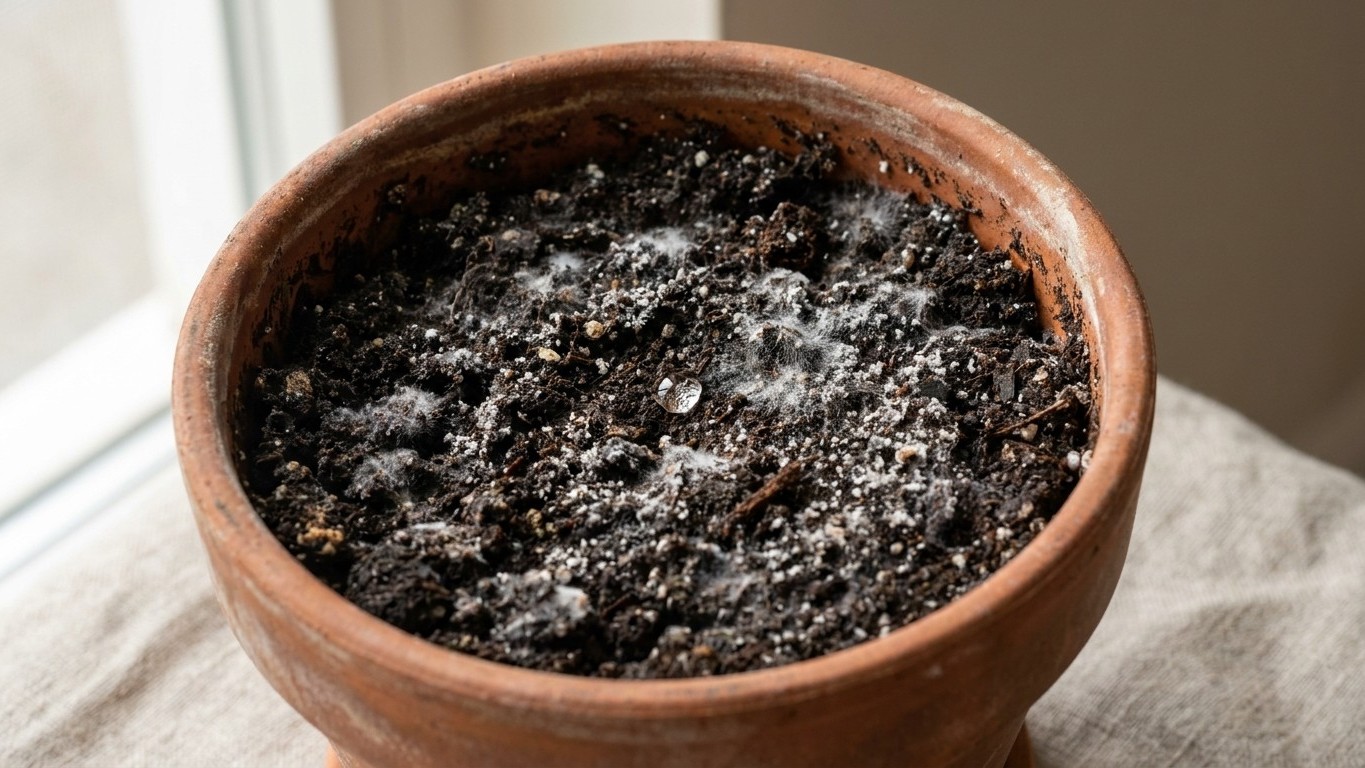
Scrape it off, water again, watch it come back within a week. That’s the loop most Houseplant owners get stuck in with that white film on the soil surface, and it’s a losing game. The real issue isn’t what’s sitting on top of the mix right now. It’s what happens to that top layer of soil during the days between one watering and the next, because that cycle of wet and dry is exactly what determines whether the white stuff is a one-time nuisance or a problem that keeps rebuilding no matter how many times you wipe it away.
Key takeaways
- Most plant owners don’t realize the white film could be one of two completely different problems that look identical but need opposite fixes
- The days between your waterings—not the white stuff itself—determine whether this cycle ever stops
- One tiny watering mistake makes mold thrive, while a different mistake concentrates salts to the surface like a wick
Mold or salt: two different problems wearing the same disguise
Before fixing anything, you need to know what you’re actually looking at, because the two most common culprits require opposite responses. If you lightly poke the white layer and it breaks apart into a soft, threadlike mat, that’s mold. If it flakes off like chalk, you’re probably dealing with salts. That distinction matters more than most plant owners realize.
The chalky version is mineral buildup, sometimes called efflorescence, and it has nothing to do with living organisms. It’s usually a buildup of mineral salts left behind after water or fertilizer evaporates, and in many cases, it’s not a disease and doesn’t mean the plant is failing. Hard water is a common cause. It means water with a high mineral content, especially calcium and magnesium, and those minerals can build up over time, especially in small pots, shallow containers, and greenhouse setups where evaporation is strong. Fertilizer contributes too: fertilizer residue forms a white salt crust when dissolved nutrients evaporate, leaving crystalline deposits on the soil surface.
The fuzzy version is a different animal entirely, literally. The common white fuzzy film on potting mix is normally saprophytic fungus feeding on dead organic matter, not living roots or leaves. It’s not attacking your plant directly. The plant risk is indirect: the same damp, stagnant conditions that allow mold to show up can also favor root rot, fungus gnats, and weak growth. And there’s a third possibility worth ruling out first: many potting mixes contain perlite, a lightweight white mineral that helps improve drainage, and after watering and settling, those bright particles may rise toward the surface and create a surprising snowy appearance that gardeners often mistake for mold, though a quick touch reveals the difference because perlite feels hard and gritty while fungal growth feels soft or fuzzy.
What actually happens in that top inch between waterings
Here’s where most advice stops short. Knowing whether you have salt or mold is only half the story. What decides whether either one keeps coming back is the moisture pattern of that top inch of mix during the gap between waterings, and each cause responds to a completely different rhythm.
Mold needs sustained dampness to establish and spread. The most common trigger is watering again before the top layer of mix has dried. If that surface layer never gets the chance to dry out fully before the next watering, you’re essentially running a continuous incubator. White mold on potting soil often sits on the surface, especially around the edges of the pot, where the mix stays damp longer. Poor airflow compounds it: if you spot fuzzy white growth, improve airflow immediately by moving your plant to a breezier spot or using a small fan on low.
Salt crust follows the opposite logic. It doesn’t need moisture to persist, it needs evaporation to concentrate. Every time water travels up through the mix and evaporates from the surface, it leaves dissolved minerals behind, and the drier and faster that top layer dehydrates between waterings, the more concentrated the residue becomes. Warm windowsills, sunny patios, and hobby greenhouses can speed up the process because they dry the top layer of mix quickly, meaning salts are more likely to concentrate at the surface instead of being washed deeper into the pot. Watering from a saucer makes this worse rather than better: when you water from a saucer underneath the plant, salt is absorbed from the soil, dissolves in the water, and rises to the surface, and when the salty water reaches the top of the soil, the water evaporates and leaves the salt as a white crust.
So the same white patch can mean two opposite watering mistakes. One plant has a surface that’s never allowed to dry. The other has a surface that dries too aggressively, pulling minerals up like a wick every single cycle. Scraping the top layer treats neither pattern, which is exactly why the film reappears.
Breaking the cycle instead of chasing the symptom
For mold, the fix is rhythm, not removal. Water only when the top inch of soil feels dry, and let it actually reach that point before the next watering rather than keeping the surface perpetually damp. Pairing that with better airflow and clearing dead leaf debris off the surface removes the fungus’s food source and its favorite humid microclimate at the same time.
For salt crust, the fix is flushing rather than scraping. You can gradually remove it by pouring a lot of water on the soil and allowing it to drain out into a large container on the bottom, then discarding the salty water instead of letting it sit in a saucer to wick back up. If your tap water runs hard, rainwater, filtered water, or a lower-mineral source can reduce repeat buildup, which is especially helpful for houseplants, seedlings, orchids, and any container grown in a greenhouse where evaporation is strong.
One detail that catches people off guard: a persistent crust isn’t cosmetic forever. Salt buildup isn’t immediately toxic, but it can hinder water absorption and damage roots over time, and sensitive plants like peace lilies may show brown leaf tips due to high salt levels in the soil. The scraping habit feels productive, but the surface you’re clearing was never the problem. The four or five days before your next watering can is where this actually gets decided.
Sources : gardenlyhome.com | quora.com