
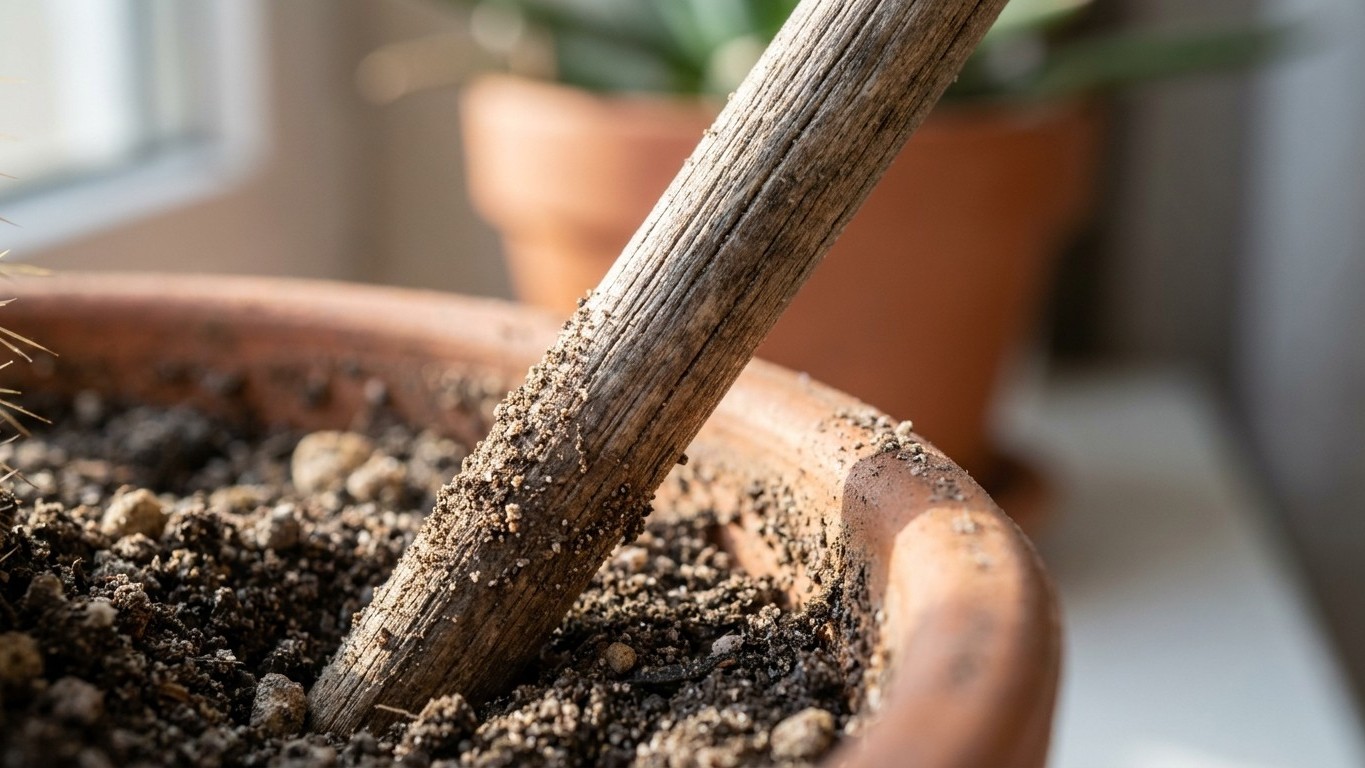
The moment a new cactus crosses your threshold, before you set it on a windowsill or worry about the right light exposure, do this: push a plain wooden skewer straight down through the soil to the bottom of the pot, count to sixty, then slide it back out. What clings to it, or doesn’t, tells you more about that plant’s near future than any care label ever will.
Growers who handle dozens of specimens a week don’t guess. They test. Testing soil moisture is crucial before watering, and inserting a wooden skewer or finger into the soil reveals the answer instantly: if it comes out clean and dry, it’s time to water, but if moisture or soil particles cling to it, wait a few more days. That thirty-second habit, repeated before every other diagnosis, is why experienced growers rarely blame light, humidity, or bad luck first. They rule out water.
Key takeaways
- Nurseries often sell cacti in suspiciously wet soil—and you won’t know until you test it
- Why expensive moisture meters fail spectacularly on cactus soil (hint: it’s about conductivity)
- The one variable growers check first before blaming light, pests, or humidity
Reading the Skewer Like a Cake Tester
The comparison isn’t accidental. Experienced plant experts have used wooden skewers and chopsticks to gauge soil moisture for years, the same way you’d poke a skewer into a cake to see if it’s done. If the batter clings, it needs more time. Soil works the same way. Moist particles of soil adhere to the wood, so a clean stake means the soil is too dry, a muddy stake means too much moisture, and a stake flecked with soil particles means the moisture level is fine.
For cacti specifically, the standard is stricter than for a leafy houseplant. The test calls for inserting a clean wooden skewer to the bottom of the pot, leaving it 60 seconds, then pulling it out: a dry skewer with no soil sticking means it’s time to water, while a damp skewer with soil attached means you should wait. No gray zone, no “maybe in a couple of days.” Either it’s bone dry all the way down, or it isn’t.
One detail trips up beginners: how long to leave the stick in. Some growers push and pull immediately, others let it sit five minutes or longer in larger pots. There’s no universal answer, but the deeper principle holds: a quick in-and-out only samples surface soil, and cactus roots don’t live at the surface. Sinking the skewer to the actual bottom of the pot, not just an inch or two, is what separates a useful reading from a false one.
Why the Moisture Meter Often Lies
Plenty of gardeners reach for an electronic probe instead, assuming a number on a dial beats guesswork. With cactus soil, that assumption backfires more often than expected. Moisture meters work based on conduction of electric current, so they don’t always properly represent how wet the soil is, especially in a mix that has built up Fertilizer salts or uses very granular material like pure pumice. Cactus mixes are built to drain fast and contain grit, sand, and pumice, exactly the ingredients that confuse a conductivity sensor.
The failure can be almost comical. If you stick a moisture meter in pure distilled water it will also think it is dry, because there’s nothing dissolved in it to conduct current. Growers who’ve compared tools directly back up the skewer over the gadget: moisture meters haven’t proven reliable with a gritty soil mix like a succulent-specific blend, because the soil doesn’t make enough surface contact with the meter to get an accurate reading. One grower who tested both put it plainly, noting that using wooden labels for their pots, if the stick comes out totally dry, that’s the right time to water desert cacti in their conditions, and it’s better to wait a week rather than risk overwatering.
None of that makes moisture meters useless everywhere. They tend to perform better in denser, more organic potting soil, the kind used for tropical houseplants or bonsai, where there’s more material to hold a charge. Cactus substrate just isn’t built for that kind of reading. If your only tool is a meter and it says “dry” the same day you got the plant, don’t fully trust it. Confirm with a stick.
Ruling Out Water Before Blaming Anything Else
Here’s the real reason growers run this test on day one, before scrutinizing light levels or hunting for pests: overwatering is the single most common killer of cacti in home care, and it’s entirely preventable if you catch it early. The fundamental rule of cactus watering is to ensure the soil dries completely between waterings, a practice that prevents root rot and other moisture-related issues that commonly affect these desert plants. Confirmation comes from the top of the field: according to the Royal Horticultural Society, overwatering is the primary cause of cactus decline in UK homes.
A skewer pulled dry the day you bring a cactus home tells you it’s safe to water right away without drowning roots that may already be stressed from transport. A skewer pulled damp, or worse, muddy, means the nursery or store already soaked that soil, and adding more water immediately would be the fastest way to trigger rot before the plant has even settled into its new spot. That single check, done before repotting, before placement, before anything else, saves you from misdiagnosing weeks of decline later as a “light problem” when it was moisture all along.
Pot material changes the math too. Terracotta pots dry 30 to 40 percent faster than plastic or glazed ceramic, so a cactus in a 4-inch terracotta pot may need water every 7 to 10 days in summer, while the same cactus in a plastic pot might go 12 to 16 days. That’s exactly why a fixed watering calendar fails and a skewer doesn’t: the stick reads the actual pot in front of you, not a generic schedule copied from a plant tag.
Keep a handful of plain wooden skewers by the potting bench, not just the fancy bamboo ones from the kitchen drawer, since untreated wood shows moisture more honestly than coated or flavored varieties. Swap in a fresh one every few checks: a stick crusted with old mineral residue from hard tap water can start giving false readings of its own, turning the simplest test in your plant kit into one more thing to second-guess.
Sources : zonedgarden.com | ottershawcacti.com