
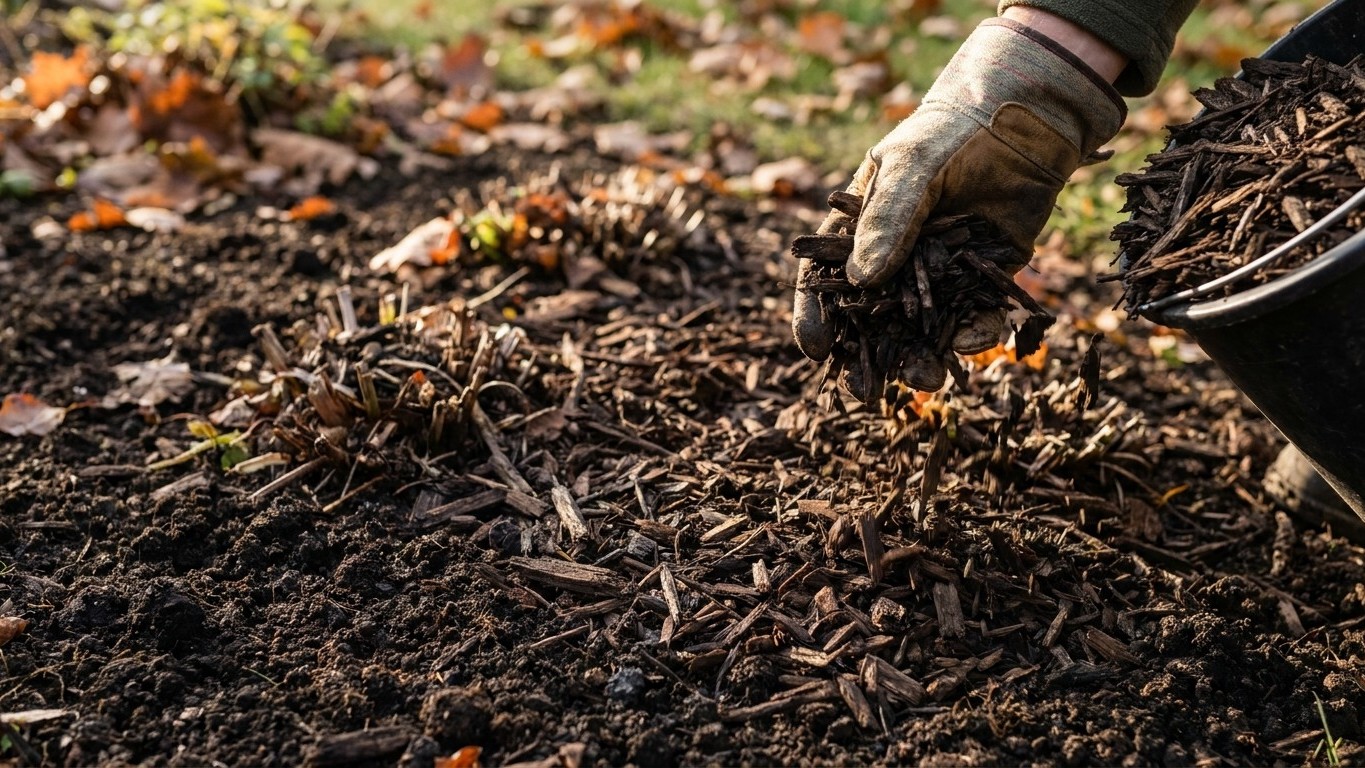
Three hours every Saturday morning, kneeling in the dirt, pulling up dandelions and crabgrass by hand. That’s the reality for a lot of gardeners every spring. But there’s a fix that takes about twenty minutes per bed in October and pays off for the entire following season: a two- to three-inch layer of mulch, laid down once the soil has cooled but before the ground freezes solid.
The timing isn’t arbitrary. Once the soil has cooled but before it freezes, a layer of mulch helps protect plant roots from the freeze-thaw cycles common in Midwestern winters. Mulch too early, while the soil is still warm from summer, and you invite trouble. Mulching too early, when the soil is still warm, can lead to problems such as increased rodent activity or delayed plant dormancy. Waiting until after several hard frosts ensures that plants have entered dormancy and the soil has cooled. Most regions hit that window sometime between late October and mid-November, right when the leaf pile in the yard starts looking less like decor and more like a chore.
Key takeaways
- One twenty-minute task in October could eliminate hours of spring weeding by blocking winter annual weed germination
- The exact timing window and thickness matter more than most gardeners realize—and getting it wrong actually makes things worse
- Earthworms and soil organisms transform the ground beneath autumn mulch into rich, fertile soil that needs raking, not weeding, come April
Why autumn beats spring for this particular job
Spring mulching gets more attention because it looks tidier for the growing season ahead. But the Oregon State University Extension Service Master Gardener program takes a firmer stance: fall is when the real weed-fighting work should happen. The Oregon State University Extension Service Master Gardener program strongly recommends mulching in autumn. Weed-suppressing mulches save a lot of work. An occasional weed may poke through the mulch, but you can easily pull it out.
There’s a second, less obvious payoff. Mulching in fall can insulate the ground from early cold snaps and slow evaporation during a time of year when rains become or remain irregular, and it can discourage the germination of winter annual weeds like chickweed and bittercress. Those winter annuals are sneaky. They germinate in fall, sit quietly through the cold months looking harmless, then explode into full, seed-dropping maturity the moment temperatures rise in March. Block their germination window in October and you’ve already won half the spring weed battle before winter even starts.
The soil itself benefits too, in ways that go beyond just weeds. Mulch suppresses early spring weeds, reduces soil erosion, and improves soil structure as it decomposes, while also supporting beneficial insects and soil organisms by maintaining a more stable and sheltered habitat. Come April, when you finally pull back that mulch, you’re not looking at compacted, weed-riddled dirt. You’re looking at soil that earthworms have been tunneling through all winter.
Getting the thickness right (this is where most people mess up)
Here’s the number that matters most: two to four inches, depending on material. Cornell’s turf and weed science program is blunt about it. Mulching depth alone can provide adequate weed control, and for optimal results, gardeners should maintain a mulch layer of 2 to 4 inches. Go thinner and you’re wasting your time. Going thinner than 2 inches limits weed prevention and leads to faster breakdown.
But more is not automatically better. This is the mistake I see constantly in front yards this time of year, piles of mulch stacked six or eight inches deep against tree trunks like little volcanoes. In addition to being a waste of money, applying too much mulch can kill shrubs, trees, and other landscape plants, so avoid applying mulch directly against the base of woody plants and avoid the mulch “volcano.” Keep a gap. Maintain a mulch-free area around the base of woody plants, roughly 3 to 5 inches around young plants and 8 to 18 inches around mature trees.
Straw and loose leaves behave differently than bark or wood chips because they compress. If you’re using shredded fall leaves, the Oregon Metro program suggests going heavier at the start. Start with a thick layer of more than six inches, since it will settle down to three inches over time. Whole, unshredded leaves are a separate problem entirely. Running over fallen leaves with a lawnmower before applying is worthwhile, because whole leaves can mat down and prevent water penetration. A soggy leaf mat doesn’t suppress weeds, it just rots into a slimy layer that blocks rain from reaching roots.
What to actually spread down there
Not every material earns its keep the same way. Bark and wood chips last the longest and look the most finished. Straw and leaves decompose faster but feed the soil more directly. Compost, meanwhile, is the odd one out. Compost increases soil fertility but does not block weeds very well, so using weed-seed-free compost from the nursery gives the best mulching results. If weed suppression is the priority, compost alone won’t cut it. Layer it under a coarser material instead.
Whatever you choose, skip the shortcut of mulching over existing weeds. Whatever type you use, it should be at least three inches thick, and you should pull or cut existing weeds before you spread mulch to reduce the chances of them growing through. A perennial weed with an established root system will push through four inches of bark chips without much difficulty. Mulch smothers seeds trying to germinate. It doesn’t smother what’s already rooted.
One more detail that gets overlooked: not every bed wants the same treatment in fall. Perennials like rhubarb or globe artichokes benefit from heavier mulch as winter protection, removed again in spring to expose plants to light, while shrubs such as roses, azaleas, rhododendrons, and hydrangeas, along with lilies, dahlias, tulips, and daffodils, do better with low-nutrient mulching too. So the two-inch rule is really a starting point, not a universal law. Walk your beds plant by plant before you commit an entire truckload of mulch to a one-size-fits-all approach, and you’ll get a spring garden that needs raking, not weeding.
Sources : extension.oregonstate.edu | yardandgarden.extension.iastate.edu