
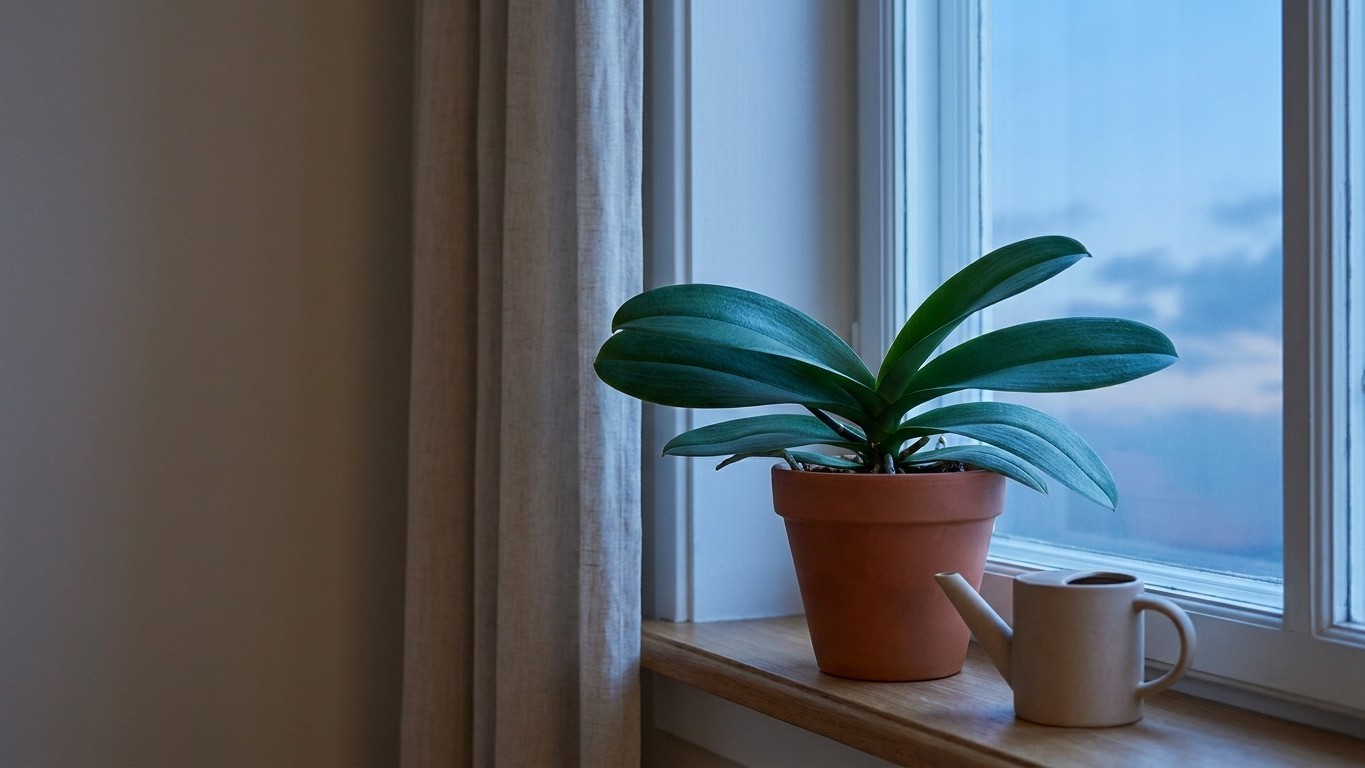
Warm rooms make plants grow leaves. They don’t make orchids flower. If your Phalaenopsis has been pumping out glossy new foliage for two years straight while the flower spike never shows up, the thermostat set at a cozy 72°F is likely the exact reason why. The blooming cue for Phalaenopsis orchids is a larger day to night temperature differential. A living room that never dips is a room that never tells the plant it’s time to bloom.
This trips up more orchid owners than root rot or bad light ever does. The plant looks healthy. The leaves are thick and green. New roots snake over the pot’s edge. Everything says “thriving” except for the one thing you actually bought it for: flowers. The explanation sits in the plant’s biology, not in your watering can.
Key takeaways
- Your perfectly comfortable 72°F living room is blocking the exact biological signal that tells orchids to flower
- Phalaenopsis need 2-3 weeks of 55-60°F nights to initiate blooms—a seasonal chill most heated homes never provide
- A simple windowsill or garage nighttime relocation can fake autumn and unlock flowering within months
The cold snap your orchid never gets
Phalaenopsis are epiphytes native to the humid forests of Southeast Asia, where seasons still exist even in the tropics. In their native Southeast Asian habitats, Phalaenopsis orchids experience cooler nights in autumn and early winter, a natural seasonal shift that signals to the plant that it is time to flower. That seasonal dip is a hormonal trigger, not just a comfort preference.
At night, orchids undergo respiration, consuming stored energies, and cooler nighttime temperatures reduce respiration, allowing the orchid to conserve more carbohydrates that get directed toward developing flower spikes and blooms. Run a home at a flat 70°F day and night, year-round, and the plant simply never gets the signal to stop building leaves and start building a spike. Because the cool spell is the trigger, a plant held at an even room temperature all year frequently grows leaves and roots but never sets buds. That’s the whole mystery, solved by a single missing variable.
The numbers researchers point to are fairly consistent across institutions. Cool nighttime temperatures of 55 to 60 degrees Fahrenheit in fall help initiate flower development, and growers should avoid exposing plants to temperatures below 55 degrees Fahrenheit. The New York Botanical Garden frames it the same way: in nature, orchids experience a 10ºF temperature difference between day and night, and this differential is important when trying to initiate flowering, particularly in autumn when several weeks of 55ºF night temperatures are helpful. Two to three weeks is usually enough. After about two weeks of cooler nights, a vigorous plant will initiate a new flower spike that lengthens slowly and buds emerge a few months later.
How to fake an autumn in your living room
You don’t need a greenhouse or a chiller to reproduce this. The simplest fix is physics: glass loses heat faster than drywall. Phalaenopsis can be placed near a window or in a bow window where they will sense the temperature dropping at night. An east-facing sill works particularly well because it still offers gentle morning light without the harsh midday sun that scorches the leaves.
If your windows are too well-insulated or your house runs uniformly warm, there’s a low-tech workaround. Orchids can also be moved to a cooler location of a house, such as a garage, at night. A three-season porch, an unheated mudroom, or even a spot right next to an exterior door works the same way. The trick is consistency: a single chilly night does nothing. It’s the sustained dip, night after night for several weeks, that flips the switch.
There’s a ceiling and a floor to respect here, though. Pushing temperatures below 55°F in the hope of a stronger trigger doesn’t speed up spike initiation, it causes cold stress and damage, so the goal is a gentle, consistent cool period, not a chill. And on the warm end, don’t assume more heat means more growth. The American Orchid Society notes that daytime temperatures above 82°F also suppress flowering, a practical concern for plants near radiators or south-facing glass. A windowsill that swings from 60°F at night to a scorching 85°F by afternoon sun isn’t triggering anything, it’s just stressing the plant in two directions at once.
Temperature isn’t the only culprit, but it’s usually the missed one
Light and humidity still matter, and they can mask or compound the temperature issue. An orchid needs to have all its needs met to generate the energy necessary to flower, and adequate light, proper watering, and proper temperature and humidity levels all contribute to a flowering Phalaenopsis. If your plant sits three feet back from a north window in a dim corner, no amount of nighttime chill will compensate for insufficient light. Increasing brightness (short of direct sun) genuinely helps: increasing the light that the orchid receives is another way to trigger flowering.
Humidity is the other half of the equation most living rooms fail on. Phalaenopsis orchids require a relative humidity of 40 to 60 percent, and central heating in fall and winter routinely drops indoor air well under that. A pebble tray under the pot, or a small humidifier nearby, closes that gap without any real effort.
What almost never causes the “leaves but no spike” pattern is overfeeding or underfeeding, despite what forum threads suggest. Fertilizer feeds vegetative growth, which is exactly the problem you’re already seeing too much of. The fix isn’t a different fertilizer schedule, it’s a deliberate three-to-four-week stretch of cooler nights, ideally starting in early fall when outdoor air naturally cooperates with the plan.
One detail growers often miss: this isn’t a one-time reset. Once your plant reblooms on this cycle, it will expect the same seasonal dip again the following autumn. A moth orchid usually blooms once a year, and the timing turns on temperature more than the calendar, with the plant reading a run of cooler nights through fall and early winter before sending up a flower spike. Mark your calendar for late September or October, crack a window at night for a few weeks, and the plant that’s been all leaves and no flowers for two years might finally do the one thing you brought it home to do.
Sources : quora.com | libguides.nybg.org