
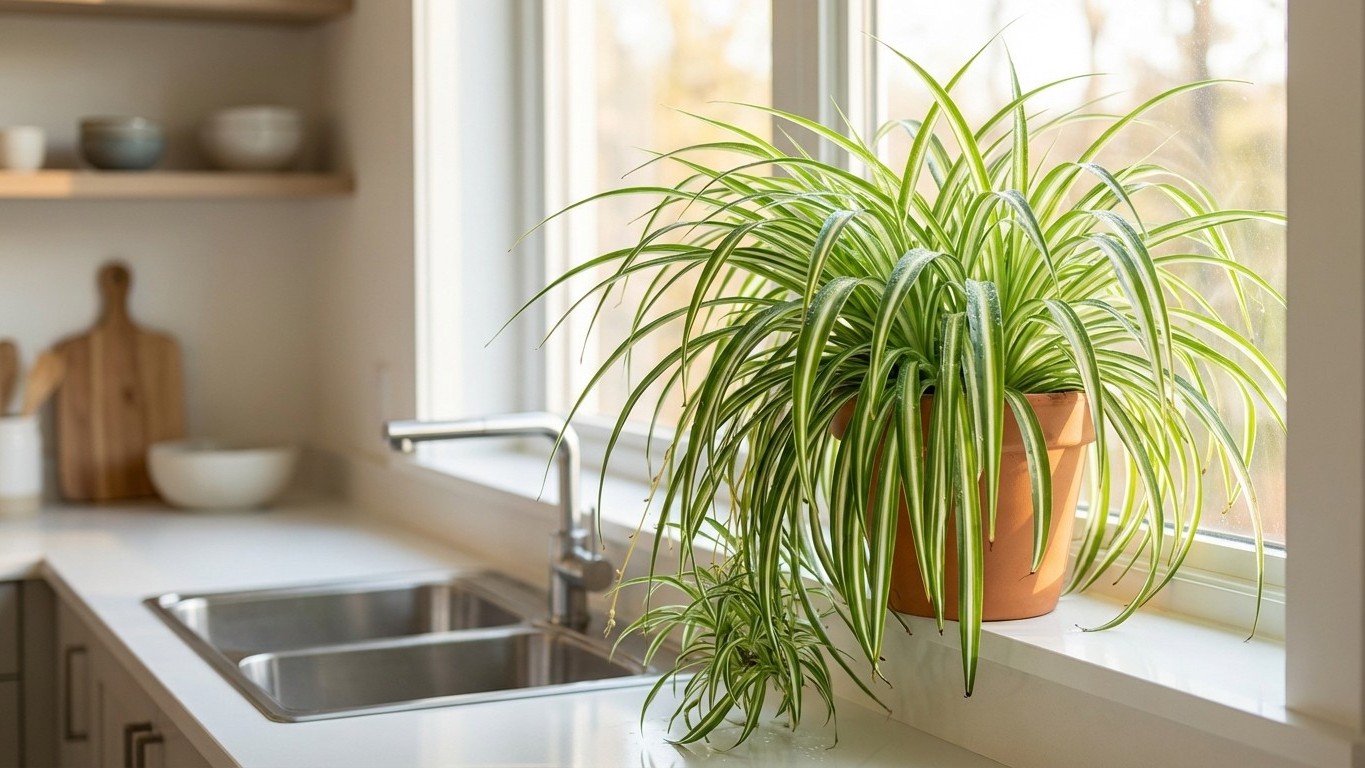
The kitchen is the hardest room in any home to keep smelling fresh. Bacon grease, last night’s fish, that garlic that somehow lingers for three days, no matter how aggressively you ventilate, certain smells just settle in and make themselves comfortable. For years, I cycled through plug-in air fresheners, scented candles, and sprays that mostly just layered a synthetic lavender cloud on top of the problem. Then I started reading about the actual science of how certain houseplants process volatile compounds, and something clicked. Some plants don’t just mask odors. They absorb them.
This isn’t folklore or wellness marketing. NASA’s Clean Air Study, conducted in the late 1980s and expanded upon since, demonstrated that many common houseplants can remove airborne chemical pollutants from enclosed spaces. The mechanism involves the plant’s leaves, its root system, and crucially, the microorganisms living in its soil, all working together to break down compounds that our noses register as “smell.” Kitchen odors are largely caused by volatile organic compounds (VOCs): sulfur-based molecules from onions and garlic, fatty acid byproducts from cooking oils, and nitrogen compounds from proteins. Plants that absorb VOCs well tend to be very good at handling exactly this kind of chemistry.
Key takeaways
- NASA-backed research proves common houseplants can remove airborne odor compounds that plug-in fresheners only hide
- Your plant’s soil microbes do half the odor-absorbing work—which is why plant care matters more than most people realize
- Strategic placement of 3-4 plants near odor sources outperforms scattered plants or synthetic alternatives
The plants that actually earn their place near a stove
Spider plants (Chlorophytum comosum) are probably the most underrated kitchen plant alive. They’re nearly impossible to kill, they thrive in indirect light, and studies have shown they can absorb formaldehyde and carbon monoxide, both of which are produced by gas stoves during normal cooking. A spider plant sitting on top of a refrigerator or hanging near a window isn’t decorating your kitchen. It’s processing it. The fact that they reproduce constantly, sending out little “spiderette” offshoots you can propagate for free, makes them a genuinely practical investment.
Peace lilies (Spathiphyllum) are the other heavy hitter. They handle ammonia particularly well, which matters more in kitchens than most people realize, ammonia-based compounds appear in cleaning products, yes, but also in the breakdown of certain proteins during cooking. Peace lilies prefer low to medium light and moist soil, which makes a kitchen windowsill their ideal habitat. One caveat worth keeping in mind: they’re toxic to cats and dogs, so placement matters if you share your home with pets.
Basil deserves a category of its own. As both an herb and an air-improving plant, it pulls double duty in a way nothing else quite matches. The natural oils it releases, linalool and eugenol among them, are mildly antibacterial and actively counteract some of the sulfur compounds responsible for post-cooking odors. A pot of basil on the counter near the stove is one of those rare home additions that improves your cooking, your kitchen’s smell, and the aesthetic simultaneously. Three jobs, zero synthetic chemicals.
Why your soil matters as much as your leaves
Here’s something most plant content leaves out: the odor-absorbing work isn’t done only by the leaves. The root zone, specifically the microbial community living in the soil around a plant’s roots — is responsible for breaking down a significant portion of the compounds a plant “absorbs.” This is why a healthy, well-watered plant Outperforms a stressed or underwatered one dramatically. A spider plant sitting in bone-dry, compacted soil is basically a decoration. That same plant in fresh, aerated potting mix with regular watering is a functioning air filter.
What this means practically: if you’re adding plants to your kitchen for smell-reduction purposes, don’t neglect basic care. Repot if the roots are crowded. Use well-draining potting mix rather than garden soil. Water consistently, and make sure your pots have drainage holes. The investment in proper care pays off in both plant health and air quality, a connection that rarely gets made explicit in the usual “just stick it on a shelf and forget it” plant advice.
Getting placement right
Volume matters. One small pothos on a distant shelf isn’t going to neutralize your Saturday morning bacon situation. The research suggests you need meaningful plant density relative to room size to see measurable air quality effects, roughly one medium to large plant per 100 square feet as a starting point, though kitchens vary wildly in size and ventilation. A galley kitchen with poor airflow will respond faster to plants than a large open-plan space connected to a dining room.
Positioning plants closer to the source of odors also makes a difference. Near the stove, near the trash can area, near the sink, these are the active zones. A cluster of three or four plants in these areas will outperform eight plants scattered randomly around the room. Snake plants (Sansevieria), with their vertical profile, are particularly good for tight counter spaces because they take up almost no horizontal footprint while still processing a meaningful volume of air through their leaves.
Pothos (Epipremnum aureum) rounds out any practical kitchen plant collection. Trailing from a high shelf above a counter, a mature pothos can cover a surprising amount of square footage with its leaves while requiring almost no attention. It handles humidity, fluctuating temperatures, and inconsistent light better than almost any other species. The trade-off is that it absorbs compounds more slowly than some of the more specialized options, but its resilience means it’s actually going to be alive and functioning two years from now, which is more than can be said for most people’s kitchen plant experiments.
The deeper question this raises: how many other “solutions” we’ve been buying in bottles or plug-in cartridges have living, self-sustaining alternatives that we’ve simply never been shown? Kitchen odors were the gateway for me, but the same principle extends to bathroom smells, pet areas, even home offices where synthetic materials off-gas continuously. Plants won’t solve every air quality problem, they’re not a replacement for ventilation or proper cooking habits. But they shift the baseline in a direction that no aerosol spray ever managed to sustain.