
Dust happens. You clean the countertops, wipe down the shelves, scrub the bathroom tiles, and somehow, your houseplants sit there collecting a fine grey layer that nobody talks about. Most of us, at some point, reach for a dry cloth and give those leaves a quick swipe. Done, right? Not quite. That single habit, repeated over months, can quietly stress your plants in ways that aren’t immediately obvious.
A friend who grows more than forty plants in a one-bedroom apartment set me straight on this. She wasn’t preachy about it. She just handed me a spray bottle and a soft microfiber cloth and said, “Watch.” What followed was a ten-minute routine that changed how I think about plant care entirely.
Key takeaways
- Why that quick dry wipe might be quietly stressing your plants month after month
- The one mistake even experienced plant owners make with commercial leaf shine products
- A surprisingly simple routine that takes less than ten minutes and visibly transforms neglected plants
Why Leaf Cleaning Actually Matters
A plant’s leaf is, in every functional sense, its solar panel. Photosynthesis Happens through the leaf surface, and when that surface is coated with dust, the plant receives less light than it needs, even if you’ve placed it perfectly by a window. Research from horticulture studies confirms that a heavy dust layer can reduce a plant’s light absorption by a measurable margin, slowing growth and dulling the deep greens you were hoping for when you bought the thing.
Beyond light, leaves breathe through tiny pores called stomata. Clogged stomata mean reduced gas exchange, which affects how efficiently a plant manages water and carbon dioxide. The plant doesn’t die dramatically. It just… underperforms. Yellowing, slower growth, a general lackluster appearance, these are often blamed on watering mistakes when the real culprit is a dusty leaf surface nobody thought to address.
There’s also the pest angle. Spider mites, in particular, love dry, dusty leaf environments. Regular cleaning disrupts their ability to settle and reproduce. Think of it as low-effort prevention that saves you from a much bigger problem down the line.
The Method Most People Get Wrong
Dry-wiping is the most common mistake. A dry cloth creates static, which attracts more dust back almost immediately. Worse, if there’s any grit in the dust, dragging a dry cloth across a leaf can cause microscopic scratches on the surface, not visible to the naked eye, but enough to affect the plant’s protective waxy coating over time.
The other mistake is using commercial leaf shine products. Those glossy sprays make your monstera look Instagram-ready for about a week, then they clog the stomata they were supposed to leave pristine. The shine is oil-based, which means it also attracts more dust. You’re essentially trading short-term aesthetics for long-term plant health. Skip them entirely.
Some people go the opposite direction and just spray the leaves with water from a distance, hoping the droplets will do the work. They won’t. Water evaporates and leaves mineral deposits, especially if you’re using tap water in a hard water area, which creates a chalky film that’s harder to remove than the original dust.
The Simple Method That Actually Works
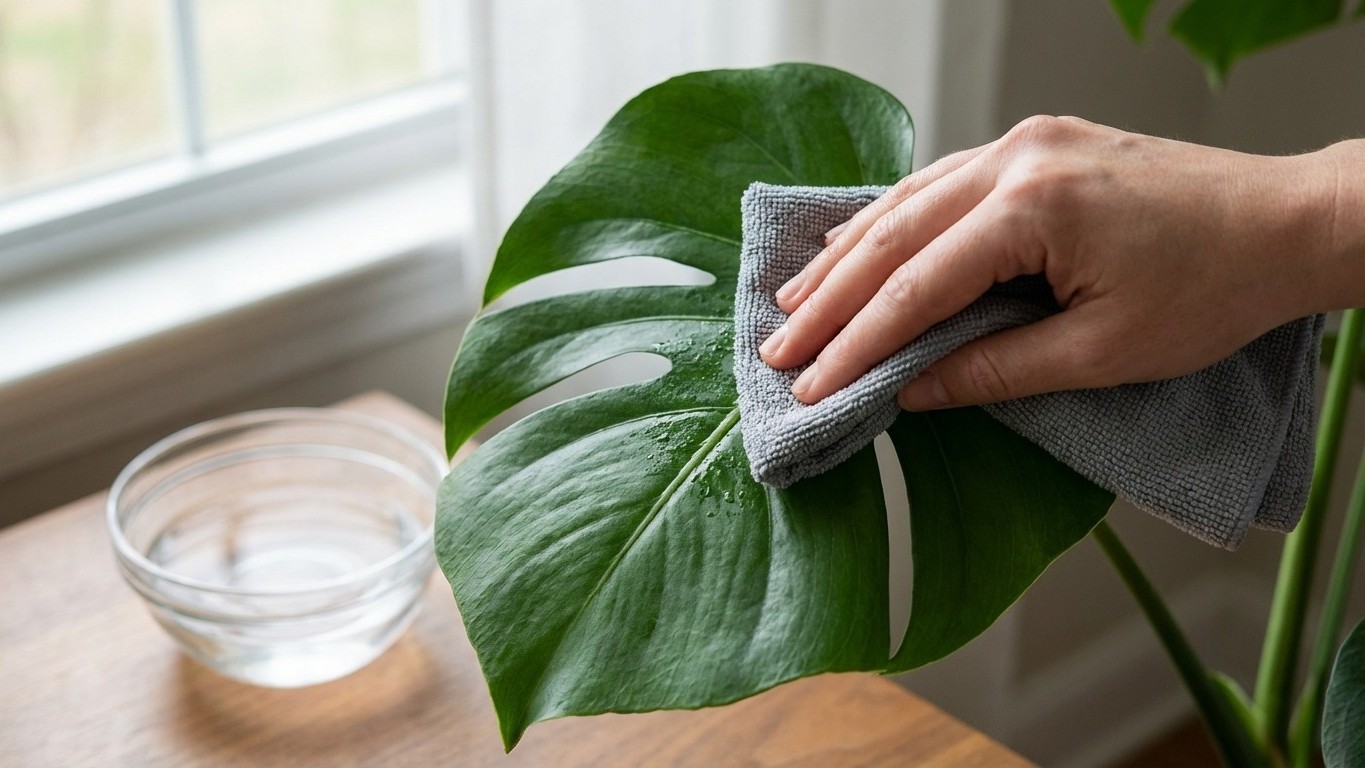
The technique my friend showed me is almost embarrassingly low-tech. Fill a bowl with lukewarm water (room temperature matters, cold water can shock tropical plants and leave spots). Add the tiniest drop of dish soap, less than you think you need. Dip a soft microfiber cloth, wring it out until it’s barely damp, and gently support the underside of each leaf with one hand while you wipe the top surface with slow, confident strokes. Then flip and do the underside — this is the part most people skip entirely, and the underside is exactly where pests like to hide.
For small-leaved plants like pothos or string of pearls, where individual leaf wiping is impractical, a lukewarm shower works beautifully. Place the plant in the bathtub or shower, rinse gently with lukewarm water, let it drain completely before returning it to its spot. Never let a plant sit in pooled water afterward.
For cacti and succulents, skip the damp cloth. A soft paintbrush or a small makeup brush gets into the crevices without introducing excess moisture to plants that are already designed to stay dry. It sounds fussy until you try it once and realize it takes thirty seconds per plant.
The frequency question is one I get asked a lot: once a month is a solid baseline for most indoor environments. If you live in a city with more particulate pollution, or if you’ve recently renovated, bump that to every two weeks. Plants near heating and cooling vents also collect dust faster and deserve more frequent attention.
A Few Plants That Need Extra Care
Fuzzy-leaved plants, African violets, begonias, some succulents, should never be wiped with a damp cloth. The moisture gets trapped in the tiny hairs and can cause rot or fungal issues. The soft paintbrush method is your only real option here, and it works well if you’re patient.
Large-leaved tropicals like fiddle leaf figs, rubber plants, and elephant ears are the plants that benefit most visibly from a proper clean. Their broad, glossy leaves show dust immediately and reward cleaning with a depth of color that honestly looks like you’ve replaced the plant entirely. The transformation after cleaning a neglected fiddle leaf fig leaf is one of those minor satisfying moments that plant people live for.
For plants with heavily textured or ribbed leaves (think certain philodendrons or begonias with patterned surfaces), work slowly along the texture rather than across it. You’ll remove more dust and avoid any accidental mechanical damage to the surface.
What strikes me most about this whole subject is how plant care advice focuses almost entirely on watering and light while treating leaf hygiene as an afterthought. Yet the leaf is where every critical plant process happens. If you’ve been puzzled by a plant that seems to have everything it needs but still looks tired, start there, with a damp cloth, a bowl of lukewarm water, and a few minutes of actual attention. The answer might be sitting on the surface of the leaf itself, quite literally.