
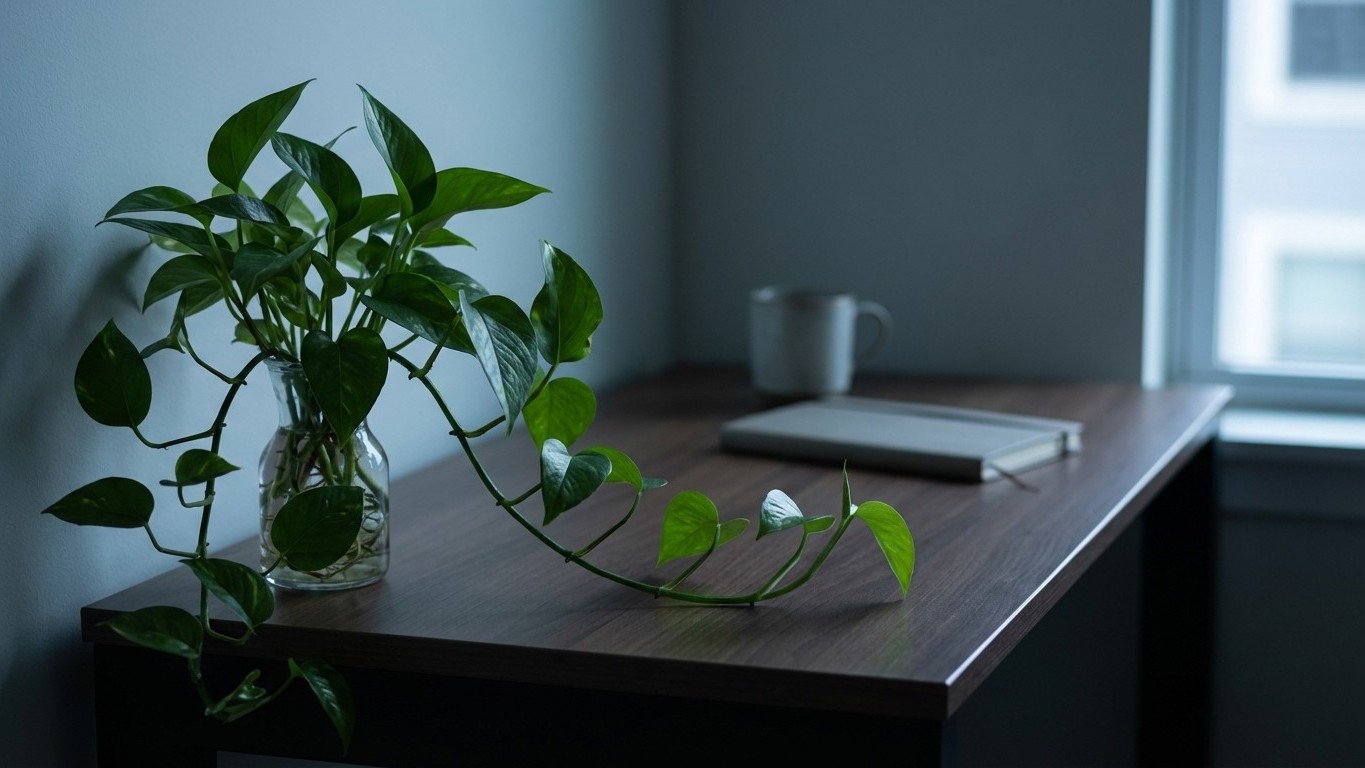
Three years. That’s how long the corner of my office has been cut off from natural light, a north-facing window blocked half the day by the building next door, a desk lamp as the closest thing to a sunrise. Most people assume plants are out of the question in spaces like this. They’re wrong. A small but resilient group of houseplants has evolved specifically to survive on the forest floor, deep in the shade of rainforest canopies, where direct sunlight is more myth than reality. These plants don’t just tolerate low light. They’ve built an entire survival strategy around it.
Key takeaways
- Plants like pothos and snake plants have evolved an entirely different survival strategy than sun-loving species
- The distinction between ‘low light’ and ‘no light’ changes everything about which plants will actually survive
- Soil quality and leaf cleanliness matter far more in dim spaces than most gardeners realize
Why “low light” is not the same as “no light”
Before we get into which plants actually work, a quick reality check on the phrase “low light.” In plant terms, this means a spot that receives indirect ambient light, the kind of glow that fills a room even when the sun isn’t hitting the space directly. A room with one north-facing window qualifies. A basement with fluorescent tube lighting qualifies. A true windowless room with no natural source whatsoever is a harder case, though certain species can survive on quality grow lights alone.
The key distinction matters because it sets expectations. A plant surviving in low light will grow more slowly, produce fewer new leaves, and won’t reward you with explosive color. What it will do is stay alive, stay green, and, over time, actually thrive once it adapts to its environment. Patience is the single most underrated gardening tool in dark rooms.
The plants that genuinely don’t need your sunny windowsill
The pothos earns its reputation as the unkillable houseplant for good reason. Its heart-shaped, waxy leaves have an almost aggressive ability to absorb whatever ambient light exists in a space, and the vines keep growing even in corners that most plants would abandon within weeks. The golden variety is the classic, but neon pothos, with its almost fluorescent chartreuse leaves, adds visual energy to dim spaces without requiring more from them. In three years of low-light desk living, a pothos cutting started in a small glass of water has become a trailing vine over two feet long.
Snake plants (officially Dracaena trifasciata, though most people still call them sansevieria) are practically photosynthesis minimalists. They can go weeks Without water, months without repotting, and years in the same low-light corner without complaint. The upright, architectural structure makes them useful in tight desk or bookshelf spaces where a sprawling plant would become a problem. One word of caution: they’re slow. Don’t expect rapid growth and don’t panic when nothing seems to happen for two months. That’s normal.
ZZ plants — Zamioculcas zamiifolia — operate on a different logic entirely. Their thick, rhizomatous roots store water the way a camel stores fat, which makes them extraordinarily drought-tolerant. The deep, waxy green of their leaves manages to look polished even in minimal light, giving off more of a curated design-forward vibe than a typical “survivor” plant. They’re slow to grow, but they’re also nearly impossible to kill through neglect, which makes them ideal for anyone who travels frequently or forgets to water for three weeks at a stretch.
Cast iron plants (Aspidistra elatior) have a name that describes exactly what they are. Victorian households used them as houseplants before central Heating existed, surviving gas fumes, coal dust, drafty hallways, and almost complete darkness. They’re not dramatic. They won’t trail beautifully or grow into impressive architectural shapes quickly. But in the kind of space where Everything else has died, they remain.
What actually makes the difference over time
Soil quality matters more in low-light conditions than most guides acknowledge. When a plant can’t photosynthesize aggressively, it needs everything else to be working in its favor. A well-draining mix that doesn’t compact or hold excess moisture prevents root rot, which is the number one killer of low-light plants (overwatering in dim conditions is a common mistake, since the soil takes much longer to dry out than it would near a sunny window). Mixing standard Potting soil with perlite, roughly 70/30, makes a meaningful difference.
Dust is a less glamorous but genuinely important factor. Leaves in low-light environments depend on every available photon, and a layer of household dust on the leaf surface can reduce the plant’s light absorption by a surprising margin. Wiping leaves with a damp cloth every few weeks isn’t fussiness. It’s maintenance that actually supports the plant’s ability to function.
Rotation helps too. If your space has even a single directional light source, a distant window, a skylight in an adjacent room, turning your pots a quarter turn every month ensures the plant grows evenly rather than leaning and straining toward the light. The asymmetry of a plant desperately reaching sideways is both aesthetically awkward and a sign of stress.
Rethinking what a plant can do for a dark room
There’s a specific kind of mental shift that happens when you stop treating dark rooms as plant-incompatible zones. These corners, shelves, and north-facing desks aren’t limitations, they’re a specific environment with its own set of compatible species. The forest floor supports more biodiversity than most people realize, and the plants that evolved there have been quietly waiting for the right windowless office to call home.
The broader question worth sitting with: if these plants can adapt their entire metabolism to a low-resource environment and still produce growth, still filter air, still add texture and life to a dim space, what does that say about the conditions we assume are non-negotiable for thriving?