
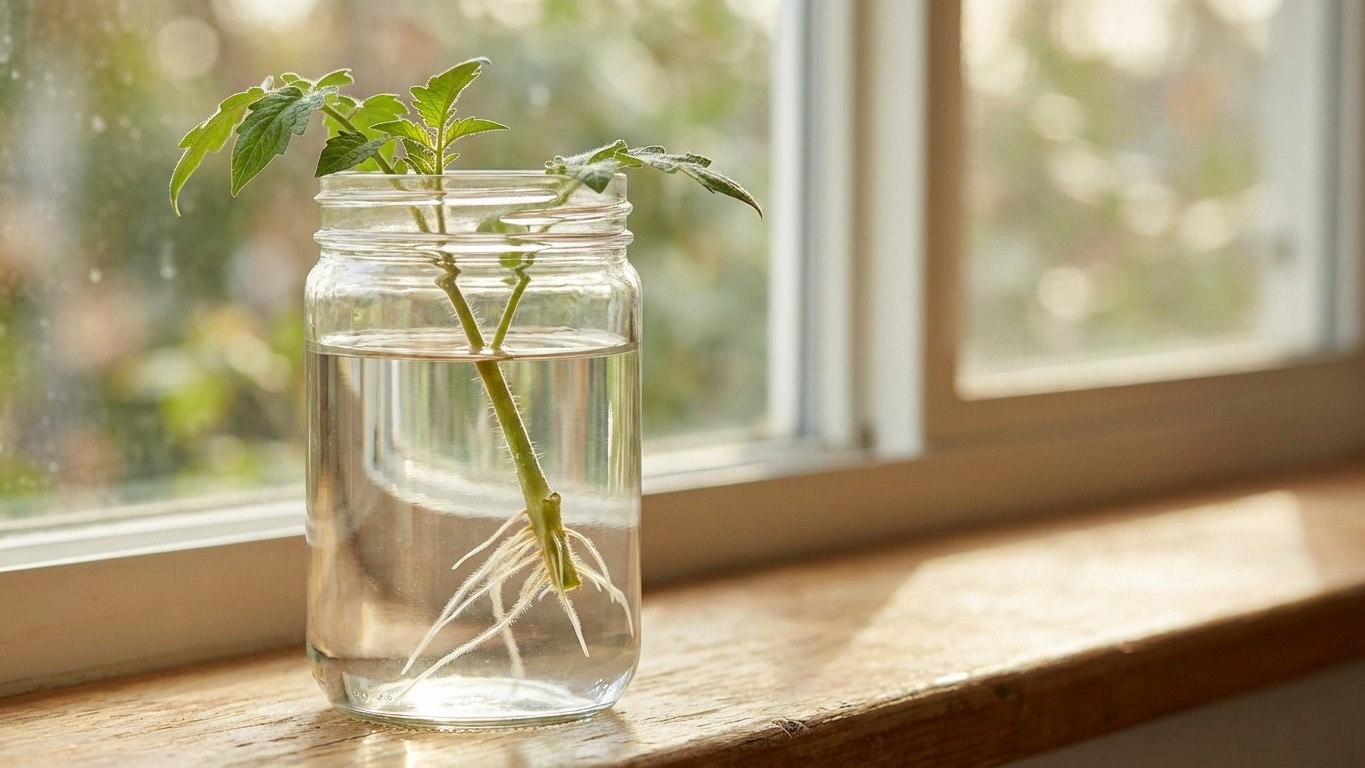
Every spring, millions of American gardeners buy the same seed packets they bought last year, coax tiny sprouts under grow lights for weeks, and wait. Six to eight weeks of patience for a plant that could have been growing in a glass of water on your Kitchen windowsill in a fraction of the time. The tomato cutting trick isn’t new. Grandmothers and homesteaders knew it for generations. Somehow, between the rise of seed catalogs and garden center nurseries, it quietly got forgotten.
Growing tomato plants from cuttings is easier than growing from seed. That’s not an opinion, it’s a fundamental truth about how this plant is wired. The tomato plant lends itself easily to cutting propagation because even the cells in its stems can become roots. You don’t need special equipment, rooting hormone, or a greenhouse. A clean jar, tap water, and a windowsill that catches some sun. That’s the whole setup.
Key takeaways
- A single indeterminate tomato plant produces enough cuttings to fill an entire raised bed through the growing season
- Tomato cuttings develop roots in 10-14 days—a fraction of the 6-8 weeks required for seed starting
- This method is the only way to clone F1 hybrid varieties, preserving your best-performing plants forever
The Hidden Resource You’ve Been Throwing Away
There’s a good chance you already have everything you need, without even buying a new plant. Tomatoes produce suckers, which are side shoots that sprout just where a branch meets the main stem. These suckers eventually grow, becoming branches with their own leaves and fruit. Most gardening advice tells you to pinch them off to keep the plant focused. That advice is correct. But what nobody adds is the part that Changes everything: don’t throw them in the compost.
A lot of gardeners recommend pruning these side shoots (suckers) to make the plant more vigorous, which is even better for propagators, because now you have the perfect cuttings to work with. You’re already doing the pruning. You’re already removing material that would otherwise be wasted. The cutting trick just redirects that waste into new plants. One healthy indeterminate tomato, over the course of a growing season, can produce enough suckers to fill a whole raised bed — or stock a few pots on a sunny Apartment balcony.
Creating new tomato plants from cuttings is also the only way to propagate F1 hybrid varieties. Seeds from an F1 hybrid won’t grow true to the parent plant. Cuttings will. So if you’ve found a variety that performs beautifully in your specific conditions, that sweet cherry tomato that never gets blossom end rot, the big beefsteak that actually ripens before October — this method lets you clone it indefinitely.
How the Rooting Actually Works (and Why It’s Almost Foolproof)
Propagating tomatoes by rooting stem cuttings is easy because the plants are such willing participants. Their tendency to form adventitious roots along the stem has made tomatoes famous among botanists. Think of it like this: tomato stems are essentially pre-loaded springs, just waiting for the right signal to push out roots. Drop a cutting in water, and that signal fires within days.
The process is straightforward. The ideal size of a tomato plant cutting is 5 to 10 inches tall. Fill a clean glass jar with room-temperature water and set it in a warm place such as a sunny windowsill. Remove the bottom sets of leaves from the base of each cutting, leaving the top four to six leaves, and set it in the water. That last step matters more than it sounds. Leaves submerged in water will rot, cloud the water, and introduce bacteria that can kill the cutting before roots have a chance to form.
In about one to two weeks, you will see new roots coming out, and these newly propagated tomato plants are ready for transplanting into a garden or pot. For comparison, it can take tomato Seedlings started from seed six to eight weeks before they reach transplanting size, but if you keep tomato cuttings warm, that time frame is cut down to a mere 10 to 14 days. That’s the kind of time math that makes you want to toss your seed packets.
One thing worth knowing: propagate tomato Cuttings only from indeterminate varieties. While cuttings taken from determinate varieties will root, they will not produce as well as their parent plants. Indeterminate tomatoes keep growing and producing until frost kills them, which is exactly the behavior that makes them so useful for indoor overwintering and continuous propagation.
Taking It Indoors: Year-Round Tomatoes from One Plant
Here’s where the trick goes from useful to genuinely clever. Home gardeners often keep a late-season indeterminate tomato by rooting terminal cuttings indoors over winter to start early plants the next season. The logic is simple but the payoff is real: instead of buying new plants or starting seeds every spring, you take cuttings from your best performers before the first frost, root them on a windowsill, and keep a compact indoor plant going all winter long.
It would be easy to continually cut and propagate multiple varieties all winter long in a small space, and many gardeners find it easier than starting seeds. The cutting, rooting, and pruning process seems to slow down the normally vigorous habits of indeterminate tomatoes, enabling you to keep more plants in less space. A sunny south-facing window is enough. The plants stay small, they stay manageable, and by spring you already have established root systems ready to go into larger containers or a garden bed.
The transition from water to soil is the one step where people lose plants unnecessarily. After a couple of weeks, when numerous white roots are visible, sprinkle a spoonful of potting soil into the water every day for three days. Tiny roots will latch onto the floating particles and start branching the way roots do when they come into contact with soil, paving the way to an easy transition. That small patience trick, borrowed from experienced propagators, prevents the shock that kills otherwise healthy cuttings.
A few things to keep in mind once the cutting is in soil: avoid over-watering, which can cause blossom end rot on the fruit, and keep soil moisture even. There is no need for rooting powder because tomatoes are so strongly inclined to root on their own, which keeps your setup as simple and low-cost as possible. Indoor plants should also be checked for pests before bringing them inside, since a hitchhiking aphid colony on a winter windowsill is nobody’s idea of a good time.
What This Changes About How You Think About Seed Buying
The average packet of heirloom tomato seeds costs between $3 and $6. Multiply that across three or four varieties, add a bag of seed-starting mix and some seedling trays, factor in the grow light electricity bill for eight weeks, and you’ve spent real money on a process with real failure points (dampening off, leggy seedlings, late frost surprises). The cutting method flips that entire equation.
By taking cuttings from a healthy tomato plant, you can create new plants that are genetically identical to the parent plant, allowing you to increase the number of tomato plants you have without having to buy additional seeds or plants. Buy one great plant, propagate it endlessly. Cuttings also seem to set fruit more quickly than plants of a similar size and age grown from seed, which means you’re not just saving money, you’re moving up the harvest calendar.
The real question isn’t whether this method works. Thousands of home gardeners, botanists, and market growers confirm it does, reliably, season after season. The more interesting question is why we collectively forgot it, and what other old-school plant tricks are sitting quietly in the background, waiting to make modern gardening a lot cheaper and a lot more satisfying.