
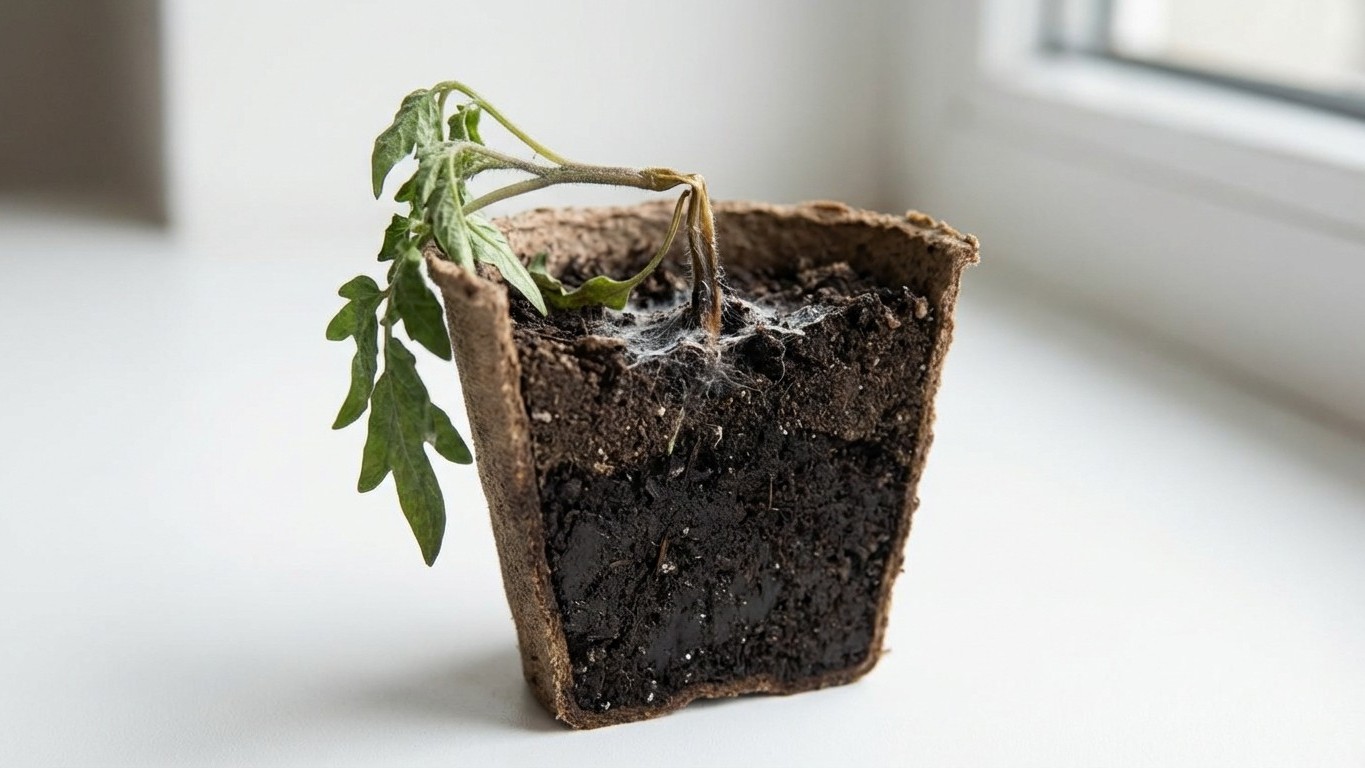
Three years of seedling failure. Every spring, the same result: tomato starts that looked perfect one week, then limp, stem-pinched, and dead the next. New seeds, new pots, new soil bags. Nothing changed. Then a seasoned gardener asked a question that reframed the whole problem: “Have you ever actually checked what’s happening in the bottom six inches of your pots?”
The answer, of course, was no. Most gardeners focus on what they can see, leaves, stems, the surface of the soil. But for tomato seedlings, the real drama unfolds invisibly, right at the bottom of the container, in a zone where water, oxygen, and fungal pathogens fight a battle you never witness until it’s already lost.
Key takeaways
- A hidden physics phenomenon creates a saturated zone at the bottom of every pot—and drainage holes can’t fix it
- Damping off fungus thrives in exactly the conditions your seedlings create, especially in the first two weeks
- One popular gardening myth actually makes the problem worse, moving danger closer to where roots live
The Hidden Enemy: What’s Really Down There
A perched water table forms at the bottom of all pots and containers. This is not a defect in your technique or your soil choice, it’s basic physics. Gravity pulls water toward the bottom of the pot, and capillary action pulls it upward to spread through the soil. Water pours out of the drainage hole until the two forces reach a balance — and the result is a pool of water saturating the soil near the bottom. : even after you see water draining from the bottom of your pot, a saturated zone remains. It doesn’t drain away. It stays.
This effect is particularly dramatic in short pots, where most seedlings are grown. If the growing medium has a high perched water table, the seedlings’ roots will be sitting in water most of the time, and it does not matter how many or how large the drainage holes are. That last part deserves repeating: drainage holes don’t solve this. The physics of capillary action in fine-particle soils simply overrules them.
Plant roots need oxygen to function. When soil stays waterlogged, all those tiny air pockets fill with water instead of air, and your tomato roots start suffocating, literally gasping for oxygen. The seedling above the soil looks stressed. You think it needs water. You water again. The problem compounds itself.
Damping Off: The Fungus Waiting in That Wet Zone
Damping off is a seedling-specific disease caused by fungal and oomycete pathogens that thrive in excessively wet soil. If they take hold of your sprouts, you may notice a white, fluffy, mold-like growth at the base and girdled or collapsed stems, the girdling typically occurs right where the stem emerges from the soil, eventually causing the entire baby plant to collapse and die.
The causal agents include fungi like Pythium, Phytophthora, Fusarium, and Rhizoctonia solani, which can attack young seedlings of many vegetables including tomato, and seedlings are susceptible to infection both before and after emerging from soil. These organisms don’t arrive as a dramatic invasion. All of the pathogens responsible for damping off survive well in soil and plant debris, and they can be introduced into the seedling tray through pots, tools, and potting media that have been used in previous seasons and not properly cleaned. Reusing last year’s pot without sterilizing it? That’s enough.
Cool temperatures, wet soil, compacted soil, high humidity, overcast conditions, and overcrowding are especially favorable to damping off. This is precisely the description of the bottom six inches of a small seedling pot in early spring, sitting on an indoor windowsill. A perfect incubator. The disease can move through an entire tray of seedlings in a matter of days, and once they’re infected, they’re near impossible to treat. Three years of identical failure suddenly makes complete sense.
There’s an additional factor that rarely gets discussed: pH drift. As potting mix or garden soil pH rises, so does a tomato plant’s susceptibility to damping off. Commercially-prepared germination mixes average around pH 5.5, while tap water tends to be alkaline, so as you water your seed pots, the pH in your containers gradually increases, and simultaneously so does susceptibility to damping off diseases. Every watering session is subtly making the environment more hostile.
What to Actually Do About It
The fix begins before you ever plant a seed. Use clean, fresh seed-starting medium, it should be lightweight, fast-draining, and have a pleasant earthy smell. Not last year’s bag, and not the bag that’s been sitting open in a damp corner of the garage. Sterilize all used pots and trays in a solution of 10% household bleach by soaking for 30 minutes. It sounds extreme until you realize that the fungal spores surviving on the wall of your plastic seed tray from last March just wiped out an entire batch of seedlings.
The soil mix itself is where most home gardeners lose the battle without realizing it. A high-quality soilless potting mix, which can contain perlite, vermiculite, peat moss, bark, or coco coir — helps to lighten the soil. Garden soil is too heavy and compacted for container use, preventing air, water, and nutrients from reaching the root zone, and it may also contain disease organisms that can harm plants. Adding perlite to whatever mix you use isn’t optional for seedlings, you can decrease the perched water table in any soil by increasing the average particle size, and adding perlite or vermiculite to most potting soil will accomplish this — but the key is to mix it throughout the soil, not to lay it at the bottom of the pot.
That last point dismantles another popular myth. Placing gravel or stones in the bottom of your pot does not improve drainage. A bottom layer of stones actually moves the perched water table higher in the pot, the saturated zone shifts upward, closer to where your seedling roots actually live. Counterintuitive, but real.
Watering technique matters as much as soil composition. One good practice is to always allow the surface of the soil to dry out a bit before each watering. The damping off fungi can only grow when the soil is fully wet, so periods of dryness hold it back. Water from the bottom if possible, and use room temperature water, not cold water. Bottom watering, setting the pot in a shallow tray of water and letting the soil wick moisture upward — reduces surface and stem wetness, which is exactly where damping off pathogens attack first.
Air circulation gets overlooked almost as often as the perched water table. Damping off most often affects indoor seedlings due to high humidity, poor ventilation, and overcrowded seed trays. A small fan running near your seed-starting area makes a genuine difference, not because air is inherently anti-fungal, but because moving air dries the soil surface and the base of stems faster than stagnant indoor air ever will.
The Pot Size Trap Nobody Warns You About
Starting tomato seedlings in pots that are too large for their current root mass is one of the most common and least-discussed causes of repeat failure. A small seedling in a large pot means a proportionally massive volume of wet soil that the tiny root system simply cannot absorb. Pot seedlings up into individual pots or cell packs, one tomato plant per cell, when they have at least one set of true leaves. This prevents overwatering caused by growing in too much moist soil.
Once tomato seedlings reach the two- or three-leaf stage, they are no longer susceptible to infection by Pythium or Rhizoctonia. That window, from germination to the second true leaf, is when they are most vulnerable, and it maps almost exactly to the period when most gardeners are growing them in small pots with fine-particle media, in low light, with irregular watering. Getting seedlings through that phase quickly, with adequate light and a well-draining mix kept consistently on the drier side, is the single most effective protection available.
One detail worth knowing: using a heating pad under trays to warm soil to 70-75°F for indoor plant production reduces damping off risk significantly. Warm soil encourages faster germination and more vigorous early growth, and a seedling that moves quickly through its most vulnerable stage simply spends less time as an easy target for pathogens waiting in that bottom six inches of saturated growing medium.
Sources : gardeningmentor.com | thehouseplantguru.com