
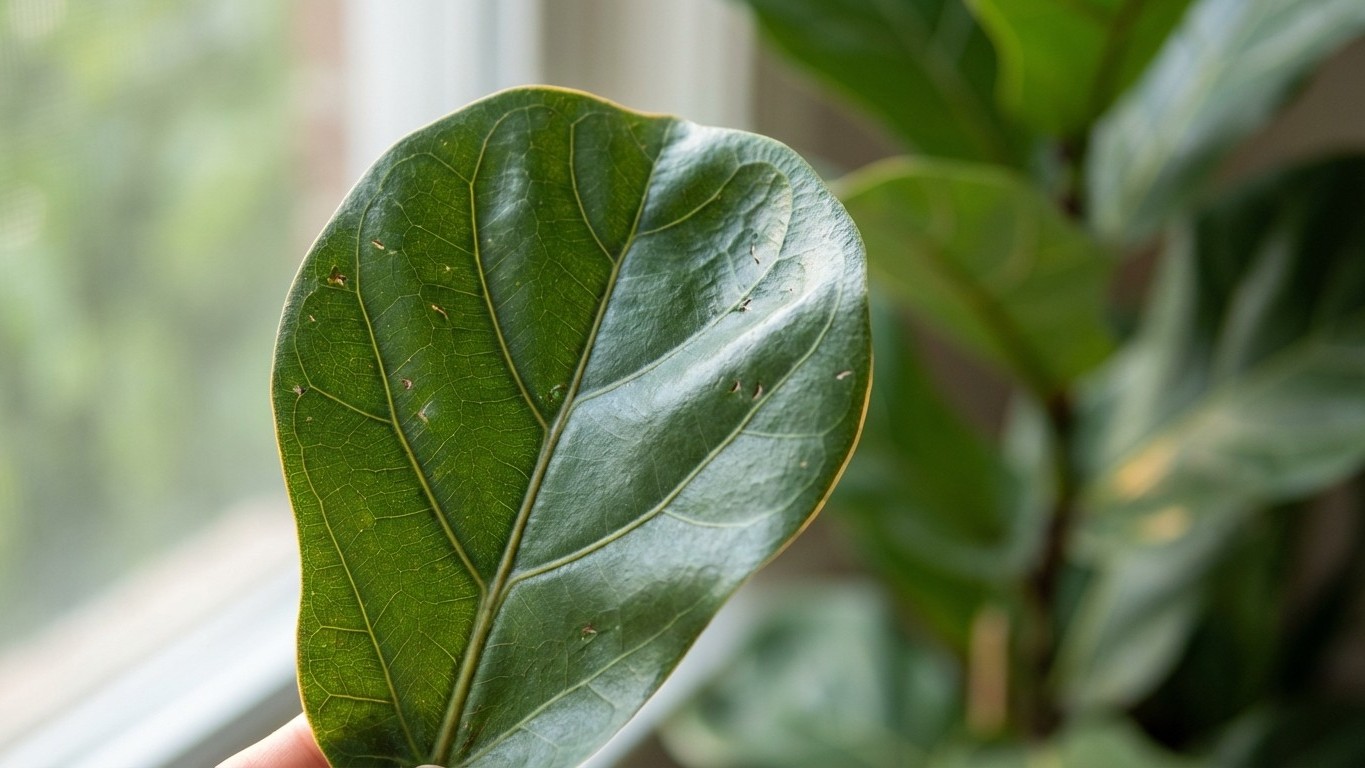
Leaf shine sprays. Millions of houseplant owners use them weekly, convinced they’re giving their plants a beauty treatment with benefits. The fiddle leaf fig, with its massive, sculptural leaves that collect dust like a horizontal surface in a construction zone, seems like the perfect candidate. A quick spritz, a gentle buff, and those leaves gleam like they belong in an architectural digest shoot. The problem is, that weekly ritual may be quietly suffocating the plant you’re trying to impress guests with.
Key takeaways
- A botanist reveals what leaf shine sprays are actually doing to your plant’s leaves
- The fiddle leaf fig is especially vulnerable to products marketed as plant care essentials
- A simple zero-cost method outperforms every commercial product on the market
What leaf shine sprays actually contain
Most commercial leaf shine products rely on silicone-based compounds or oil emulsions, sometimes combined with surfactants and synthetic polymers. The pitch is simple: coat the leaf, repel dust, boost gloss. And visually, it works. The fiddle leaf fig (Ficus lyrata) responds with an almost lacquered finish that looks deeply satisfying on Instagram. The reality underneath that shine, though, is less photogenic.
Fiddle leaf figs breathe through tiny pores called stomata, concentrated primarily on the underside of their leaves. A botanist at a university extension program put it bluntly to me: these coatings don’t distinguish between the top surface and the pores. Over repeated applications, the product builds up, and the leaf’s ability to regulate gas exchange, transpiration, and even photosynthetic efficiency gets compromised. The plant isn’t dying dramatically. It’s just quietly stressed, week after week.
The irony is real. You’re applying a product to make the leaves look healthier while making the plant slightly less capable of doing the biological work that keeps it alive. Three months of weekly spraying can accumulate enough residue that even a thorough wipe-down won’t fully remove it.
The fiddle leaf fig problem specifically
Not all houseplants react the same way to leaf shine. A snake plant or a ZZ plant, with their thick, waxy cuticles and lower stomatal density, can tolerate the occasional coat better than most. The fiddle leaf fig is a different story. Its leaves are large and thin-ish relative to their surface area, with a stomatal density that requires genuine airflow to function well. These are plants native to the tropical rainforests of West Africa, where leaves are constantly rinsed by humidity and rain, not coated in synthetic polymers.
There’s also the dust trap effect. Leaf shine creates a slightly tacky surface texture over time. Dust and airborne particles adhere to it more readily than they would to a clean, dry leaf. The result: within days of your weekly shine treatment, the leaves look dull again, prompting another application. It’s a cycle that serves the product manufacturer more than it serves your plant.
One more thing worth knowing: some leaf shine formulations contain alcohol or citrus-derived solvents that can degrade the leaf’s natural waxy layer, called the cuticle. That cuticle is the plant’s first line of defense against water loss and pests. Weakening it on a fiddle leaf fig, a species already notorious for sulking at the slightest environmental change, is the horticultural equivalent of removing someone’s sunscreen before sending them out into direct sun.
What actually works (and costs almost nothing)
The botanist’s recommendation was almost comically simple: a clean, damp cloth. A microfiber cloth with plain lukewarm water removes dust without blocking pores, without leaving residue, and without altering the leaf’s surface chemistry. For a plant the size of a mature fiddle leaf fig, this takes about four minutes every two to three weeks. That’s it.
If you want to add a very mild cleaning boost, a few drops of neem oil diluted in water (roughly 1-2 drops per cup of water) does double duty: it removes grime and acts as a mild deterrent against common pests like spider mites and fungus gnats. Neem oil is plant-derived, biodegradable, and doesn’t film over stomata the way silicone products do. It’s been used in traditional horticulture for decades, with a solid safety record for most tropical houseplants when properly diluted.
The one technique to avoid, regardless of what product you’re using: never spray anything directly on fiddle leaf fig leaves and let it air dry. Always wipe. The spray droplets concentrate at the edges and veins as they evaporate, leaving residue exactly where you don’t want it. Wipe gently from the stem outward, following the leaf’s natural direction, and support the leaf from underneath so you’re not stressing the petiole.
Reading the signs your plant is already overcoated
If you’ve been spraying regularly for months, there are physical signs worth checking. Hold a leaf up to the light and look for a slight sheen or uneven texture that differs from the leaf’s natural gloss. New leaves on a fiddle leaf fig emerge naturally glossy and bright; older leaves should still have some reflectivity without looking plastic. If mature leaves look uniformly flat or slightly waxy in a way that feels artificial under your fingers, residue buildup is likely the cause.
A deeper clean is possible. A solution of one part white vinegar to ten parts water, applied with a soft cloth, can break down silicone and oil residues. Test it on one leaf first and wait 48 hours to confirm no adverse reaction before treating the whole plant. After cleaning, give the plant a Week Without Any product before resuming a plain-water maintenance routine.
The fiddle leaf fig has a reputation for being difficult, but much of that difficulty is self-inflicted by well-meaning owners overcomplicating its care. The plant doesn’t want to be lacquered. It wants to breathe. A $0 damp cloth outperforms a $15 bottle of leaf shine in every measurable way, and the leaves, over time, actually look better for it.