
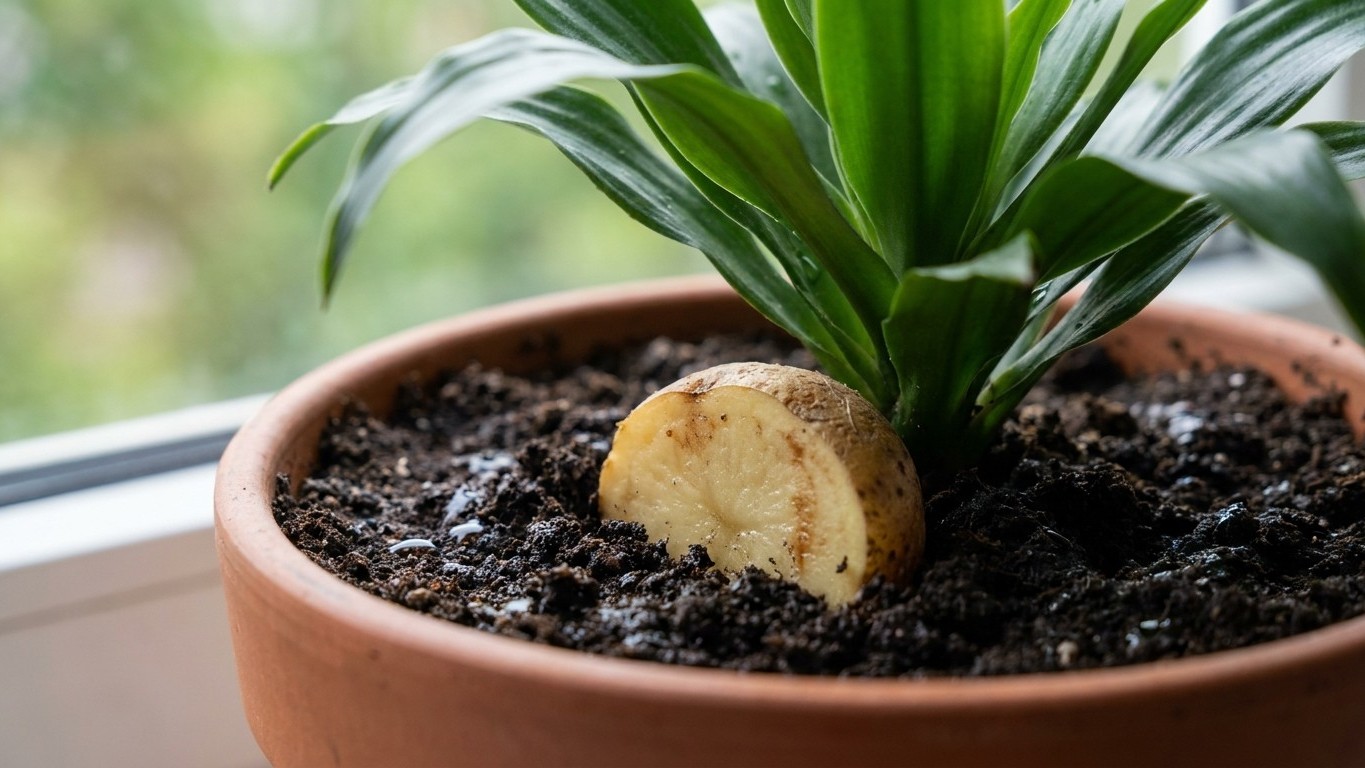
One raw potato. That’s the kitchen scrap. No expensive sprays, no neon-yellow sticky traps dotting every windowsill like some kind of entomological art installation. Just a slice of raw potato, pressed into the soil of your houseplant, and those infuriating little flies start to disappear. The method is real, it works, and the biology behind it is surprisingly satisfying once you understand what you’re actually fighting.
Key takeaways
- A kitchen scrap can solve an infestation most gardeners attack with expensive sprays
- The real enemy isn’t the flying gnats you see—it’s the invisible larvae in your soil
- There’s a reason universities recommend this method over all the neon-yellow traps
The enemy you probably don’t fully understand
Fungus gnats are a common pest of plants grown indoors, especially where humidity and moisture are high. Most people see them hovering near their fiddle-leaf fig and instinctively reach for a spray bottle. That’s the wrong move, because the adults flying around your face are almost irrelevant to the actual problem. Fungus gnat adults only live for about a week, but during that time, a single female can lay 100-300 eggs. The real damage happens underground.
Fungus gnats are small, dark flies that lay their eggs in moist soil. Their larvae feed on decaying organic matter and sometimes plant roots, which can cause yellowing leaves, wilting, and slow growth. Young plants and seedlings are especially at risk, when larvae run out of organic matter to eat in your soil, there’s a risk they may chomp on your plant’s roots next, which can stunt plant growth, particularly in seedlings, newly rooted cuttings and younger plants. A wilting plant that receives adequate water isn’t necessarily thirsty. It might be losing its root system to invisible larvae.
There’s another factor most guides skip over. Because they love carbon dioxide, the only thing more appealing to fungus gnats than the moist soil of your plants is the CO2 in your breath. That’s why they end up in your face, your coffee cup, your wine glass during dinner. They’re not attracted to you out of spite. You’re just exhaling a gas they find irresistible.
Why raw potato works, and how to use it
Raw potato chunks placed in the soil are very attractive to fungus gnat larvae. These may be used to check pots for larvae. Also, to trap them away from plant roots. After a few days in a pot, remove infested chunks, dispose of them, and replace with fresh ones. This is the kitchen scrap trick, and it comes recommended by the University of California’s Integrated Pest Management program, not just a gardening influencer.
This works because fungus gnat larvae love potatoes and will quickly ditch the roots of your plant to infest a potato instead. You’re not killing the larvae with any chemical compound. You’re giving them something they prefer over your plant’s roots, then removing that something and throwing it in the trash. Within three to four days, the gnat larvae will leave the soil of your potted plants and enter the raw potato, and you can simply pick up the potato slice and throw it away. Repeat every few days, and you’re systematically dismantling the population from the soil up.
The potato method also serves as a diagnostic tool, which is something most other remedies can’t claim. The reason this works so well in comparison to other pest repellent strategies is that it tackles the problem of larvae, not just the flies themselves. It is also a very clear indicator of how many larvae you are dealing with, and whether you may need to add other methods to help tackle the problem. If your potato slice comes up clean after four days, you’re winning. If it’s crawling, you know the fight isn’t over yet.
The cinnamon strategy: a second kitchen scrap worth burying
A potato handles the larvae. But what about prevention, stopping the next generation from taking root in the first place? Here’s where another pantry staple earns its place in the pot. Cinnamon has anti-fungal properties, so it makes sense that, as fungus gnat larvae primarily feed on fungi as well as algae and decaying organic matter, this spice might be a useful aid.
The antifungal properties of cinnamon are thought to be due to the presence of cinnamaldehyde, a compound responsible for the spice’s characteristic flavor and aroma. Cinnamaldehyde has been shown to inhibit the growth of fungal spores by wreaking havoc on their stability and disturbing the integrity of the cell wall. In practice, this means sprinkling a light layer of cinnamon on the soil surface starves larvae of their primary food source and makes the whole environment less hospitable for egg-laying adults. The smell also repulses gnats and other insects like ants and spider mites, discouraging them from loitering around your plants and laying their eggs in the soil.
One caveat worth noting: there is a chance a thick layer of cinnamon can grow mold when dampened, despite its antifungal properties. A light sprinkling is sufficient to create an anti-pest barrier. You’re seasoning the soil, not burying the plant. And if you want to go further, you can work it into the soil, as the antifungal properties of cinnamon can help prevent soil-borne diseases, protect plant roots, and help prevent issues like root rot.
What actually breaks the cycle for good
The uncomfortable truth is that most single-solution approaches fail. You need one treatment for the larvae and one for the flying gnats. Treating both at the same time is the key. A raw potato draws out larvae; yellow sticky traps placed at soil level intercept the adults before they lay another round of eggs. Together, they attack the life cycle at two distinct stages.
The other variable, and the most important one, is moisture. Fungus gnats love moisture, so let the top 1-2 inches of soil dry completely before watering again. This disrupts their life cycle, as larvae can’t survive in dry soil. Overwatering is, consistently, the root cause, almost every infestation traces back to soil that stays perpetually damp. Plant debris is an excellent source of the decaying organic matter in which fungus gnats prefer to lay their eggs. So it’s important to keep the soil around your plants clear of debris such as fallen leaves, flowers, and fruit.
For serious infestations that outlast these kitchen remedies, there is a biological option that consistently outperforms the rest. Products like mosquito bits contain Bacillus thuringiensis israelensis (Bti), a bacterium that is toxic to insect larvae. Simply sprinkle the mosquito bits on the soil surface or mix them into the top layer of soil. When you water your plants, the Bti is released into the soil, where it is ingested by the fungus gnat larvae, effectively killing them. This method is safe for humans, pets, and plants.
One detail the internet rarely mentions: fungus gnats can also spread pythium, a group of plant pathogens that causes seedlings to rot. The flying adults aren’t just an annoyance, they can carry disease from pot to pot as they search for the next place to lay eggs. Getting them under control protects your entire plant collection, not just the one pot currently under siege.
Sources : homesandgardens.com | indoorgardener.org