
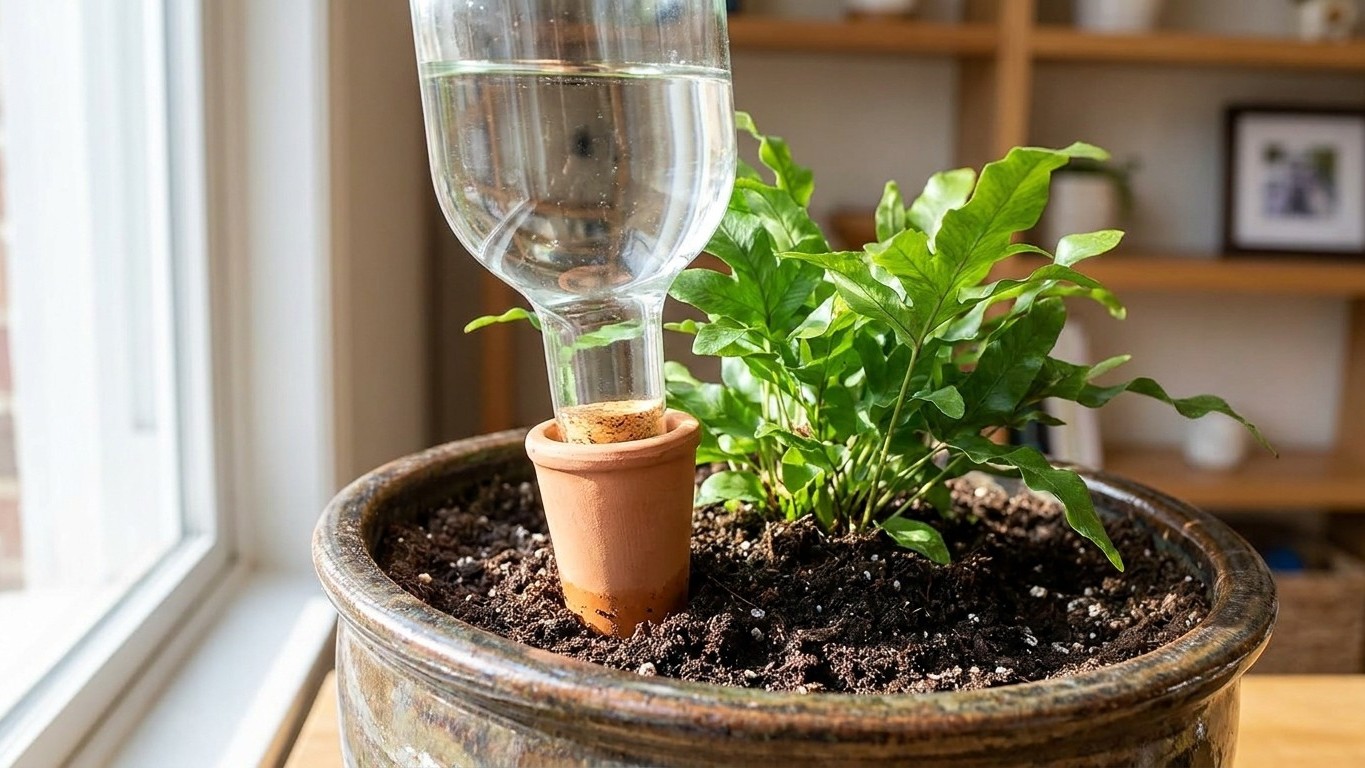
Three weeks. No watering. And the plants are perfectly fine. When a neighbor casually mentions that, it sounds like a parlor trick, or a flex from someone who only owns cacti. But her secret isn’t a heat-resistant plant collection or some rare soil formula. It’s a terracotta spike, a recycled wine bottle, and a technique that predates the Roman Empire.
Key takeaways
- A 4,000-year-old watering technique scaled down for apartment living actually works—here’s the science
- One critical setup step most people skip that determines whether your spike succeeds or fails
- Why 80% of houseplant deaths happen, and how this one tool solves the problem entirely
The Tool Your Plants Have Been Waiting For
Watering spikes, also known as irrigation spikes, gradually release water towards the roots of your container plants, and take less than five minutes to set up. The concept sounds almost too simple to work. Terracotta watering spikes are cone-shaped tools made from porous clay. When inserted into soil and paired with a water-filled bottle, they create a slow-drip watering system that delivers moisture directly to the roots.
The real cleverness is in the self-regulation. Terracotta absorbs water and releases it gradually. As the surrounding soil dries, it naturally pulls water through the spike. This creates a self-regulating system: when soil is moist, less water is released; when dry, more is supplied. No batteries. No app. No timer. Just clay doing what clay has always done.
Horticulturalist Michael Clarke explains the physics behind it: “Because terracotta is porous, the water slowly seeps out through the clay into the surrounding soil. As the soil dries out, it draws more moisture from the spike, and when the soil is moist, the release of water slows down. It is a very efficient method because water is delivered directly to the roots, and watering plants from the bottom reduces evaporation and surface runoff.”
A 4,000-Year-Old Idea, Scaled Down for Your Living Room
This isn’t some recent gardening hack that went viral on social media. Ollas (pronounced “oh yahs”) are an old mode of irrigation that originated in China and North Africa over 4,000 years ago. Clay pot irrigation was described in writing then, but was most likely used in gardens centuries before that. Farmers in arid regions buried clay vessels between crop rows, filled them with water, and let the soil tension do the rest. The principle hasn’t changed one bit.
These cone-shaped devices, often crafted out of terracotta, work in a similar way to garden ollas, an ancient self-watering trick where a terracotta system is buried under the soil. Modern spikes are essentially a miniaturized, apartment-friendly version of this technique. Olla, or clay pot, irrigation is considered the most efficient watering system by many, since plants are never over- or under-watered, saving from 50% to 70% in water, according to Farmer’s Almanac. That’s the equivalent of cutting your plant watering effort roughly in half — with zero guesswork.
The reason this matters goes beyond convenience. According to horticultural studies and gardening experts, over 80% of houseplant deaths are related to incorrect watering, with overwatering being the primary culprit. Most of us don’t kill our plants through neglect. We kill them with too much love and too much water, too often. Over-watering severely limits, or even cuts off, the supply of oxygen that roots depend on to function normally, meaning that plants do not get adequate oxygen to survive. A terracotta spike eliminates that risk almost entirely by letting the plant decide when it’s thirsty.
How to Actually Use One (And What People Get Wrong)
Setup takes about five minutes, but there’s one step most people skip that makes the whole system work better. Before the first use, soak the terracotta spike in water for 10–20 minutes. The spike should be fully saturated. This saturation of the porous terracotta ensures the spike will work quickly once it is in the soil. Skip this step and the dry clay will spend its first few days pulling moisture from your soil instead of releasing it into it.
Placement matters too. When inserting the stake, position it near the plant’s root zone, about 2–3 inches from the stem for small plants or 4–6 inches for larger ones. Ensure the stake is buried deep enough to reach the active root area where water is most needed. Once it’s seated, flip a water-filled wine or soda bottle upside down into the spike’s opening. The amount of water your plants are receiving is clearly visible at all times, and easy to top up. A low bottle is your signal to refill.
Soil type makes a real difference in performance. The effectiveness of spikes may vary depending on the type of soil you’re using. Clay soils may not allow water to permeate easily from the spike to the surrounding soil, and a chunkier-style mix will not hold water well or allow wicking through the medium. Standard indoor potting mix tends to work best, since it contains enough organic material to support good capillary action. As for which plants thrive with this system: indoor champions include herbs like basil and mint, along with pothos, philodendrons, and fiddle leaf figs.
The Honest Limits of “Set It and Forget It”
Three weeks without watering is impressive, but it comes with an asterisk. Both terracotta watering spikes and self-watering globes can keep your plants hydrated for up to 7 to 14 days, depending on the plant size, pot type, and soil moisture. So your neighbor is likely refilling the bottle every week or so, even if she’s not hand-watering. That still represents a dramatic reduction in active effort. In summer, refill spikes every 3–4 days as plants drink more. During winter, indoor plants may only need refills every 7–10 days as growth slows and evaporation decreases.
There’s also the question of bottle size. Bottle attachment spikes limit the amount of water you can leave in the bottle, making them less ideal for long periods of time. They’re also a bit chunky in small pots. Bottle-style spikes give you less control on watering levels since the bottle remains above the soil and uses more gravity to force water into the pot. A full 750ml wine bottle buys more days than a small plastic bottle. For really long trips, over a week, a neighbor checking in is still smarter than relying on any spike alone.
One maintenance tip worth knowing: rotating spikes monthly prevents salt buildup in specific soil areas. White mineral deposits can be removed with a vinegar soak, while uneven watering may indicate the need for additional spikes. Keep that in mind if you have hard tap water, which is the norm in most U.S. cities. Using filtered water or rainwater slows the mineral buildup and extends the spike’s lifespan considerably, a small habit that pays off over a few seasons of use.
Sources : amazon.com | amazon.com