
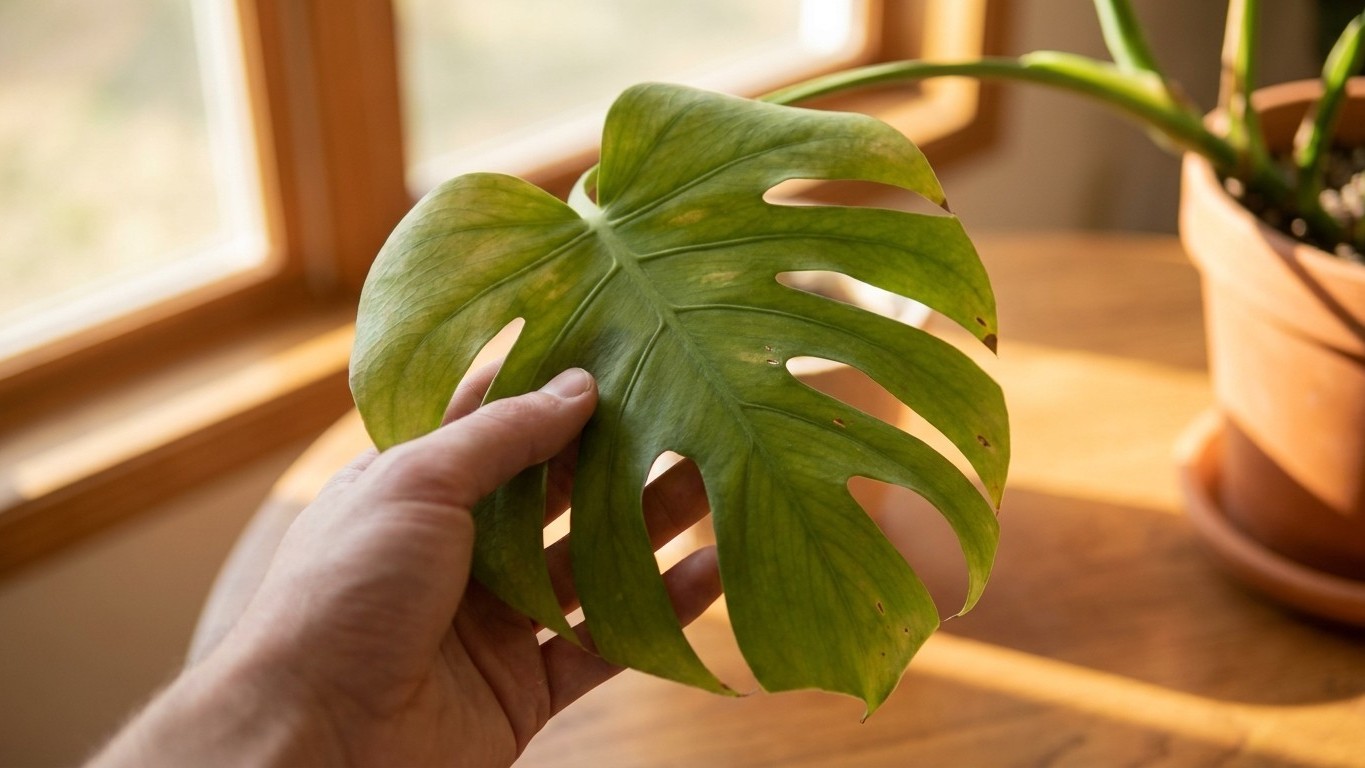
Running a grow light beside your brightest south-facing window sounds like a generous gesture toward your plants. More light equals more growth, right? Plant specialists will tell you the opposite is happening, and the evidence is written all over your plant’s leaves, if you know where to look.
Key takeaways
- The leaves near your window are showing hidden signs of damage that have nothing to do with water or nutrients
- Combining a grow light with natural window light can push photosynthesis intensity past what most houseplants can survive
- One simple measurement and one small adjustment can transform a struggling plant into a thriving one
The problem with “more is more”
Light stress is one of the most underdiagnosed issues in indoor plant care, partly because it mimics other problems. Yellowing leaves get blamed on overwatering. Bleached patches get attributed to drafts or mineral buildup. But when a grow light is positioned next to a window that already delivers strong natural light, the combined intensity can push many common houseplants well past their photosynthetic capacity.
Plants can only process a certain volume of light energy at any given moment. Beyond that threshold, called the light saturation point, photosynthesis doesn’t speed up. The excess energy has nowhere to go and begins breaking down chlorophyll, the green pigment responsible for converting light into food. The result looks deceptively like a nutrient deficiency: pale, washed-out foliage that no amount of fertilizer will fix.
Different species have radically different tolerances. A monstera deliciosa, native to the dappled shade of Central American forest floors, saturates at roughly 400 to 600 micromoles of photons per square meter per second (µmol/m²/s). A south-facing window in July already delivers somewhere between 500 and 800 µmol/m²/s on a clear afternoon. Add an LED grow light two feet away, and you can easily push that number past 1,200, the territory where sun-worshipping cacti start to feel at home, not shade-tolerant tropicals.
What your leaves are telling you right now
Three specific leaf changes signal that your plant is overwhelmed by combined light exposure. First, look for bleaching or pale yellowing on the upper leaf surface, the side that faces the light source directly. This is chlorophyll breakdown in action, and it typically appears first on the newest, most tender growth.
Second, check whether the leaves are curling downward at the edges, sometimes called “taco-ing.” This is a physical response: the plant is literally folding inward to reduce the surface area exposed to light. Curl direction matters here, downward curling points to light or heat stress, while upward curling more often indicates underwatering or low humidity.
Third, and easiest to miss, feel the temperature of the leaves closest to both the window and the grow light. Heat compounds light stress. An LED grow light that runs warm, positioned near glass that amplifies afternoon sun, can raise leaf surface temperature by 10 to 15 degrees Fahrenheit above ambient air temperature. At those levels, enzymes involved in photosynthesis begin to denature, the plant’s internal machinery breaks down before the leaves show visible damage.
Brown, crispy tips that spread inward along the leaf blade (not just at the margins) are the late-stage signal. By the time you see those, the plant has been under stress for weeks.
Why the window placement instinct makes sense, but backfires
The logic seems sound: place the grow light where the most natural light already exists to maximize the plant’s exposure during dark winter months or in climates with consistently overcast skies. The flaw is that grow lights were designed to substitute for daylight, not to supplement what is already adequate or abundant.
In commercial greenhouse operations, supplemental lighting is triggered by sensors. When natural light drops below a set threshold, the artificial source activates. When natural light exceeds that threshold, the artificial source cuts off automatically. Home growers don’t have that feedback loop, so they leave the grow light running on a timer regardless of what the sky is doing outside.
A simple way to audit your setup: use a free lux meter app on your smartphone (they are imprecise but useful for comparisons) and measure light levels at the leaf surface on a clear afternoon with the grow light running. If you’re seeing readings above 10,000 lux for shade-tolerant species like pothos, peace lilies, or Chinese evergreens, the combined exposure is too high. For context, a bright overcast day outdoors registers around 10,000 to 25,000 lux, direct summer sun exceeds 100,000.
The fix is simpler than you think
Relocate the grow light to a genuinely low-light area: a north-facing corner, a hallway, a spot more than six feet from any window. That is where supplemental light delivers real benefit, compensating for the near-darkness that many indoor spaces actually experience. The plant near your sunniest window almost certainly doesn’t need the help.
If the goal is to grow high-light plants, succulents, certain herbs, dwarf citrus, in a window spot, skip the grow light entirely and focus on maximizing the window’s output instead. Clean the glass regularly (grime can reduce light transmission by 20 to 30 percent according to horticultural extension data), remove any sheer curtains, and consider reflective panels or white walls nearby to bounce natural light back toward the plant.
Timing matters too. If you do want to use a grow light near a window, run it only during the hours when natural light is genuinely low: the first two hours of morning before sunrise intensity builds, or the final hour before sunset. During peak afternoon hours, the window alone is doing the work, and probably overdoing it without any help.
One detail most growers never check: the distance between the grow light and the plant canopy changes the equation dramatically. At 12 inches from a high-output LED panel, light intensity can be three to four times higher than at 24 inches. Moving the fixture just one foot farther away cuts the delivered intensity by roughly 75 percent, thanks to the inverse square law of light. That single adjustment, no new equipment, no timers, no apps, can be the difference between a struggling plant and a thriving one.