
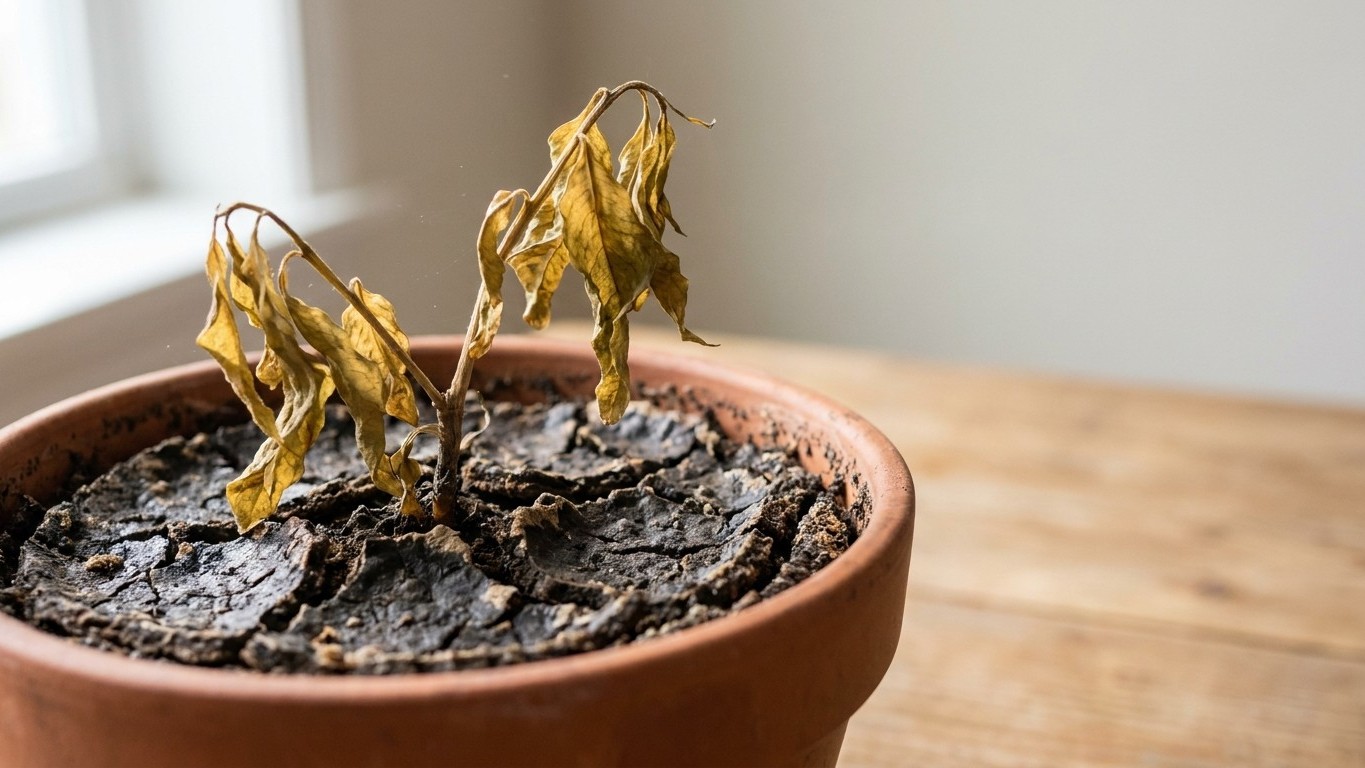
A month after spreading coffee grounds over your soil, you scrape away the top layer and find a hard, dark crust, almost like a ceramic tile sitting over the dirt. Water beads right off it. Your plants, watered faithfully every few days, have been dying of thirst the whole time. The grounds did exactly what no gardening TikTok mentioned: they sealed the soil shut.
This is the coffee grounds paradox. Used correctly, they are a genuine soil amendment. Used casually, dumped in a thick layer straight from the filter, they become a waterproofing agent. The fine particles lock together when they dry, forming a hard crust that prevents water and air from reaching plant roots. The physics here are simple: coffee grounds are extremely fine-textured. When applied in any quantity, they pack together the way wet sand does on a beach, loose when moist, rock-solid once dry.
Key takeaways
- Coffee grounds form a rock-hard, water-repelling crust when applied directly to soil surface
- Even mixed into soil, excess grounds steal nitrogen from plants during decomposition
- There’s a proven safe method that actually works—and it doesn’t involve direct soil contact
The crust problem nobody talks about
If applied in quantity to the soil surface, the fine particles clog together to form a barrier that prevents water and air from reaching plant roots. This is the mechanism behind wilting plants in perfectly watered pots, and it trips up gardeners who followed well-meaning internet advice to the letter. The grounds look beneficial, dark, rich, nitrogen-heavy. They smell like a productive garden. But appearance is misleading.
Thick layers of coffee grounds can compact and become hydrophobic, shedding the water needed for plant growth. If this organic matter dries out, it’s very difficult to rehydrate. “Hydrophobic” is the key word. The surface literally repels water rather than absorbing it. You water the pot, the liquid rolls off the crust and drains down the sides of the container, never reaching the root zone. This hydrophobic crust prevents water from reaching plant roots, essentially creating drought conditions even when you’re watering regularly. Your plant shows stress. You water more. Nothing changes. The crust holds.
OSU soil scientist Linda Brewer, who has studied this phenomenon directly, put it bluntly: “The big message is that generally people are too enthusiastic. You really need to take the recommended dosages to heart. I’ve seen raised beds ruined by too much coffee.”
The second hidden problem: your grounds are stealing nitrogen
Water repellency is not the only trap. Even when grounds are mixed into soil rather than left on top, applying too much at once creates a second problem that’s counterintuitive to most gardeners. As coffee grounds break down, nitrogen is tied up by soil microorganisms using it to grow and reproduce. The microbes decomposing the grounds need nitrogen to fuel that process, and they take it directly from your soil, competing with your plants for the same resource.
The decomposition of the coffee grounds competes for the nitrogen that would otherwise be feeding your plants, so rather than adding nitrogen to the soil, coffee grounds may actually deplete it. This nitrogen lock-up is temporary, once the grounds have fully broken down, the soil structure actually improves — but in the meantime, your plants may show the classic signs of nitrogen deficiency: yellowing leaves, stunted growth, weak stems. You added a “fertilizer” and your plants look worse. Maddening, and entirely predictable once you understand the mechanism.
Researchers at the University of Melbourne determined through experimentation that even limited amounts of coffee grounds in soil had a detrimental effect on the growth of broccoli, leek, radish, violas, and sunflowers. The grounds were applied directly, without composting first. The conclusion was stark: plants grew poorly regardless of soil type.
What actually works
The fix is not complicated, but it requires abandoning the “dump and walk away” approach entirely. When using coffee grounds as a soil amendment, soil scientist Brewer recommends working in a half inch of grounds to a depth of 4 inches. That means actually mixing them into the soil rather than layering them on top. After applying coffee grounds, cover with a 4-inch layer of organic mulch, wood chips, bark, or leaves, to prevent compaction and protect the soil. The coarser material acts as a buffer, keeping air pockets open so the fine grounds beneath can’t fuse into a sheet.
For container plants and Houseplants specifically, direct application is higher-risk. Damp coffee grounds on the surface of indoor plants can sometimes attract fungus gnats. Larvae, when present in large numbers, can damage roots and stunt plant growth, particularly in seedlings and young plants. Significant root damage and even plant death have been observed in interior plantscapes and in houseplants when high populations were associated with moist, organically-rich soil. A crust that attracts gnats while blocking water is, to put it plainly, the worst of both worlds.
The safest and most effective method for indoor use: make coffee tea. Steep used coffee grounds in water for 24-48 hours to create a nutrient-rich “tea.” This method is fantastic for giving container plants and indoor plants a gentle, immediate nutrient boost without the risks of direct soil application. You get the minerals, potassium, phosphorus, calcium, magnesium, without the crust, without the gnat bait, without the nitrogen lock-up.
For compost piles, grounds are genuinely valuable. Coffee grounds make up no more than 15–20% of your total compost volume. At that ratio, they act as a “green” nitrogen source, accelerating decomposition without the downsides of direct soil contact. OSU Extension’s Compost Specialist Program reported that coffee grounds helped sustain high temperatures in compost piles for two weeks, thus reducing the presence of potentially dangerous pathogens as well as weed seeds in the pile. That’s a concrete win: cleaner, hotter compost.
One more myth worth burying
While fixing the crust problem, it’s worth correcting another widely repeated claim: that coffee grounds acidify soil. They don’t. Not meaningfully. Brewed coffee is moderately acidic, but the brewing process pulls most of those acidic compounds into your cup. Spent grounds left behind are close to neutral, typically landing between pH 6.5 and 6.8. If you’ve been piling grounds around your blueberries specifically to lower soil pH, the effect is negligible. For real acidification, look to sulfur amendments or dedicated acidic fertilizers.
The overall picture: coffee grounds work, but as a soil structure amendment rather than a fertilizer, and exclusively when mixed in, not piled on. The main benefit comes from improving soil structure and drainage. As soil microbes feed on the grounds, they release compounds that bind soil particles into stable, well-draining aggregates. Worms are drawn to them too, with earthworms reproducing at higher rates in unwashed coffee grounds than in standard soil — which means better aeration and faster nutrient cycling down the line. The payoff is real. It just requires patience, restraint, and the willingness to actually dig the grounds in rather than scatter them across the surface like a barista finishing a latte.
Sources : positivebloom.com | housedigest.com