
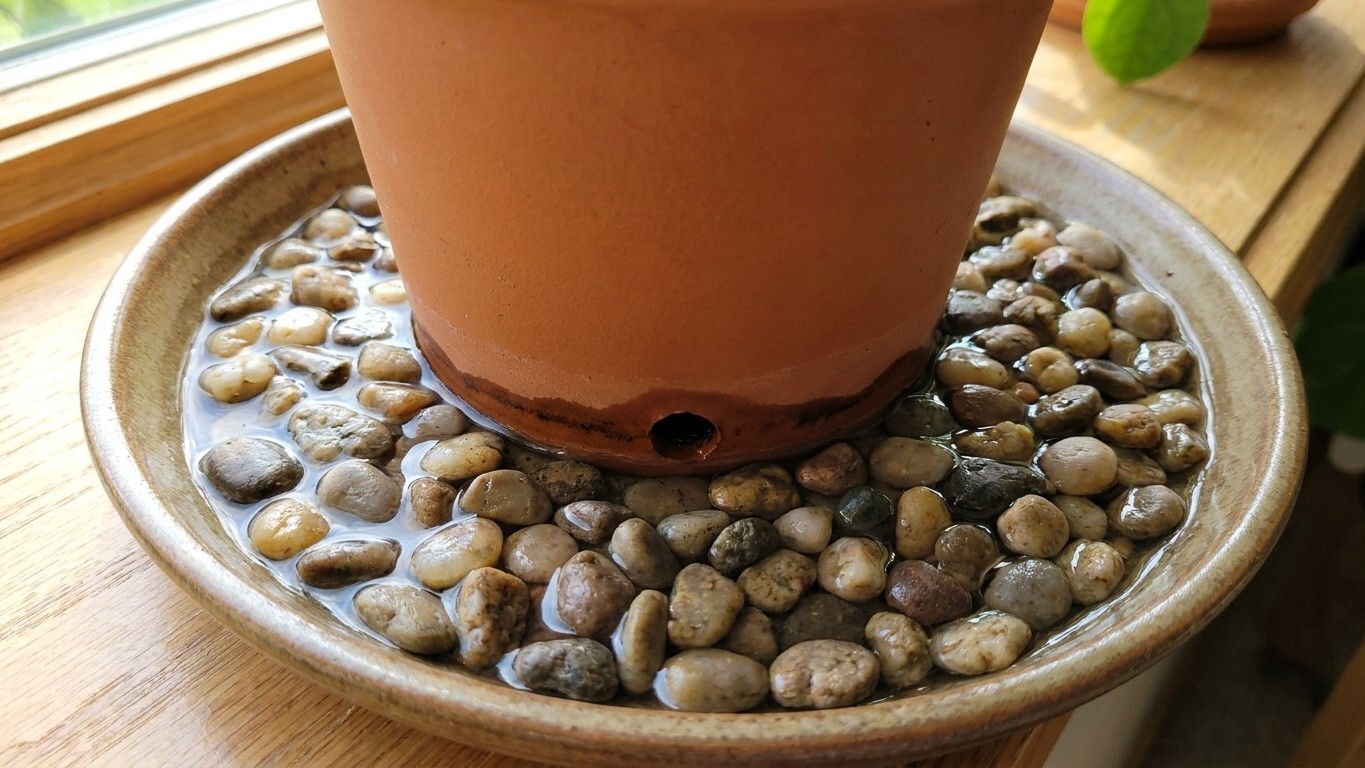
The pebble tray is one of the most recommended humidity hacks in the houseplant world. Fill a shallow tray with pebbles, add water just below the surface, set your pot on top, the evaporation supposedly creates a humid microclimate around the foliage. Guides repeat it. Influencers demonstrate it. Beginner plant kits sometimes include a little tray as standard. The advice has achieved the status of received wisdom. The problem is that received wisdom, when applied without understanding, can quietly destroy a plant over several months while you believe you’re doing everything right.
Key takeaways
- A tiny water level mistake transforms your humidity hack into a root-suffocation trap
- Your plant looks fine for months while underground destruction spreads silently
- The plants most famous for loving humidity are the ones most vulnerable to this specific trap
What the guides leave out
Evaporation works. That part of the science is accurate. Water sitting in a tray beneath a pot does release moisture into the air immediately surrounding the plant. In a dry apartment in winter, with forced-air heating pulling humidity down to 20–30%, that localized boost is real, even if modest. So the technique itself isn’t wrong. What most guides fail to address is the margin for error, specifically, what happens when the water level drifts even slightly above the tops of those pebbles.
Pots with drainage holes (which is what you should be using) sit on top of the pebble layer. The drainage hole is supposed to stay above water level. But pebbles shift. Evaporation rates vary with the season. You get busy for a week, then overcompensate by adding too much water. Any time the water surface touches the bottom of the pot, you’ve created a wick. The growing medium starts pulling that water upward by capillary action, and the base of the root zone becomes permanently saturated. Not occasionally wet. Saturated. There’s a difference, and roots feel it immediately.
The slow rot nobody notices
Root rot doesn’t announce itself. The foliage might look perfectly fine for weeks, even months, because the plant is drawing on stored energy and whatever healthy roots remain above the damage zone. By the time you see yellowing leaves, wilting despite wet soil, or a faint sour smell rising from the pot, the destruction is already extensive. Lift the pot and you’ll find what looks like brown mush where white, firm roots should be. In severe cases, entire root systems collapse into nothing, not even visible rot, just absence.
The culprit is Pythium, Phytophthora, and various anaerobic bacteria that thrive when oxygen is excluded from the root zone. Roots need air as much as they need water. Soil that stays waterlogged drives out oxygen, suffocates root cells, and creates exactly the warm, wet, low-oxygen conditions these pathogens prefer. A pebble tray with the water level slightly too high replicates the conditions of chronic overwatering, except it does so continuously, even when you’re being careful with your watering can.
Tropical plants with reputations for loving humidity, peace lilies, calatheas, nerve plants, are particularly vulnerable to this trap. Their reputation for needing moisture in the air leads growers to keep the tray filled aggressively. The irony is sharp: the plants most associated with humidity are also among the most sensitive to waterlogged roots.
Making the technique actually work
The fix is straightforward once you understand the mechanism. The water in your pebble tray should never reach the bottom of the pot. A gap of at least half an inch between the waterline and the pot’s base is the working minimum, more is better. This means you need pebbles with enough depth to keep the pot elevated, and you need to check the water level consistently rather than just topping it up to a visible fill line.
A useful calibration: after filling the tray, press one finger gently into the drainage hole of the pot. If you feel moisture, the water is too high. Drain some out. It takes fifteen seconds and removes most of the risk. Some growers switch to a layer of LECA (lightweight expanded clay aggregate) instead of regular pebbles, the larger, more uniform size makes it easier to maintain a consistent gap, and the material doesn’t compact over time the way small river stones can.
Cleaning the tray every few weeks also matters more than most guides mention. Stagnant water at room temperature grows algae and bacteria quickly. That biological load doesn’t stay in the tray, it migrates. Regular emptying and rinsing with diluted white vinegar keeps the microenvironment cleaner without harming the plant.
Alternatives worth considering
A pebble tray raises local relative humidity by roughly 3–5 percentage points in standard room conditions, according to several horticultural extension studies. That’s not nothing, but it’s not transformative either. A small ultrasonic humidifier in the same room will raise ambient humidity by 10–20 points and benefit every plant nearby, not just the one sitting on the tray. For a 150-square-foot room, a mid-range humidifier uses less electricity than a single LED bulb left on for the day.
Grouping plants together is the other underused approach. Plants release moisture through transpiration, leaves exhale water vapor constantly. A cluster of six plants creates a measurably more humid microenvironment than any single specimen surrounded by open air. The effect compounds as the group grows. This also happens to make arrangements look more intentional and lush, which is a separate benefit entirely.
The pebble tray isn’t bad advice. It’s incomplete advice. And incomplete advice, followed faithfully and without questioning, is often more dangerous than no advice at all, because it gives you confidence precisely when skepticism would serve you better. The plants that died to common “best practices” vastly outnumber the ones that died from pure neglect.