
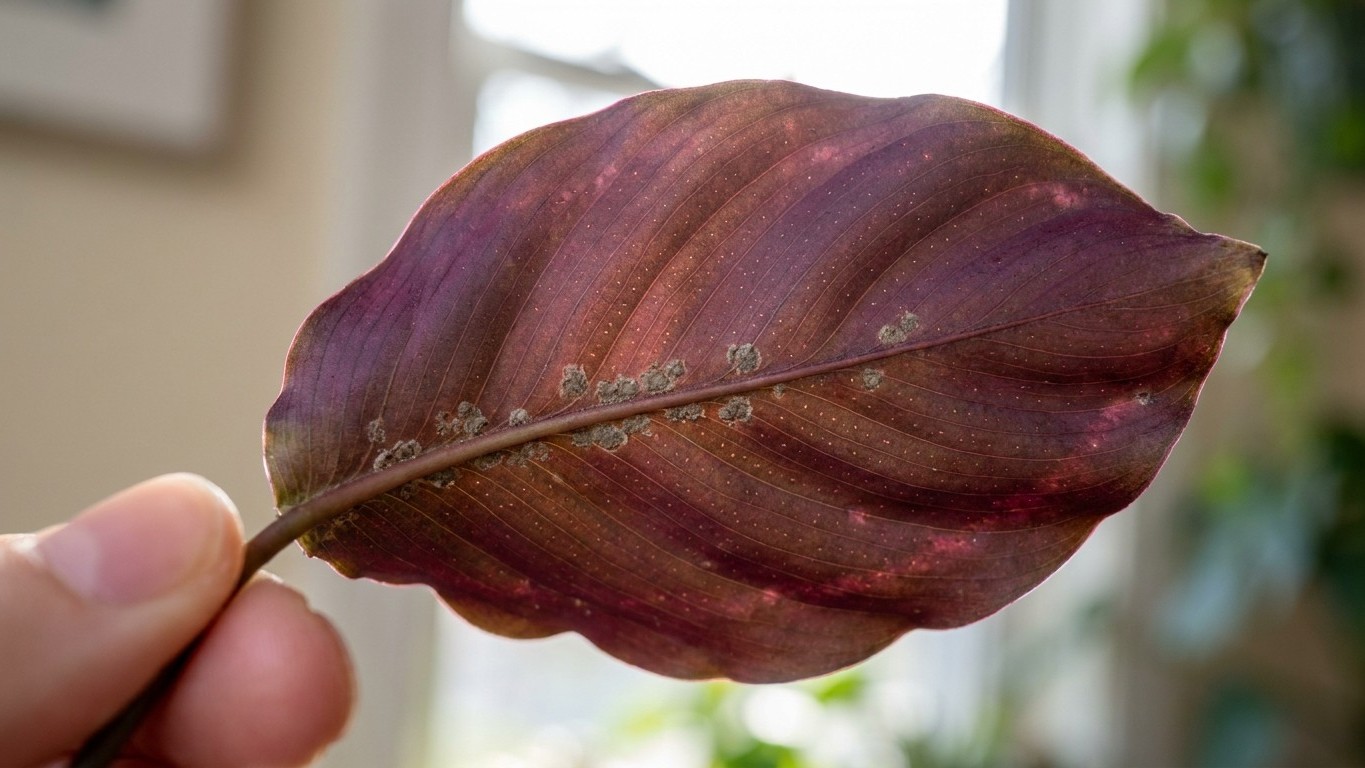
Ten days of nightly misting, and the underside of a single Calathea leaf told the whole story. What looked like a loving ritual, a fine spray of water before lights out, had quietly created the exact conditions these tropical plants struggle with most.
Calatheas have a reputation as drama queens, and they’ve earned it. Native to the forest floors of Central and South America, they thrive in warm, humid air, but they are surprisingly sensitive to water sitting directly on their leaves. The distinction between ambient humidity and leaf surface moisture is one that most beginner growers never hear about, and it’s the difference between a thriving plant and a slow decline.
Key takeaways
- A common humidity technique may be silently damaging your Calathea in ways you can’t see from above
- The distinction between ambient humidity and leaf surface moisture is the secret most plant guides never mention
- There’s a specific reason nighttime misting is far more dangerous than daytime application
What I Found Under the Leaf
Flipping the leaf revealed small brownish-gray spots clustered near the midrib and along the edges where droplets tend to pool. The texture had changed slightly, a faint fuzziness in two of the spots. That’s fungal growth. Not catastrophic yet, but a clear sign that something had been accumulating over those ten nights that the top of the leaf had hidden perfectly.
Calathea leaves are naturally patterned on top, making early damage easy to miss. The undersides, smoother and lighter green or burgundy depending on the variety, show stress much faster. Those brownish patches are the early signature of Helminthosporium leaf spot, a fungal condition that thrives in exactly the conditions nightly misting creates: repeated moisture, low nighttime airflow, and warm temperatures. The spores don’t need much. A few hours of standing water on leaf tissue is enough to give them a foothold.
The other thing visible under the leaf: the stomata, those microscopic pores plants use to breathe, were partially blocked. Calatheas do most of their gas exchange from the underside of their leaves. When water films form over those pores repeatedly, the plant’s ability to take in CO2 and release oxygen is temporarily impaired. Over weeks, this can visibly slow growth and dull the color of new leaves.
Why Misting Feels Right But Often Isn’t
The instinct makes sense. You know Calatheas want humidity. You see the leaves curling or the tips browning. A spray bottle feels like the most direct response. The problem is that misting raises the relative humidity around the plant for roughly 10 to 20 minutes, then it evaporates, which means the actual humidity benefit is minimal. What doesn’t evaporate quickly is the water that collects in leaf folds, along veins, and in the dense overlapping growth at the center of the plant.
Nighttime makes this worse. During the day, warmth and air movement help moisture evaporate from leaf surfaces within an hour or two. At night, temperatures drop, airflow slows, and your home is quiet. Water sits. That’s precisely when fungal spores germinate most aggressively. A study published by the American Phytopathological Society has documented that leaf wetness duration, not frequency, is the primary driver of fungal infection rates in tropical foliage plants. Eight hours of wet leaf surface at night does more damage than four daytime mistings combined.
There’s another wrinkle specific to Calatheas: their leaves move. These plants are nyctinastic, they fold their leaves upward at night in response to darkness, a movement controlled by small joints at the base of each leaf stem called pulvini. When you mist a Calathea right before it starts this nightly fold, you’re essentially trapping moisture inside a closed structure for hours. The interior of that folded leaf becomes a micro-environment with near-zero airflow.
Better Ways to Give Your Calathea the Humidity It Needs
The fix isn’t complicated, but it does require abandoning the spray bottle as a primary humidity tool. A small ultrasonic humidifier placed two to three feet from the plant delivers consistent ambient humidity without ever wetting the leaf surface directly. For Calatheas, a target of 50 to 60 percent relative humidity is the sweet spot, enough to mimic their native understory environment without creating the moisture problems of direct misting. A basic hygrometer (they cost around $10) takes the guesswork out of it entirely.
Pebble trays work as a low-tech alternative. A shallow tray filled with pebbles and water, placed beneath the pot but with the pot sitting above the waterline, creates localized evaporation around the plant. It won’t raise humidity to tropical levels in a dry apartment, but it adds a meaningful 5 to 10 percentage points in the immediate vicinity of the plant. Grouping plants together achieves something similar through collective transpiration, each plant benefits from the moisture released by its neighbors.
If you want to keep misting as part of your routine, the timing matters more than anything else. Morning misting, done several hours before the plant folds its leaves for the night and with enough daylight warmth to speed evaporation, carries far less risk. Aim for the soil surface or the air around the plant rather than directly onto the leaves.
As for the damaged Calathea, the affected leaves won’t recover, fungal spots are permanent on leaf tissue. But removing those leaves, adjusting to a humidifier, and keeping the plant in a spot with gentle daytime airflow is enough to stop the progression. New growth that comes in under the corrected conditions will be clean. Calatheas are forgiving enough to bounce back from ten days of well-intentioned mistakes. The real risk is the grower who sees no immediate dramatic collapse and keeps misting for months, wondering why the plant slowly looks worse despite all that devoted attention.