
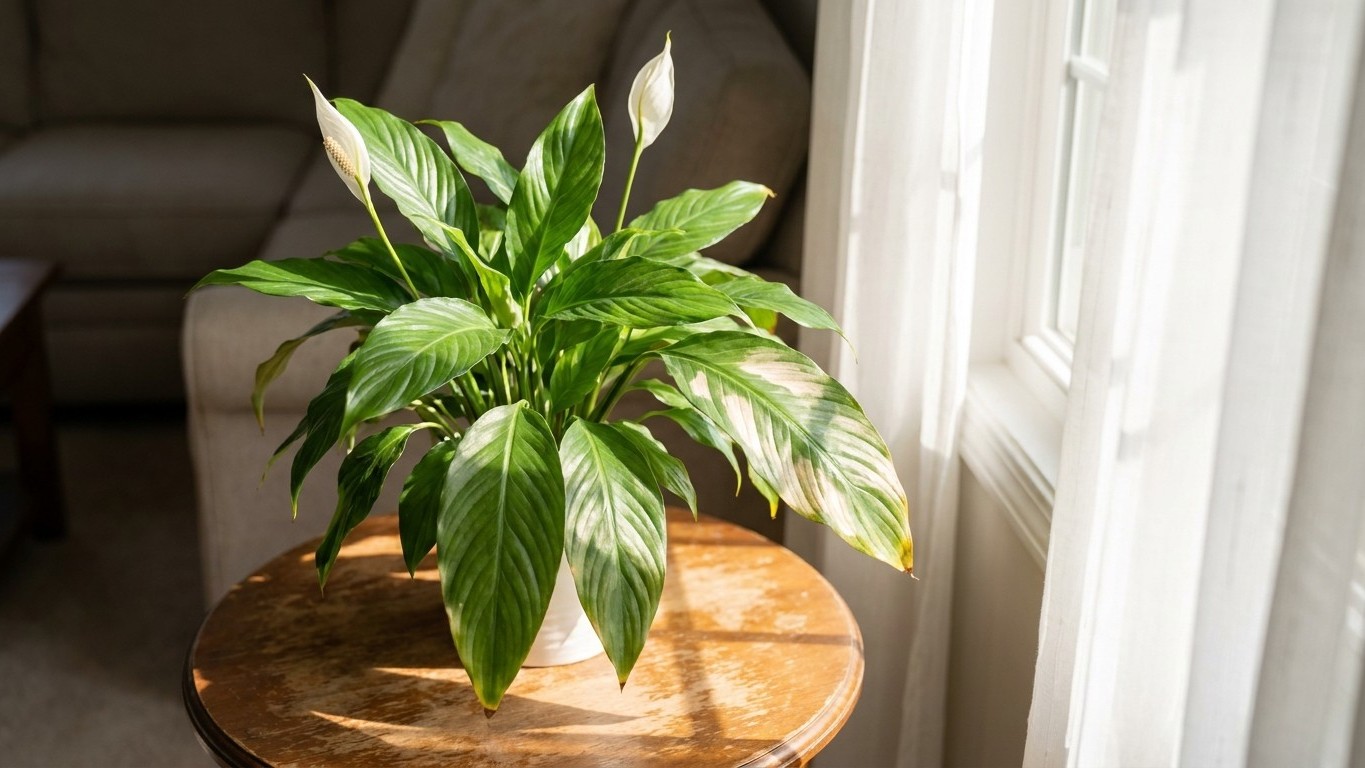
A peace lily sitting in a bright window sounds logical, more light, healthier plant. Three days after making exactly that move, the leaves had developed pale, almost bleached patches that looked nothing like normal yellowing. The culprit wasn’t a disease, a pest, or even overwatering. It was the sun itself.
Key takeaways
- A peace lily moved to direct sunlight can develop white, bleached patches within 48-72 hours—not from disease, but from cellular breakdown
- Peace lilies evolved in tropical forest understory where they receive only 2-5% of sunlight; a south-facing windowsill delivers 10-15 times more light than they can safely process
- Once bleached, those cells are permanently damaged and won’t recover, but the right indirect light position and proper care can restore the plant within weeks
What Actually Happened to Those Leaves
The white or silvery-white patches that appear on peace lily leaves after a sudden move to bright light are called photobleaching, a form of sun scorch that differs visually from the typical brown crispy tips most plant owners recognize. The chlorophyll in the leaf cells breaks down faster than the plant can replace it, leaving areas that look almost bleached, sometimes shiny, sometimes papery, always permanent. That last word matters: unlike a wilting leaf that recovers with water, a bleached cell is dead tissue. The discoloration won’t reverse.
The intensity of the damage often surprises people because peace lilies look like they’re thriving in the days right before it happens. The plant doesn’t signal stress immediately. Instead, the cellular breakdown accumulates over 48 to 72 hours, and then it becomes visible all at once. This delayed response is one reason the windowsill gets blamed less often than, say, a recent watering or a new fertilizer.
Why Peace Lilies Are Especially Vulnerable to Direct Sun
Spathiphyllum species evolved on the forest floor in tropical Central and South America, where light filters through multiple canopy layers before reaching them. In their natural habitat, they might receive as little as 2 to 5 percent of the total sunlight hitting the treetops above. That’s a radically different light environment than a south or west-facing windowsill in late spring, where direct sun can deliver ten to fifteen times more photons per second than this plant was designed to process.
The leaf structure reflects this origin. Peace lily leaves have a thin cuticle (the waxy outer layer) and relatively low concentrations of the protective pigments that sun-tolerant plants use as a kind of internal sunscreen. A succulent sitting in the same window would simply deepen in color. A peace lily starts destroying its own photosynthetic machinery within hours.
There’s also an acclimatization factor that most advice glosses over. Even sun-tolerant plants can scorch if moved abruptly from low light to direct exposure. The difference is that a peace lily’s acclimatization ceiling is much lower, it can adapt to brighter indirect light, but direct sunlight remains damaging regardless of how gradual the transition. This isn’t a plant you can slowly train to tolerate a sun-drenched sill. The biology simply doesn’t support it.
The Right Kind of Light for a Peace Lily (And Where to Actually Put It)
Bright indirect light is the phrase that gets repeated constantly in plant care circles, but it’s worth being specific about what that means in a real home. A spot one to three feet back from a south or east-facing window, where the plant receives strong ambient light but no direct sun rays touching the leaves, is close to ideal. The light should be bright enough to read comfortably without switching on a lamp, that’s a practical benchmark that works surprisingly well.
North-facing windows in most U.S. homes provide enough light for a peace lily to survive but not to thrive. Growth slows considerably, and flowering becomes rare. The plant stays alive but operates at a low baseline. East-facing windows offer the most forgiving option: gentle morning sun that’s softer than afternoon exposure, followed by indirect light for the rest of the day. Many experienced plant owners keep their peace lilies a few feet from an east window and report consistent blooming with minimal problems.
Sheer curtains change the equation dramatically. A white or off-white sheer can cut direct sun intensity by 50 to 80 percent while maintaining the bright, diffused quality that peace lilies respond well to. If the windowsill is genuinely the only available spot in a room, a sheer curtain is a practical fix rather than a workaround. The plant gets the ambient brightness; the harsh direct rays get filtered before they reach the leaves.
Managing the Damage and Moving Forward
Once the white patches appear, the affected tissue won’t recover. Removing the damaged leaves is a judgment call: if more than half the leaf surface is bleached, cutting it off at the base with clean scissors is reasonable and lets the plant redirect energy. If only a portion of the leaf is affected, leaving it in place preserves photosynthetic capacity while the plant pushes out new growth.
After moving the plant to an appropriate indirect light position, recovery typically shows in two to four weeks, with new leaves emerging healthy and uniformly green. Resist the temptation to fertilize heavily to “speed up” recovery, a stressed plant with compromised leaves can’t absorb extra nutrients efficiently, and fertilizer salts can compound the stress. Water normally, maintain reasonable humidity (peace lilies prefer 50 percent or above), and let the plant rebuild at its own pace.
One detail worth knowing: the same sun-scorch mechanism applies to variegated peace lily cultivars, but the damage can be harder to spot early because the white variegation masks the bleached patches. With variegated types, watch for a dull, matte texture on the white sections rather than the normal slightly glossy appearance, that texture change often signals cell damage before the visual discoloration becomes obvious.