
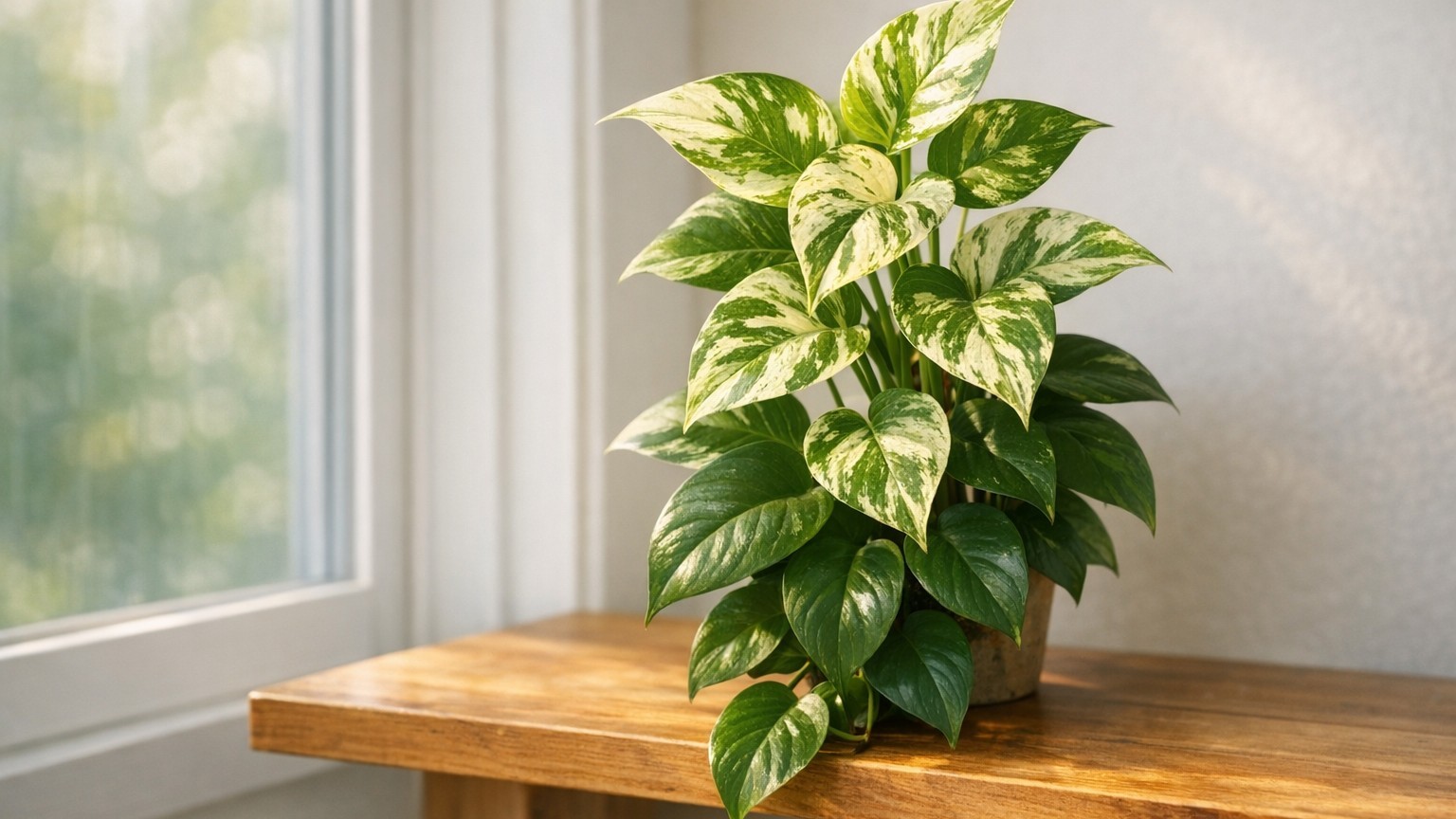
White marbling on a variegated pothos doesn’t just look pretty, it’s a biological balancing act that can collapse faster than most plant owners expect. One month in a low-light corner is all it takes. The white or cream patches on variegated pothos leaves contain no chlorophyll, which means those cells produce zero energy. The green portions carry the entire photosynthetic load for the plant. Move that plant into darkness, and something predictable happens: the pothos starts selecting for survival over aesthetics.
Key takeaways
- Your variegated pothos didn’t lose its white cells permanently—it chose survival over beauty when light dropped
- The reversion happens slowly at first, then suddenly: false confidence for 2-4 weeks, then rapid all-green leaf production
- Restoring variegation requires 200-400 foot-candles of indirect light, not darkness; recovery takes 6-10 weeks of proper conditions
Why variegation disappears, and it’s not a mystery
Plants don’t make decorating decisions, but they do make metabolic ones. When light drops below a functional threshold, a variegated pothos will progressively push out leaves with more green, reducing the proportion of white tissue because white tissue is, from the plant’s perspective, dead weight. Each new leaf that emerges reflects the plant’s current energy budget. Shade the plant enough, and that budget demands maximum chlorophyll coverage. The result: solid green leaves, one after another, until the variegation seems to have vanished entirely.
The science behind this sits in how pothos propagates its cells during leaf development. Variegation in pothos (specifically Epipremnum aureum) is chimeric, meaning the white cells come from a genetically distinct layer of tissue that coexists alongside normal green cells. Under stress, the green cell layers outcompete the white ones during growth. Low light is one of the most reliable triggers for this shift. A 2019 review on chimeric plant variegation published in Horticulture Research confirmed that light availability directly influences the competitive expression of cell layers in chimeric species.
The tricky part? You don’t lose the variegated genetic potential permanently, at least not right away. The plant still carries those white-capable cells. But if you let this go on long enough, some cultivars will stabilize their all-green form through repeated cell division, making recovery increasingly unlikely over time.
The “protection” instinct that backfires
Moving a variegated plant away from a window to protect it from drafts, air conditioning, or direct sun is one of the most common mistakes in indoor plant care. The reasoning feels sound: direct sunlight scorches leaves, especially the white portions, which lack the protective pigments that green tissue has. True. But the solution isn’t darkness, it’s filtered or indirect bright light.
A north-facing corner with no reflective surfaces often delivers less than 50 foot-candles of light. Most variegated pothos cultivars need somewhere between 200 and 400 foot-candles to maintain their patterning. That gap is enormous. A lightly curtained east-facing window, by contrast, can deliver 300 to 500 foot-candles during morning hours, enough to keep the plant functioning at full capacity without the leaf-burn risk of afternoon sun.
There’s also a timing element that catches people off guard. The damage from low light doesn’t show up immediately. The last few leaves that were already forming when you moved the plant will still emerge with normal variegation, giving you false confidence for two to four weeks. Then the reversion hits, and it looks sudden even though the plant made that metabolic decision back on day three or four.
How to bring the variegation back
Recovery is possible, but it requires patience and the right conditions. Move the plant back to a spot with bright indirect light, within three to six feet of an east or west-facing window works well in most homes. Avoid south-facing windows with unfiltered midday sun; a sheer curtain solves that. Once the plant is getting adequate light again, new growth should start showing variegation within two to three leaf cycles, which can take anywhere from six to ten weeks depending on the season and temperature.
Pruning plays a supporting role here. If the plant has pushed out several fully green stems, cutting those back to a node closer to the soil encourages new growth from the base, where the chimeric tissue layers are often better preserved. This isn’t a guarantee, but it does redirect the plant’s energy toward fresh development rather than sustaining already-reverted foliage.
Fertilization matters less than light in this equation, but a balanced liquid fertilizer applied every three to four weeks during active growth gives the plant the nutrients it needs to produce new leaves efficiently. Don’t over-fertilize in an attempt to speed things up, excess nitrogen pushes lush, green leafy growth, which is the opposite of what you want when trying to restore a delicate variegated pattern.
One more variable worth considering: soil moisture. A plant sitting in consistently soggy soil has compromised root function, which reduces its ability to process light even when light is available. Letting the top two inches of soil dry out between waterings keeps the roots healthy and ensures the plant can actually use the improved light conditions you’re providing.
What this tells you about variegated plants in general
Variegated pothos are among the more forgiving variegated plants available, they revert slowly compared to, say, a variegated monstera, which can go fully green after a single season in poor conditions. But “forgiving” doesn’t mean “invincible.” The same principle applies across variegated philodendrons, tradescantias, and hoyas: the less chlorophyll a plant has, the more light it needs, not less.
A useful mental model is to think of variegated leaves as a car running on a smaller fuel tank. The engine works, but the margin for error is tighter. Keep that tank full with adequate light and the plant performs beautifully. Run it low for a few weeks and it compensates by rebuilding a bigger tank, one that’s entirely green.
One detail that surprises most growers: even artificial grow lights can maintain and sometimes restore variegation, provided they deliver sufficient intensity (at least 1,000 to 2,000 lux for extended daily periods). In windowless apartments or dark offices, a quality full-spectrum grow light positioned six to twelve inches above the canopy can outperform a mediocre north-facing window, which explains why some of the most strikingly variegated pothos specimens you’ll find online are grown entirely under artificial light.