
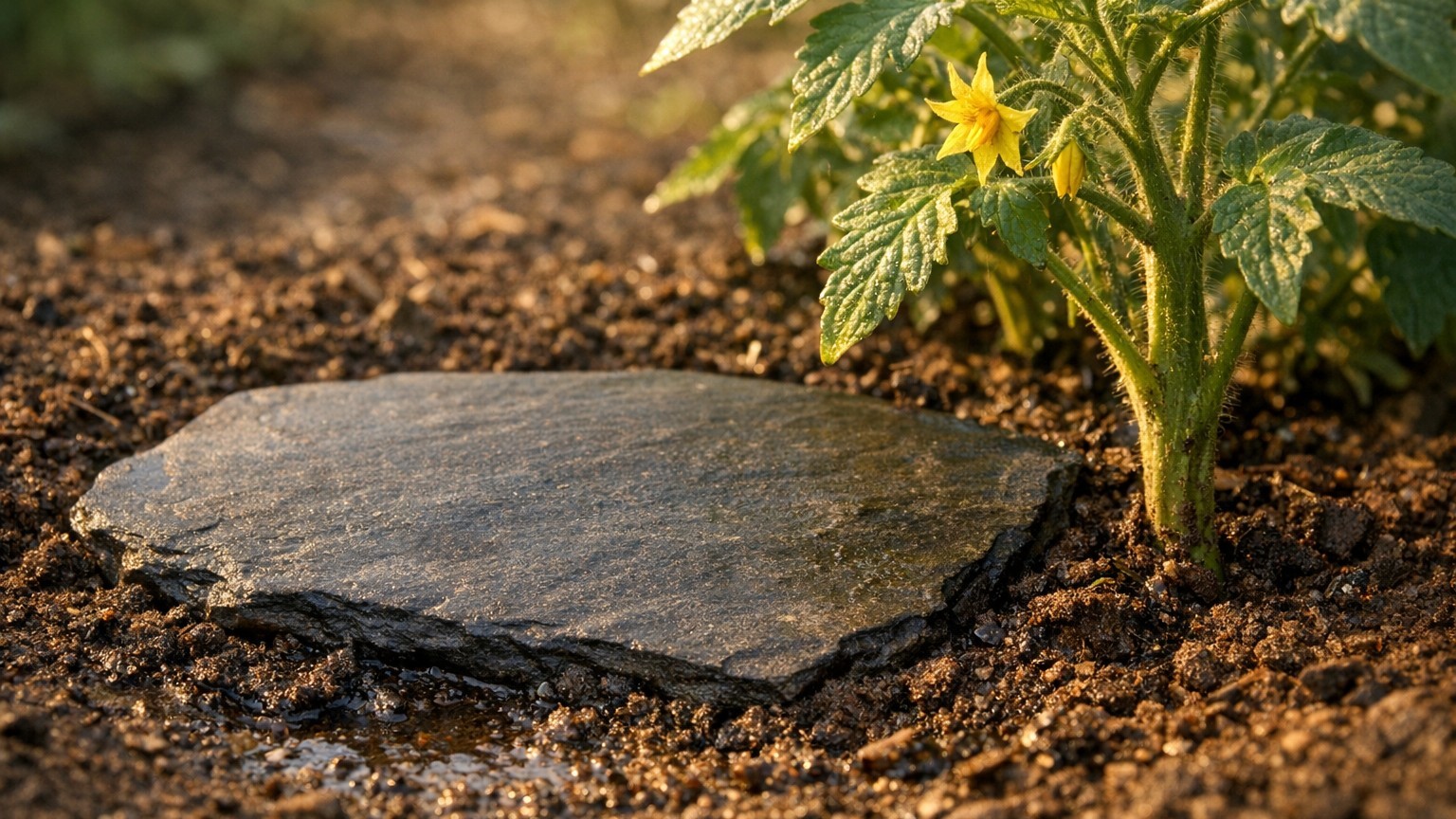
When my grandmother laid a flat stone at the base of each tomato plant every spring, it looked like a quirk. Something she’d inherited from her own mother, tucked in alongside other garden lore you weren’t supposed to question. I smiled. I ignored it. For years, I grew tomatoes the modern way, bags of store-bought mulch, irrigation timers, fertilizer charts. And my results were fine. Not exceptional. Just fine. Then a drought summer forced me to actually pay attention, and I started researching what she was doing. Turns out, she was running a surprisingly sophisticated microclimate management system with a rock she found in the yard.
Key takeaways
- Your grandmother’s flat stone trick wasn’t superstition—it’s based on real thermal and moisture dynamics
- The stone creates a natural buffer against temperature swings and evaporation that modern gardeners overlook
- Blossom end rot and cracking tomatoes are often moisture problems in disguise, and stones help prevent them
A Stone Is Not “Just a Stone”
Garden rocks have remarkable thermal properties that influence soil temperature. During the day, rocks absorb and retain heat from the sun, creating a microclimate that benefits nearby plants. At night, they release that stored heat, preventing drastic temperature fluctuations in the soil. For tomatoes, which hate cold nights early in the season, this is not a trivial benefit. A stone placed close to the base acts like a slow-burning radiator, invisible, silent, free.
Research on stone thermal dynamics confirms a counterintuitive double function: during daytime, rocks insulate soil from solar radiation, keeping temperatures beneath cooler than in exposed soils; during nighttime cooling, the effect reverses, rocks retain heat and soils beneath stay warmer. These two trends result in narrower daily fluctuations under stones than in adjacent soils. Think of it as a buffer against the wild swings of a summer that goes from scorching at noon to surprisingly cool at midnight. Tomatoes growing in unstable temperature conditions divert energy to stress response rather than fruit production. A flat stone smooths that curve.
The Old Farmer’s Almanac is direct about this: to help tomatoes through periods of drought, place a flat rock next to each plant, the rocks prevent water from evaporating from the soil. This isn’t folk wisdom being patronized with a nod; it’s cited practical advice alongside irrigation and fertilizer guidance. The stone, is doing the work of a small, low-tech mulch layer — without decomposing, without harboring slug hideouts, without needing replenishment mid-season.
The Real Enemy: Inconsistent Moisture
Most tomato problems come down to water. Not too much, not too little, but inconsistently delivered, that’s where gardeners lose their crops without understanding why. Blossom end rot, one of the most frustrating afflictions home gardeners face, is actually caused by a deficiency in calcium that causes cell walls to break down. Simply adding calcium through sprays may sound like the easy answer, but it’s more easily controlled by managing moisture stress as tomatoes develop. The rot looks like a nutrient problem. The fix is hydration management. The distinction matters enormously.
Actively growing parts of the plant, such as developing tomatoes, must have a continuous supply of calcium to prevent dark spots from developing, and the conditions that cause blossom end rot are closely linked to inconsistent soil moisture throughout the growing season. A flat stone pressed against the soil surface next to each plant interrupts the evaporation cycle at exactly the right point, keeping that top layer from drying between rain events or watering sessions. Stones act as a protective layer, reducing water evaporation from the soil surface — a dual role in thermal regulation and moisture retention that is especially beneficial in arid climates or during periods of drought.
Studies confirm that organic mulches reduce evaporation by 40 to 60 percent during peak summer, and report up to a 30 percent increase in tomato yield when using straw or leaf mulch. A stone won’t match straw’s organic benefits, but it competes head-to-head on the evaporation front, and our grandparents, working without drip irrigation or soil thermometers, were essentially solving the same equation with whatever materials the yard provided.
Why Flat? Why Not Just Any Rock?
Shape matters more than it seems. A flat stone maximizes soil contact area, which means more coverage over the evaporation zone and better conduction of that retained nighttime heat into the soil below. Research shows horizontal temperature gradients near stones can be steep, surface soils may be up to 7°C cooler at just 0.5 cm from a rock, compared to soil 50 cm away. That thermal shadow extends downward too, keeping root-zone temperatures from spiking dangerously on a blistering July afternoon.
Placement is equally deliberate. The Farmer’s Almanac advises finding flat rocks and placing one next to each plant to prevent water from evaporating from the soil, not on top of the crown, not piled against the stem, but snug beside the root zone like a companion. This placement detail is what separates the technique from simply throwing gravel around. The goal is to cover the most vulnerable square foot of soil, the area where roots are dense and where dry spells do the most damage.
Dark-colored stones absorb more heat than light stones. Because all stones in a garden setting are partially buried in the soil, their color affects the soil temperature and can be used to push a microclimate warmer or cooler. This is where a little extra thought pays off: a darker slate or dark river stone placed next to tomatoes in a short-season northern garden will deliver meaningfully more warmth than a pale limestone chunk. Grandma probably just grabbed what was at hand. But if you’re picking deliberately, go dark.
What to Combine It With
The stone trick works even better when paired with consistent watering habits. A good strategy for preventing blossom end rot is to keep the soil evenly moist, infrequent, deep watering is much better than applying a little water all the time. The stone doesn’t replace a watering schedule; it extends the window between sessions by slowing evaporation from the patch of soil it covers. Think of it as buying you an extra half-day of buffer during a hot week.
Mulch also moderates soil temperature, protecting roots from extreme heat or cold, and by forming a barrier, prevents soil-borne diseases from splashing onto leaves during rain or irrigation, significantly reducing fungal issues like blight. The most effective approach combines both: a flat stone on one side of the plant to lock in heat and moisture, a light layer of straw or shredded leaves on the other to suppress weeds and block splash. Neither method alone achieves what both do together. Straw significantly slows surface evaporation, reducing the wet-dry cycles that trigger blossom end rot and fruit cracking, and Penn State Extension identifies mulching paired with consistent irrigation as the primary prevention strategy for blossom end rot.
One detail that rarely comes up in modern gardening guides: rocks, particularly those with mineral compositions, contribute to the gradual release of nutrients into the soil. As they weather and break down over time, stones release minerals such as calcium, magnesium, and potassium into the ground. Over decades of use, the same flat stone placed season after season next to a tomato plant may be contributing trace minerals to the very soil it sits on. The pace is geological, not horticultural, but it’s real. My grandmother kept the same stones year after year, moving them from bed to bed like small investments. She may have understood something about long-term soil building that composting alone can’t replicate.
Sources : site.extension.uga.edu | hgic.clemson.edu