
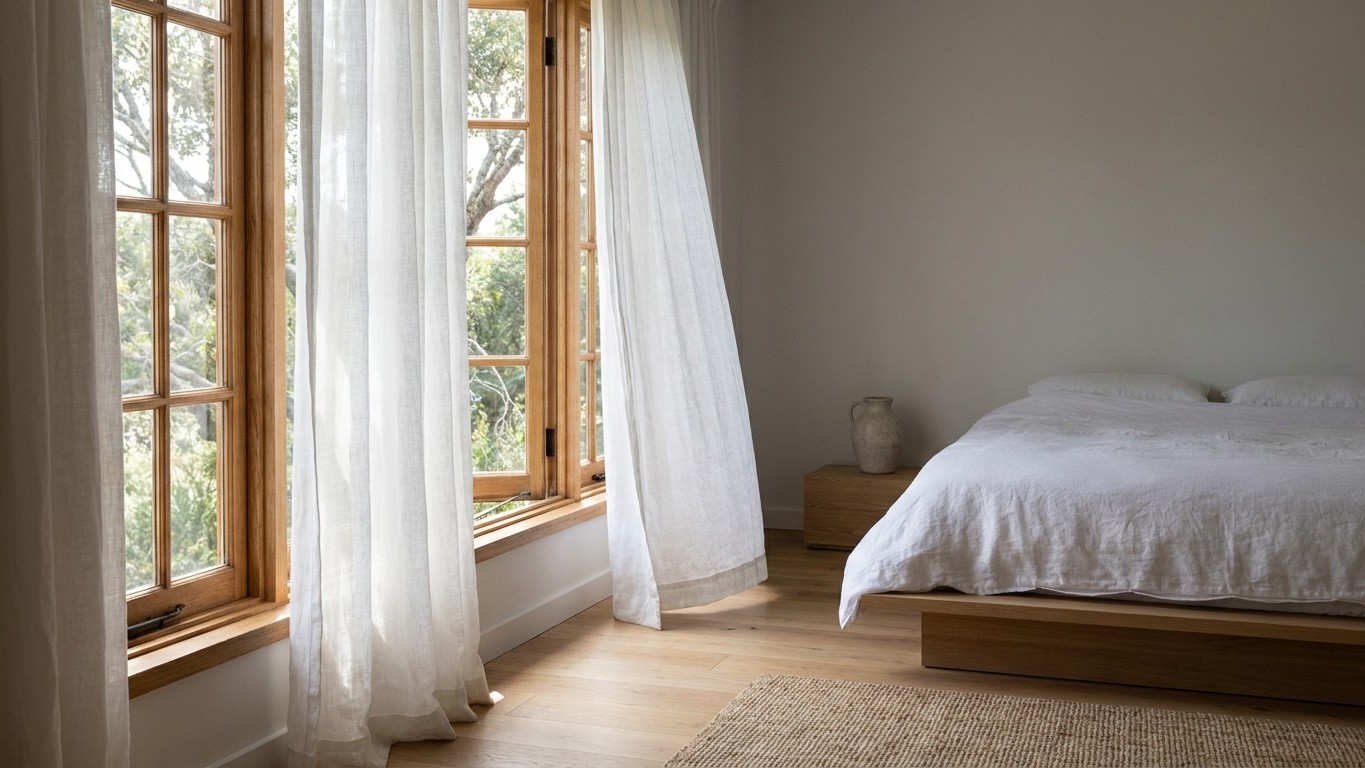
Cross-ventilation is one of the oldest cooling strategies humans have ever used, and it still outperforms most modern gadgets when applied correctly. The basic physics: warm air rises and exits through high openings, pulling cooler air in through low ones. Get that loop working in your home and you can drop the indoor temperature by 5 to 10 degrees Fahrenheit on a dry day, without touching a thermostat.
Key takeaways
- What happens when you open two windows at different heights and opposite sides of your home?
- Why does the time of day you run your natural ventilation system matter more than the system itself?
- Which direction should your ceiling fan actually spin in summer—and why does almost nobody get it right?
The science of airflow you can actually use
Most homes have windows on opposite or perpendicular walls, which is exactly what you need. Open a low window on the shaded, cooler side of your house (typically north or east in the morning) and a high window on the opposite side. The temperature differential does the work, cooler dense air flows in at the base while warmer air is pushed out at the top. A two-story home has a built-in advantage here: stairwells act as natural chimneys, channeling hot air upward toward second-floor windows.
The catch is timing. Running this system during the day when outdoor temperatures peak is counterproductive, you’re just importing hot air. The sweet spot is between 9 PM and 6 AM in most of the continental U.S., when outside temperatures typically drop below indoor levels. Close everything up before the heat builds again, and you’re essentially banking cool air like thermal storage.
Window size matters more than most people realize. A small intake opening paired with a large exhaust opening actually speeds up airflow, the same principle that makes a garden hose nozzle shoot farther when you narrow it. Angling a window at 45 degrees, where the design allows, can redirect airflow across more of the room rather than sending it straight through.
Strategic window placement and shade logic
If you’re in a position to choose window placement, during a renovation or building from scratch, the orientation question is worth treating seriously. South-facing windows receive the most direct sun in the northern hemisphere, which is a liability in summer but an asset in winter. East-facing windows catch morning light before the day heats up; west-facing ones take the brutal late-afternoon sun. North-facing windows receive diffuse, relatively cool light year-round and are the best candidates for intake openings in summer.
Exterior shading dramatically changes the equation. A roof overhang designed to block the high summer sun while admitting the lower winter sun can reduce solar heat gain through south-facing glass by up to 80 percent, according to the U.S. Department of Energy. Awnings, pergolas with climbing plants, and mature trees on the south and west sides of a house accomplish something similar, and deciduous trees are particularly clever about it, losing their leaves precisely when you want winter sun to come through.
Interior window treatments help but are a second-best solution. Cellular shades trap air and reduce heat transmission, and reflective window film can reject a significant portion of solar radiation. The problem is that once sunlight has already entered the room, even if a curtain blocks it from going further, you’ve already introduced radiant heat into the space. Blocking the sun before it hits the glass, outside, is always more effective than trying to manage it inside.
Fan placement that actually changes the temperature
A ceiling fan doesn’t cool a room, it cools the people in it, by accelerating evaporation from skin. The perceived temperature difference can feel like 4 degrees cooler, which is meaningful. What most people get wrong is the rotation direction: counterclockwise in summer (when viewed from below) pushes air straight down, creating that wind-chill effect. Clockwise in winter draws warm air down from the ceiling. This is controlled by a small switch on the motor housing that most owners never touch.
Box fans in windows punch above their weight when positioned correctly. Place one facing outward in a window on the hot side of the house to actively exhaust warm air, and let a shaded window on the opposite side act as a passive intake. Running this setup after dark, especially in climates where nighttime temperatures drop into the mid-60s, can bring a bedroom down to sleeping temperature in under an hour. A $30 box fan doing that work is hard to argue with.
Whole-house fans, the larger units installed in the ceiling between the living area and the attic — take this concept to a much more aggressive level. They can exchange the entire air volume of a home in a few minutes, venting heat out through attic louvers. The Department of Energy estimates they use roughly 10 to 15 times less electricity than central air conditioning. The trade-off is noise, and they require attic ventilation to function properly, but in low-humidity climates they are genuinely effective all summer.
What doesn’t work as well as advertised
Swamp coolers, evaporative coolers, are often mentioned in the same breath as natural ventilation, but they’re only useful in dry climates. In the Southeast or anywhere summer humidity sits above 60 percent, they add moisture to air that’s already too humid, making the space feel worse. The cooling mechanism depends entirely on evaporation, which slows to a crawl when the air is already saturated.
Thermal mass is a more durable concept. Dense materials, concrete floors, stone walls, clay tiles, absorb heat during the day and release it at night, shaving the temperature peaks inside a home. Adobe architecture in the Southwest has operated on this principle for centuries. Lighter wood-framed homes don’t have the same advantage, but adding thermal mass strategically (a stone accent wall, ceramic tile in a sunlit room) can moderate daily temperature swings without any energy input at all. In a world where electricity prices have continued climbing, that’s a passive investment that pays out every single summer.