
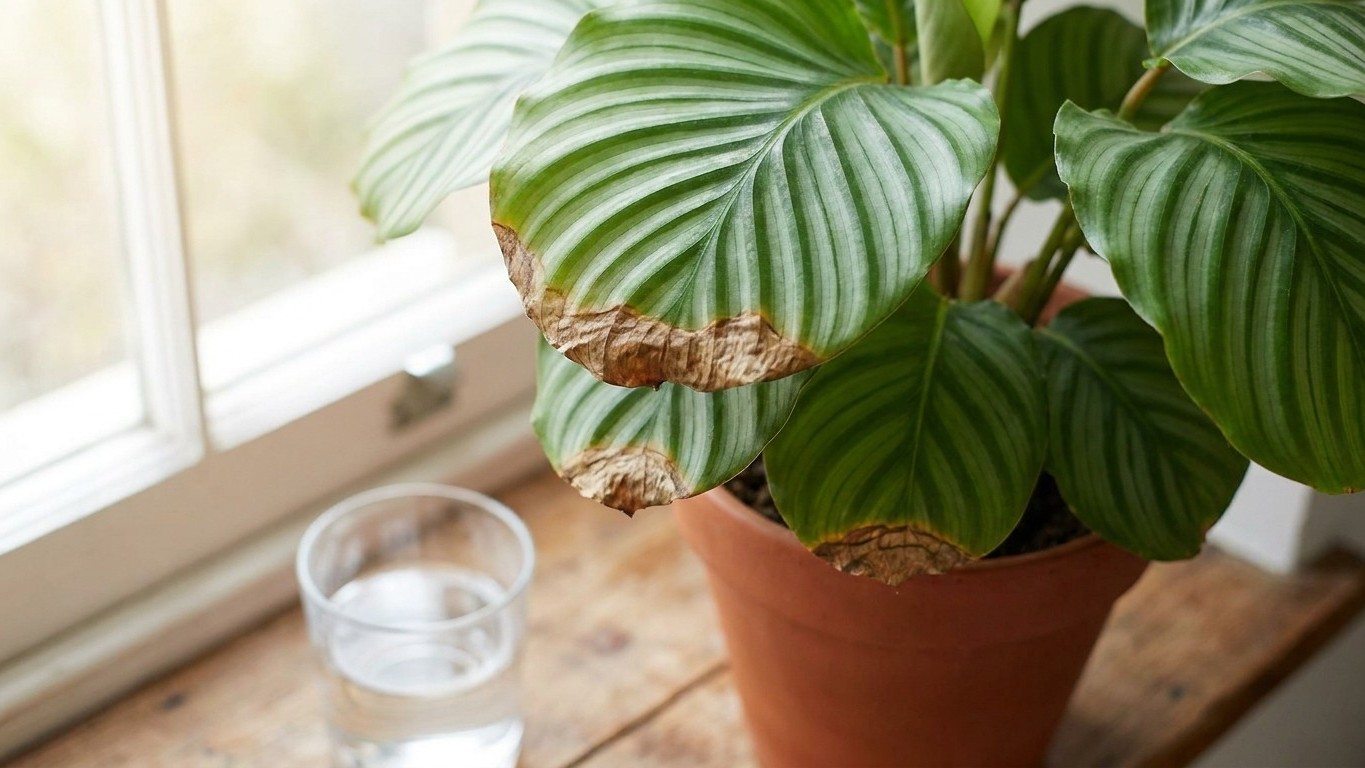
For two decades, the advice seemed bulletproof: leave tap water in an open container overnight, let the chlorine evaporate, then water your plants in the morning. Generations of houseplant owners swore by it. The logic was clean, the method was simple. The browning tips, though, kept showing up.
Here’s what most plant guides written before 2015 got wrong: they were designed for a different era of municipal water treatment. The chemistry of what comes out of American taps has shifted considerably, and the overnight-sit method that worked for your grandmother’s spider plants is only solving half the problem at best.
Key takeaways
- Chloramine replaced chlorine in most U.S. water systems since the mid-1990s—and it doesn’t evaporate overnight like chlorine does
- Brown leaf tips that look like underwatering might actually be chemical damage from chloramine, fluoride, or salt accumulation in soil
- Rainwater and catalytic carbon filters work; standard Brita filters and the overnight method alone don’t
Chlorine was never the whole story
The overnight method does work for chlorine. That part is accurate. Chlorine is a volatile compound, and given enough time and surface area, it will off-gas from standing water. A wide-mouthed pitcher left out for 8 to 24 hours can reduce chlorine levels meaningfully. But since the mid-1990s, most U.S. water utilities have been transitioning away from chlorine as their primary disinfectant, replacing or supplementing it with chloramine.
Chloramine is a compound formed by combining chlorine with ammonia. It’s more stable, longer-lasting in distribution pipes, and far less prone to forming certain disinfection byproducts. From a public health standpoint, it’s a genuine improvement. From a houseplant standpoint, it’s the compound that doesn’t care about your overnight ritual. Chloramine does not evaporate from standing water at room temperature, not in 24 hours, not in 48. You would need to leave water sitting for several days, or boil it, to significantly reduce chloramine levels.
The EPA’s drinking water regulations permit chloramine levels up to 4 milligrams per liter in treated water. That’s safe for humans. For sensitive tropical houseplants like calatheas, peace lilies, or dracaenas, even lower concentrations can be enough to cause the characteristic brown leaf tips that look so much like underwatering that most people reach for the watering can more often, compounding the stress.
What those brown tips are actually telling you
Tip burn is one of the most misread signals in houseplant care. The assumption is almost always water frequency or humidity. And those factors do matter. But when the browning is isolated strictly to the tip of the leaf, progressing slowly, and appearing across multiple plant species despite different watering schedules, the water chemistry itself deserves a closer look.
Chloramine isn’t the only offender, either. Fluoride is added to most municipal water supplies in the U.S. at concentrations around 0.7 milligrams per liter, and it accumulates in soil over time with repeated watering. Plants in the Dracaena, Chlorophytum (spider plant), and Maranta families are especially sensitive to fluoride buildup. The damage typically shows up as brown, scorched-looking tips, which can be confused with drought stress or low humidity. A soil flush, done by running large volumes of water through the pot to drain out accumulated minerals, can provide temporary relief, but if you keep using the same tap water, the buildup resumes within weeks.
Salt accumulation from softened water adds another layer. Homes with water softeners are swapping calcium and magnesium ions for sodium, and sodium at elevated concentrations in soil actively draws moisture away from roots through osmotic pressure. The plant looks thirsty because, in a physiological sense, it is, even if the soil is moist. Plants watered with softened water for months will often show wilting alongside brown tips, a combination that confuses even experienced growers.
What actually works instead
Rainwater remains the gold standard, and collecting it doesn’t require much more than a barrel under a downspout. Rainwater is naturally soft, low in dissolved solids, and slightly acidic, which suits the majority of tropical houseplants perfectly. A study published through university extension services has long confirmed that collected rainwater consistently outperforms treated tap water for sensitive species, showing measurably lower rates of tip burn in controlled comparisons.
Filtered water is the practical middle ground for most households. A basic activated carbon filter (standard pitcher filters like Brita) does remove chlorine effectively, but chloramine is a different matter. Specifically, you need a filter with a catalytic carbon block, not standard activated carbon. Catalytic carbon breaks down the chloramine molecule rather than simply adsorbing it. Most high-end under-sink systems include this, and some pitcher-style filters now do as well, though it’s worth checking the specifications rather than assuming.
Distilled water is chemically clean but lacks minerals entirely, which some plants actually need in small amounts. Used exclusively over years, it can lead to micronutrient deficiencies unless you’re fertilizing regularly. Reverse osmosis water sits in a similar category: excellent purity, but best used with a dilute fertilizer to reintroduce trace minerals.
For the overnight-sitters who aren’t ready to overhaul their system entirely, a few adjustments make the habit more effective. Use a wide, shallow container rather than a tall pitcher, maximizing the water surface exposed to air. Add a vitamin C tablet (ascorbic acid) to the water, about 1,000 mg per gallon. Ascorbic acid neutralizes both chlorine and chloramine rapidly, within minutes, and is completely safe for plants. Aquarium stores have sold dechlorination drops for decades based on this same chemistry, and plant owners are increasingly borrowing the technique.
There’s also the question of temperature. Cold tap water can shock tropical plants with warm root zones, causing root constriction even before any chemical issues come into play. Letting water sit overnight does solve this specific problem regardless of its chloramine limitations, which is probably why the method never fully fell apart as advice, even as its core chemistry became outdated.
One detail worth knowing: municipal water treatment varies significantly by city. The EPA’s Consumer Confidence Report system requires every water utility to publish an annual water quality report, and you can look up exactly what your local utility is using, at what concentrations, including whether chloramine or chlorine is the primary disinfectant. What’s coming out of the tap in Phoenix is not the same as what’s coming out in Boston, and your plant care shouldn’t pretend it is.