
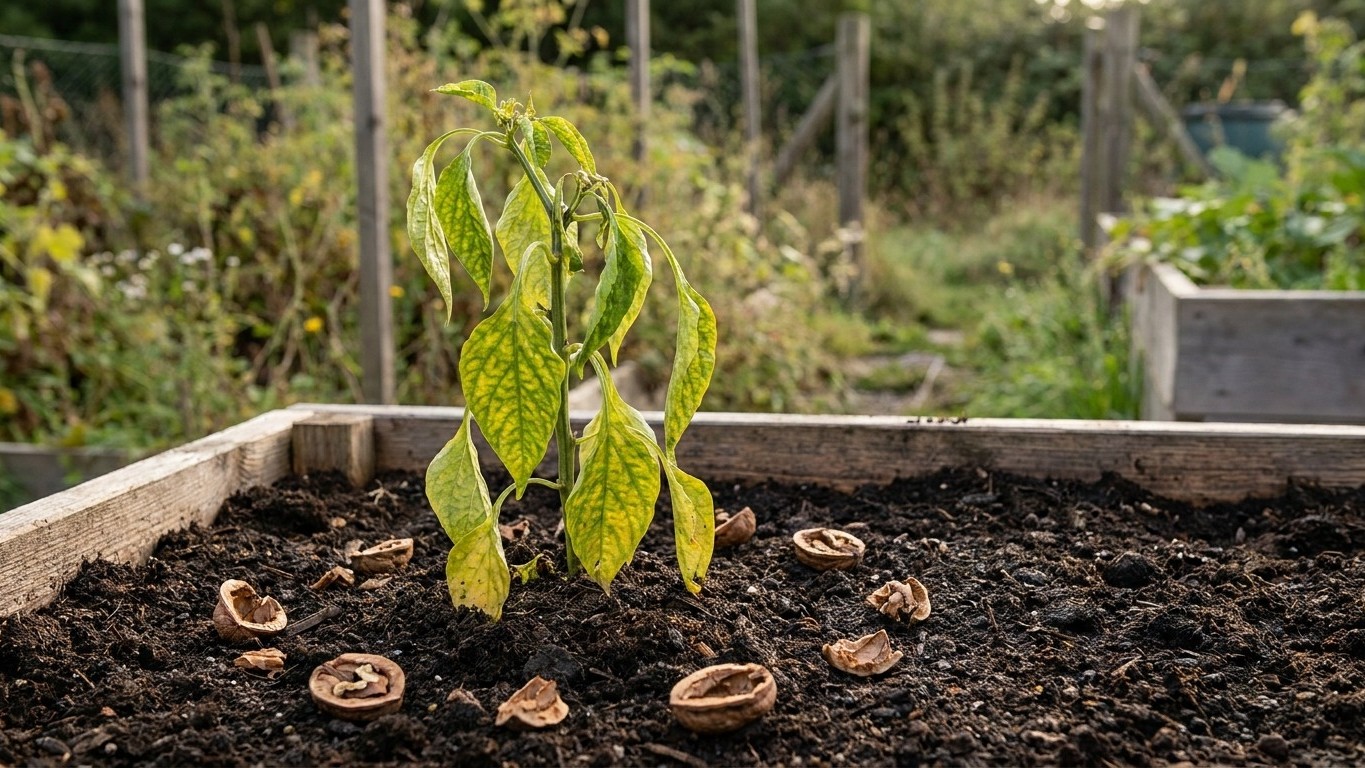
Peppers wilting in May despite regular watering usually points to one of a handful of culprits: root rot, transplant shock, or a nutrient lockup. But if the soil in question got a steady diet of walnut leaves and husks all autumn, there’s a much more specific suspect waiting underground. It’s called juglone, and it doesn’t care how green your compost pile looked.
Walnut trees produce this compound as a chemical weapon against competition, and it shows up in every part of the tree except the actual nutmeat. Juglone is found in all parts of the walnut tree except the nut itself: leaves, branches, bark, wood, and especially in its roots and nut husks. Dumping leaves onto the heap felt like a harmless shortcut compared to hauling bags to the municipal drop-off. The tree, though, doesn’t stop being allelopathic just because its leaves detached from the branch. Allelopathy is nature’s way of reducing competition. Certain plants, like the black walnut, release chemicals that inhibit the growth of others around them.
Key takeaways
- Walnut leaves break down safely in weeks, but the husks hide a toxic compound that lingers for months
- Pepper plants can collapse from invisible root damage even when soil stays perfectly moist
- A simple seedling test reveals whether your compost is truly safe before planting your whole garden
Why the Leaves Weren’t the Real Problem
Here’s the twist most backyard composters miss: walnut leaves themselves break down fast. Walnut leaves can be composted because the juglone toxin breaks down when exposed to air, water and bacteria, and the toxic effect can be degraded in two to four weeks. Under normal conditions, a pile that’s been turned and kept moist should have neutralized leaf-based juglone well before spring planting.
The husks are a different story entirely. Nut husks belong to the same slow-decomposing family as walnut shells and sawdust, and they hang onto their toxic compound far longer than foliage does. It’s a different story when it comes to walnut sawdust, wood chips, and nut husks. These materials decompose much more slowly and retain juglone for longer periods, and it’s best to let them compost for at least 6 months before using them in your garden to give the juglone time to thoroughly break down, ensuring they no longer pose a threat to sensitive plants like tomatoes, peppers, and azaleas. An autumn-to-May window barely clears six months, and that’s assuming ideal hot-composting conditions, not a passive backyard heap that got dumped on and largely ignored.
Shells and husks are also just physically stubborn. Walnut hulls or shells will decompose slowly in a compost pile because they are so woody in nature. Chunks of husk that looked “mostly composted” on the surface may have stayed nearly intact at the core, still leaching juglone every time it rained.
What Juglone Toxicity Actually Looks Like on Peppers
The symptoms match what a lot of gardeners describe as unexplained spring collapse. Peppers and tomatoes react in a strikingly similar way to root contact with the compound. Affected plants often wilt in a relatively short time after contact with black walnut roots, even when the soil is moist. The entire plant may wilt, or only a part. Later as the wilting becomes more severe, the leaves start to brown and the plant dies. On tomato relatives specifically, the foliage often distorts before it dies outright. Tomato leaves begin yellowing, as well as twisting and puckering, and the internal stem tissue may also become darkened or discolored.
What makes this especially frustrating is that the plants can look fine one week and be collapsing the next, because moisture doesn’t protect against it the way it does against drought stress. That’s the detail that throws people off. A gardener checks the soil, finds it damp, and rules out the obvious explanation, all while the actual cause sits invisible in the root zone.
Timing Makes It Worse Than It Sounds
Spring compost from autumn leaves carries an extra irony: walnut foliage is more toxic exactly when gardeners are most likely to use finished compost. Walnut leaves have the highest juglone content in the spring, and although they still contain this troublesome compound in the fall, it is less. That seasonal swing doesn’t excuse an under-composted pile, but it does mean the risk window isn’t evenly spread across the year.
The fix isn’t complicated, just patient. Extension horticulturists consistently land on the same recommendation for husks, shells, and woody walnut debris. Composting the material for a minimum of six months allows the chemical to break down to a safe level even for plants sensitive to juglone, like tomatoes, and if you have an active and productive compost pile with a good balance of air, water, and bacteria, the juglone that causes issues for tomatoes and other plants will be readily broken down. Regular turning and adequate moisture aren’t optional extras, they’re what actually drives the microbial activity that neutralizes the compound in the first place.
For anyone staring at drooping pepper plants right now, there’s a low-stakes diagnostic worth trying before ripping everything out. Black walnut leaves may be composted separately, and the finished compost tested for toxicity by planting tomato seedlings in it. A seedling in a small pot of suspect compost, watched for a couple of weeks, tells you more than any soil test kit from the hardware store. If it yellows and curls, the heap needs another season. If it stays green, the problem was something else entirely, and the walnut husks were just an innocent bystander this time.
Sources : ask.extension.org | confessionsofacomposter.blogspot.com