
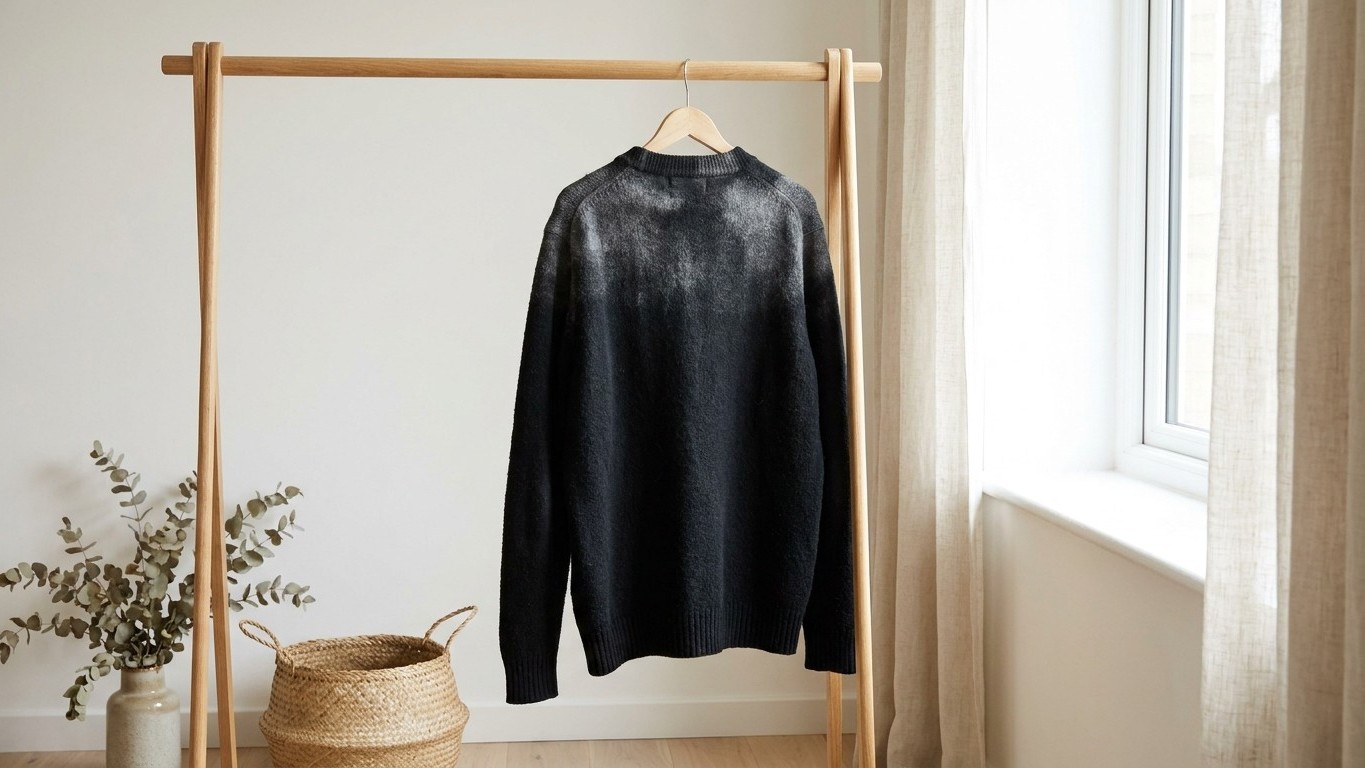
Six months of daylight did more damage to that black jumper than years in a drawer ever could. The shoulders had gone from deep charcoal to a patchy, ashen gray, exactly where the fabric caught the window’s glow every single day. No spill, no bleach, no washing mistake. Just light, doing what light does to color when nobody’s paying attention.
The instinct behind an open rail makes sense. You see everything you own, nothing gets buried in a dark corner, and getting dressed in the morning turns into browsing rather than digging. But visibility comes at a cost that most people don’t calculate until the damage is already visible on the fabric itself.
Key takeaways
- A simple wardrobe choice revealed an invisible culprit: six months of ambient light permanently changed the color of a beloved piece
- Natural fabrics and dark colors fade fastest under UV exposure, and the damage happens so gradually you won’t notice until it’s too late
- The solution isn’t abandoning open storage—it’s understanding exactly where the danger zone sits in your room
Why the Shoulders Go First
Light doesn’t need to be direct sunlight streaming through glass to bleach a garment. Direct exposure of clothes to sunlight and the accompanying UV rays and heat cause fading of textiles, and sunlight and UV rays are present even in cold, cloudy climates. A north-facing bedroom window still lets in enough ambient UV to work slowly on anything hanging in its path, and the shoulders of a garment on an open rail are usually the highest, most exposed point in the room.
Color and material both play a role in how fast that damage shows. Lighter fabrics are reflective, while darks and colors absorb light and heat, accelerating the breakdown of pigment and making them more susceptible to fading. That’s the physics behind why a black jumper reveals sun damage faster and more dramatically than a pale linen shirt hanging right next to it. Fiber type matters just as much. Natural fabrics like cotton, wool, silk fade faster than synthetic or man-made fabrics like polyester, nylon, acrylic, and acetate. A wool jumper, was always the most vulnerable piece on that rail.
What makes this kind of fading so easy to miss in real time is its pace. Damage isn’t always immediate; sometimes it takes months or years for the effects to become noticeable. You don’t watch a sweater fade the way you’d watch a coffee stain spread. It happens in increments too small to register day to day, then one afternoon you pull the piece out for the first time in a while and the color shift hits you all at once.
The Open Rail Trade-off
An open rail solves a real problem. Traditional closets bury clothes, and one of the biggest frustrations with wardrobes is visibility, since clothes get pushed to the back, crushed together, and forgotten. Rails fix that instantly. Everything is right there, and outfit planning stops feeling like archaeology.
The flip side is that open storage removes the layer of protection a closed door provides. Retailers who sell fabric care products are blunt about this: closets with doors or drawers provide better protection than open shelving or hooks where sunlight might reach them. That doesn’t mean an open rail is a bad idea, it means placement decides whether it works in your favor or against it. A rail tucked into an interior wall behaves completely differently from one positioned beside a bright window, even in the same bedroom.
There’s a reason hardware suppliers building these systems flag window proximity specifically. Placement next to a window can fade fabrics and highlight dust, while positioning near a door can lead to constant bumps. Dust and fading turn out to be the two most common complaints about open storage, and both are largely about where the rail physically sits in the room, not whether open storage itself was the wrong call.
Keeping the Rail Without Losing the Wardrobe
None of this means going back to a closed closet. It means being a little more deliberate about how the rail is set up. A few adjustments make a real difference over time:
- Move the rail away from direct window light, even a few feet of distance changes the exposure dramatically over months.
- Rotate what hangs in the brightest spot, so no single garment absorbs the same daily dose of light indefinitely.
- Save the darkest, most fiber-sensitive pieces for a drawer or the back of the rail, since natural fabrics fade faster than synthetics and darker colors show it first.
- Swap harsh bulbs for LED where the rail sits, because LED lights do not have ultraviolet rays, unlike some older bulb types that add their own dose of damage on top of daylight.
Fabric choice matters here too. If a piece is genuinely irreplaceable, it might not belong on an open rail at all. Natural fibers like cotton, silk, and linen offer minimal UV protection and can show signs of fading after just a few hours of direct sunlight, which is why synthetic fabrics with better UV resistance are often recommended for pieces that see more light exposure. A polyester blend jacket can handle a sunny corner far better than a wool coat or a silk blouse ever will.
The open rail isn’t the enemy here. A window is. Once that distinction clicks, the fix is less about giving up the visual, boutique-style storage people love and more about treating one specific stretch of wall, the one that catches the most daylight, as off-limits for anything dark, natural-fibered, or sentimental. Everything else can hang in plain sight without quietly bleaching while you’re not looking.
Sources : knowingfabric.com | oxxousa.com