
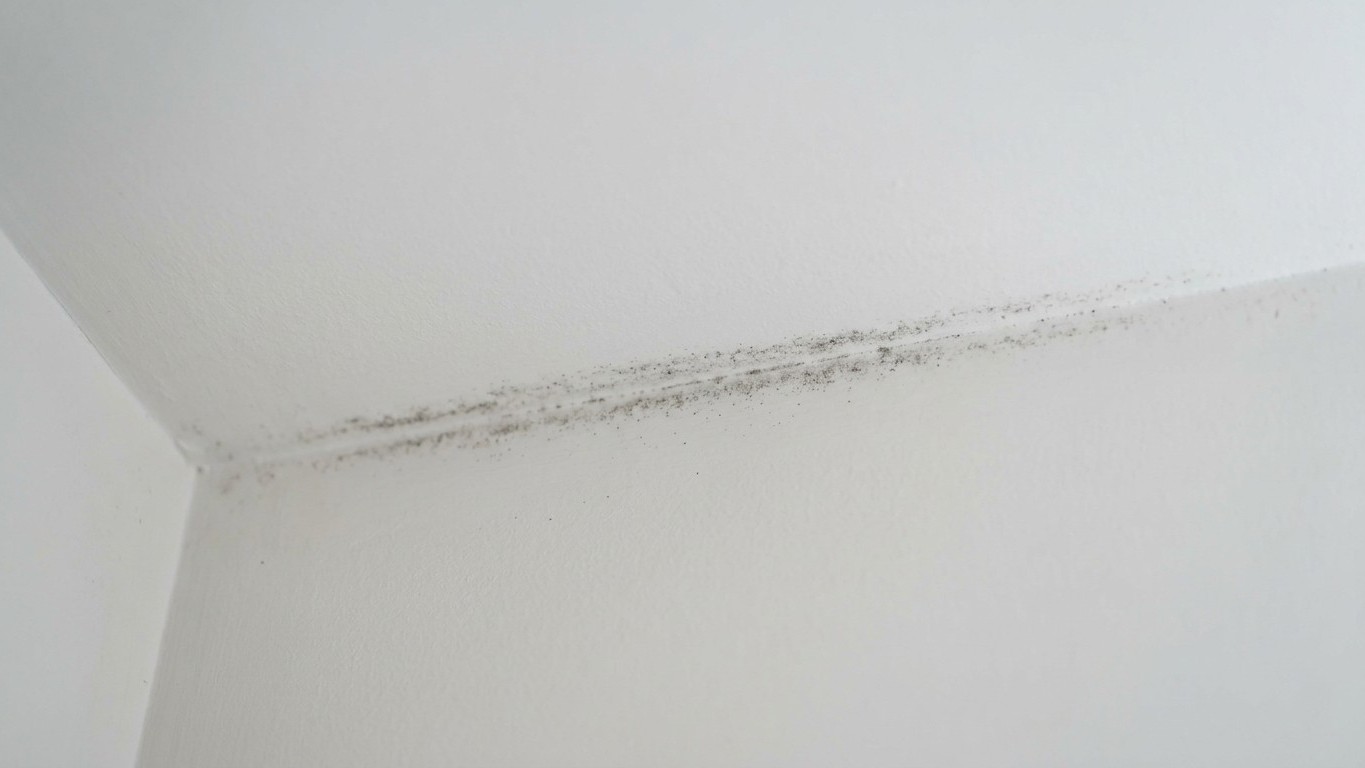
A black line creeping across a bathroom ceiling isn’t dirt. It’s a map, tracing exactly where the extractor fan’s exhaust should have been going for two years but wasn’t. That thin, sooty streak along the crown of the ceiling, right where it meets the wall, is often one of the first visible signs that a fan has stopped moving air, even if the motor is still humming along like nothing’s wrong.
Key takeaways
- A fan can spin and make noise while moving almost no air at all—here’s how to tell in 15 seconds
- That black line traces exactly where moisture is pooling because your fan isn’t pulling it out
- Two years of unvented shower steam adds up to conditions where mold thrives in less than 48 hours
What that black line is actually telling you
The line itself is a mix of dust, moisture, and mold spores that have found a permanent home in the cool, damp air pocket where warm shower steam collects before it has anywhere else to go. If the space does not dry out quickly, spores settle and begin to spread, which is why black spots usually appear on ceilings, grout lines, and around vents. A fan can still spin, still make noise, still feel “on,” and yet move almost no air at all. Dust and lint build up on the blades and inside the housing, and over months that resistance quietly kills the suction without ever killing the sound.
There’s a simple test that takes fifteen seconds. Turn the fan on and hold two squares of toilet paper against the grille. If the fan holds the paper, it’s pulling a decent amount of air. If it falls, the fan is too weak or the duct is blocked. A lot of homeowners skip this step for years, precisely because the grille sits too high to bother with, tucked into a ceiling corner nobody looks at unless they’re lying in the bathtub staring straight up.
What makes this particular failure sneaky is that the fan doesn’t need to fully die to cause damage. A ceiling that starts getting mouldy patches can be traced to an extractor fan that isn’t working properly, even while it’s still making a whirring noise. The bearings can be grinding away, the blades caked in enough lint to cut airflow by half, and from the floor it all sounds perfectly normal.
Why moisture wins so fast in a bathroom
The math behind that black line is more dramatic than most people realize. Every shower releases half a pound of water vapor into your bathroom, and without proper exhaust fan ventilation, that moisture settles on walls, ceilings, and hidden spaces where mold thrives in just 24-48 hours. Two years of showers with a fan that’s barely pulling its weight adds up to a staggering amount of vapor that had nowhere to go but straight up.
Ceilings, and the corner where ceiling meets wall in particular, are usually the coldest surfaces in the room. Cold spots exist because external walls, tiles and ceilings under a cold loft remain cool, causing moisture to condense there first, and a fan helps but cannot fully combat surfaces that stay cold and damp. That’s the physics behind why the stain traces a line rather than spreading evenly. Warm, humid air rises, hits the cooler ceiling perimeter, and gives up its moisture right there, night after night, shower after shower.
The federal government has been blunt about the threshold that matters most here. The EPA identifies that mold will not grow if moisture is not present, establishing moisture control as the primary prevention strategy, and optimal indoor humidity levels should remain below 60 percent, ideally between 30 and 50 percent relative humidity. A fan that’s underperforming, even slightly, is often enough to tip a bathroom permanently over that line.
Fixing it without tearing the ceiling apart
The good news: a black line doesn’t automatically mean a gutted bathroom. Most fixes start with the fan itself, not the drywall. A physical inspection means turning off power at the circuit breaker and checking for a rattling fan box, which can loosen duct connections. Pulling the cover and vacuuming out two years of lint often restores real suction in under an hour, no tools beyond a screwdriver required.
If the fan is clean but still weak, the duct run itself might be the culprit, especially in older homes where ducting sags or loops through a cold attic space. Ducting that follows a long path into a loft cavity should have a condensation trap that lets the moisture drip away, and without one, water pools inside the pipe and feeds exactly the kind of growth that eventually shows up as staining below. It’s worth having someone check where the duct actually terminates, too: fans that vent into an attic instead of outside just relocate the moisture problem rather than solving it.
Sizing matters as much as cleanliness. Building codes set a floor, but it’s a low one. The International Residential Code mandates a minimum 50 CFM intermittent operation or 20 CFM continuous operation for exhaust fans, while the Home Ventilating Institute recommends the more robust standard of 1 CFM per square foot for bathrooms up to 100 square feet. A fan installed to bare code minimums in a larger or oddly shaped bathroom may never have had enough pull to begin with, black line or no black line.
As for the stain itself, once the airflow problem is solved, cleaning it is the easy part. According to the EPA, you can handle mold cleanup yourself if the affected area is less than 10 square feet, using detergent and water rather than bleach, which tends to bleach the surface without actually killing what’s underneath. Anti-mold ceiling paint helps the line from returning, but only once the fan is doing its actual job again, not before.
Set a reminder to check that grille every six months, even if it means dragging out a step stool. A fan that looks fine and sounds fine can still be quietly failing, and the ceiling is usually the last place to find out, not the first.
Sources : michrose.com | mybuilder.com