
Six weeks. That’s how long I watched bright orange blooms open, wilt, and drop into the mulch without a single zucchini to show for it. I blamed the heat wave. I blamed bad soil. I even blamed the neighbor’s cat that kept napping in my raised bed. Then, one Tuesday morning before 10 a.m., I picked a flower with a straight, skinny stem and no baby fruit behind it, and everything/”>Everything clicked. That flower was male. It had never been designed to become a squash. It existed for one purpose only, and I’d been ignoring that purpose for over a month.
Zucchini plants are what botanists call monoecious, meaning a single plant grows both male and female flowers separately rather than combining both parts in one bloom. Male flowers typically appear first and in greater numbers, often several weeks before the female blossoms emerge, and they are identifiable by the long, thin, straight stem they sit upon, their purpose being solely to produce pollen. Once that pollen is spent, the male flower withers and drops off the plant, which is normal and should not be confused with a problem. I’d been staring at a parade of perfectly healthy males and mistaking their natural life cycle for a disaster.
The females tell a different story when they fail. Female flowers have a distinct, miniature, unpollinated fruit, a swollen ovary, located directly behind the petals, and this small swelling is the zucchini itself, which will only grow if the flower is successfully pollinated. If nothing pollinates that stigma in time, the plant aborts the tiny fruit, which begins to shrivel, turn yellow or brown, and subsequently falls off the plant. That’s the drop most gardeners actually mean when they complain about zucchini failure, and it has almost nothing to do with the weather itself, and almost everything to do with timing.
Key takeaways
- Male zucchini flowers outnumber females early in the season, creating a pollination timing mismatch
- Zucchini flowers close by afternoon—you have only a morning window for successful pollination
- Hand-pollinating takes five minutes with a paintbrush, and one male flower can service multiple females
The morning window nobody warns you about
Here’s the detail that changed how I garden: zucchini flowers aren’t open all day. Zucchini flowers tend to open up wide in the morning and are often closed by the afternoon, so it is important to hand pollinate in the morning. Come back at 2 p.m. with your paintbrush and good intentions, and you’ve already missed the window. Blooms in this plant family typically are only open for one day, and will simply drop off the plant if they are not pollinated, which can be caused by low bee activity due to cool, wet temperatures or from pesticide sprays.
Bees do most of the heavy lifting in a normal season, carrying pollen from male to female blooms without any human involvement. But their schedules don’t always match the plant’s. Female and male flowers must be open at the same time for cross-pollination, and many male flowers may emerge before you see the first female flower. Early in the season, that mismatch is completely normal, part of the plant establishing itself before it commits to fruit. But if it drags on for weeks, or if pollinator numbers in your yard are low, nothing is going to fertilize those ovaries on its own. That’s exactly the situation I’d been in: dozens of male flowers, a scattering of females, and zero bees showing up before those female blooms sealed shut for the day.
How to actually hand-pollinate, step by step
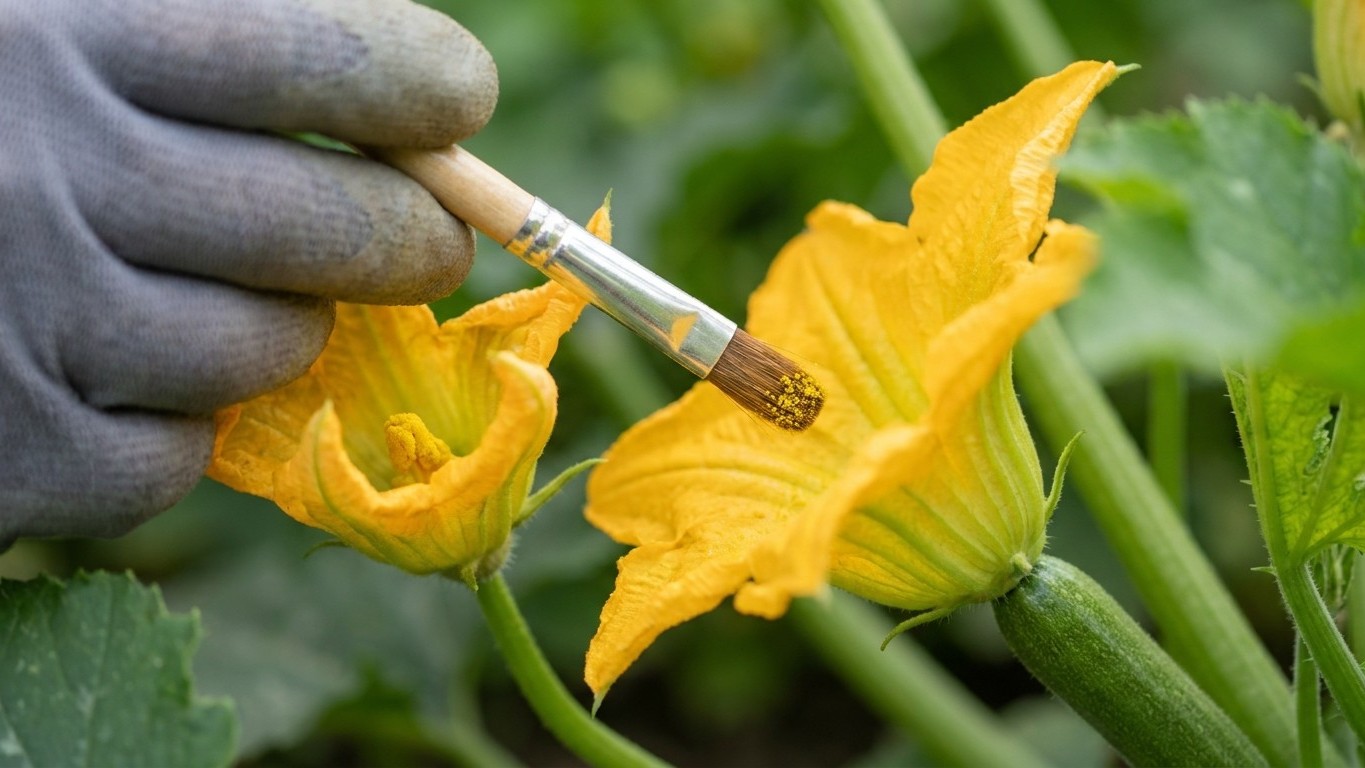
Once I understood the biology, the fix took less than five minutes a day. Go out early, ideally between 7:00 and 10:00 a.m., when the flowers are fresh and wide open. Find one open male, identifiable by its thin stem and a single pointy bit inside it covered in dust-like pollen, and one open female, marked by shorter, thicker bases, with a tiny, undeveloped zucchini sitting right behind each blossom. Snip the male, strip back its petals, and either touch the pollen-loaded center directly onto the female’s stigma or transfer it with a small paintbrush or cotton swab. It genuinely is as unglamorous as it sounds. One decent male flower can service 2 to 3 female flowers before its pollen runs out, so don’t feel guilty raiding a few for the cause, there are always more coming.
The payoff is fast once fertilization actually takes. Once a female flower is successfully pollinated, the fruit grows incredibly fast, and you’ll usually see a harvestable zucchini within 4 to 8 days. If instead the little fruit yellows and shrivels within a day or two, the pollination didn’t take, and you simply try again on the next female that opens. It’s not a design flaw. It’s the plant refusing to waste energy on something that has no future.
What was really behind my heat-wave theory
Heat wasn’t entirely innocent in my case, to be fair. Extension research shows temperature does affect pollen quality directly. Young zucchini fruits can fail to grow normally due to poor pollination from high temperatures and low bee activity. And extreme high temperatures, often exceeding 85°F to 90°F, can compromise pollen viability even when transfer happens successfully. So the heat wasn’t a lie, exactly, it was just one factor among several, and far from the main one. Watering habits matter too: plants watered inadequately produce smaller leaves and fewer flowers, leading to reduced pollination, because drought-stressed plants redirect resources from flower production to survival mechanisms. Overcrowded plants and pesticide use near open blooms compound the problem further, since insecticides other than insecticidal soap or horticultural oil shouldn’t be applied in the vegetable garden during the bloom period.
My zucchini patch is back to producing now, one plant giving me more squash than I can reasonably eat in a week. The strange part is how little effort the fix required once I stopped guessing. Five minutes with a paintbrush before the coffee finishes brewing, and the flowers that used to rot on the vine are turning into actual dinner. If your plant looks lush, blooms constantly, and still gives you nothing, skip the weather forecast and check the clock instead. Chances are the problem was never the sun. It was that nobody showed up on time.
Sources : bloomingexpert.com | hgtv.com