
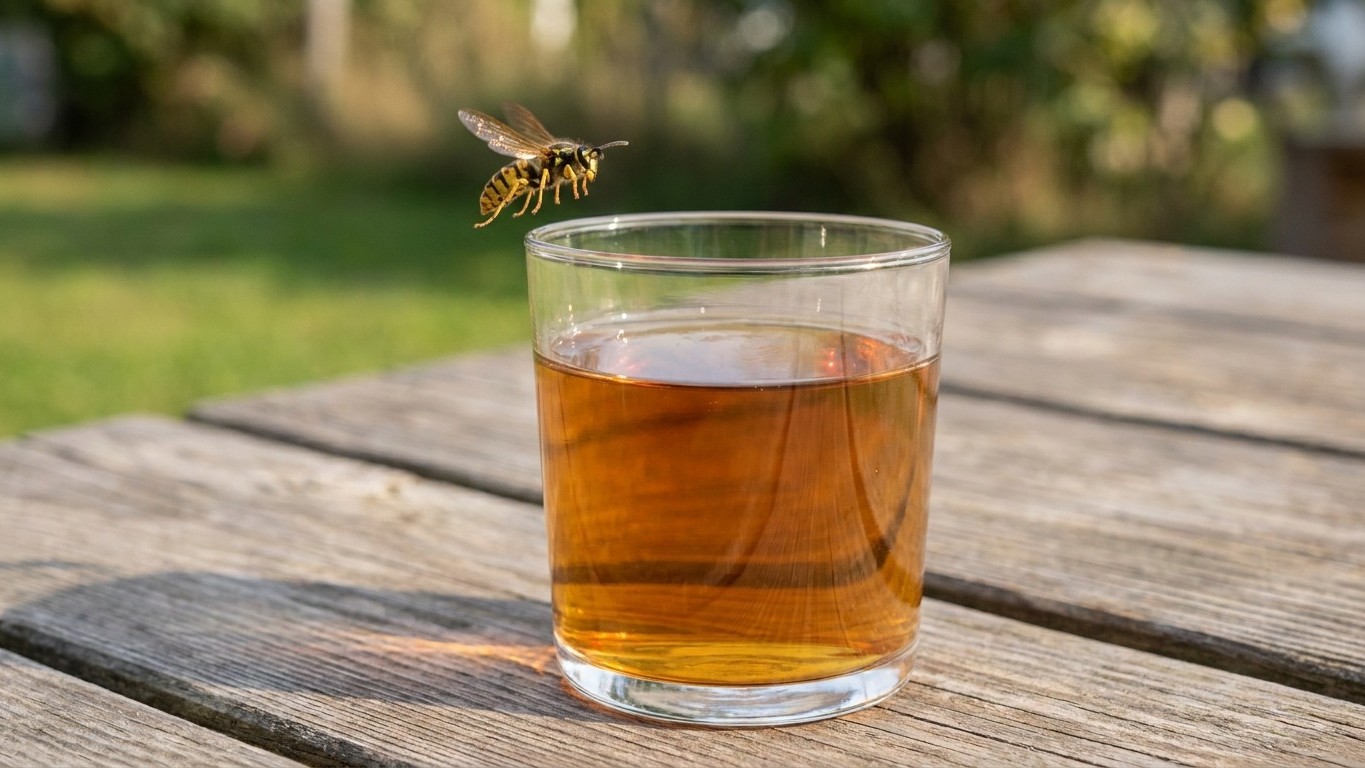
That soda you left on the picnic table for thirty seconds? By the time you reach for it again, three wasps are already inside the can. This isn’t random bad luck or a sudden outbreak of insect rudeness. It’s the tail end of a biological program that started months earlier, back when that same wasp was a diligent little pest-control worker instead of a drink thief.
The shift happens because the entire food economy inside a wasp nest collapses in late summer. For most of the season, adult wasps barely touch sugar at all. Adult worker wasps spend much of their time hunting other insects such as caterpillars, flies, and aphids, and these insects are not eaten directly by the adults. Instead, the captured prey is taken back to the nest and fed to the larvae, and as the larvae digest this protein-rich food, they produce a sugary liquid that the adult wasps consume. It’s a trade: protein goes in, sugar comes out, and everybody in the nest stays fed without ever raiding a human picnic. Researchers call this exchange trophallaxis, and the larvae offer a sugary food supply to the workers via this process.
Key takeaways
- A wasp nest’s internal food system completely changes in late summer—discover what triggers the shift
- Wasps aren’t becoming meaner; they’re operating under two critical pressures that rewire their entire behavior
- The science behind why wasps linger so long in your drink—and what it reveals about their desperation
The Nest’s Sugar Factory Shuts Down
Here’s what changes. Sometime in August, depending on the region and species, the queen slows down or stops laying eggs entirely. By late summer, new queens and males are produced, and the colonies begin to decline as the queens stop laying eggs. Fewer eggs mean fewer larvae. Fewer larvae mean less of that regurgitated sugar syrup that kept the workforce calm and fueled all summer.
The math is brutal for the colony. A single yellow jacket nest can hold 1,000 to 4,000 workers by the time it peaks in August, all of them accustomed to a steady internal sugar supply. When that supply dries up, adult wasps are forced to search elsewhere for energy, and this is when human environments suddenly become very attractive. Your backyard isn’t being targeted. It’s simply the nearest sugar source once the nest’s own pantry runs empty.
There’s a cruel irony here too: what wasps find in your trash can or beer glass is a poor substitute for what they lost. The larval liquid is an exceptionally high-quality sugar source, derived in part from chitin found in insect shells, and it provides adult wasps with everything they need to remain active, focused, and relatively calm. Soda and fruit punch don’t come close nutritionally. So wasps end up drinking junk food out of desperation, not preference, which explains why they linger so long and swarm so persistently around anything sweet.
Why This Also Makes Them Grumpier
Sugar scarcity is only half the story. The other half is what’s actually growing inside the nest at this point in the season. In late summer, the colony shifts from producing sterile workers to producing reproductive individuals, new queens and males, the colony’s genetic future. That single fact rewires worker behavior almost overnight. The workers become hyper-defensive of the nest because its contents have changed from replaceable workers to irreplaceable reproductive wasps.
So you get a double bind: hungrier wasps searching further from the nest for sugar, and more defensive wasps guarding a nest that now contains next year’s entire genetic lineage. Add to that the sheer population density. A pest control breakdown puts it plainly: the nest is at full capacity, resource demands are enormous, and thousands of foraging workers are competing for food, meaning more wasps equals more encounters with humans equals more stings. This is simple crowd math, not some late-season personality change.
None of this means wasps become malicious. Entomologists are careful about that distinction. When wasps get “aggressive,” it isn’t because they suddenly become mean, it’s that their tolerance for intrusion drops significantly. A wasp landing on your glass in July was probably scouting for caterpillars near your tomato plants. That same wasp in September is running on empty, defending a nest full of future queens, and reacting to your swatting hand like it’s an existential threat rather than a mild annoyance. Swatting, by the way, is exactly the wrong move: wasps interpret it as a threat and may sting.
What Actually Works Once You Understand the Signal
Knowing the biology changes how you should react. Wasps hovering over your lemonade aren’t hunting you, they’re running a failed sugar search that started with an empty larval feeding station back at the nest. That reframes the entire situation as logistics, not aggression, and logistics can be managed.
Cover drinks with a lid or a napkin between sips (wasps drowning in cans is one of the more common summer stings, since people don’t see them before drinking). Rinse recyclables before tossing them, since trash cans should be tightly sealed, and recyclables should be rinsed thoroughly to remove sugary residue. Clean up spills fast at cookouts, since if you’re dining outside or hosting a backyard cookout, cleaning up spills immediately and keeping food covered removes the incentive before it starts. And check your property now, before the population peaks further: look under eaves, around sheds, and in corners of outdoor furniture for early signs of nests.
The good news, if you can call it that, is temporary. This entire frantic phase is the colony’s death rattle. Once the new queens mate and disperse to find winter shelter, the rest of the colony, workers included, simply dies off with the first hard frost. The wasp drowning in your iced tea in late August has, at most, a few more weeks left to live, and it knows it on some biological level even if it can’t know it the way we do. That’s not an excuse to let it sting you. It’s just a reason to stop taking it personally.
Sources : hampshire-waspcontrol.co.uk | all-safe-pest.com