
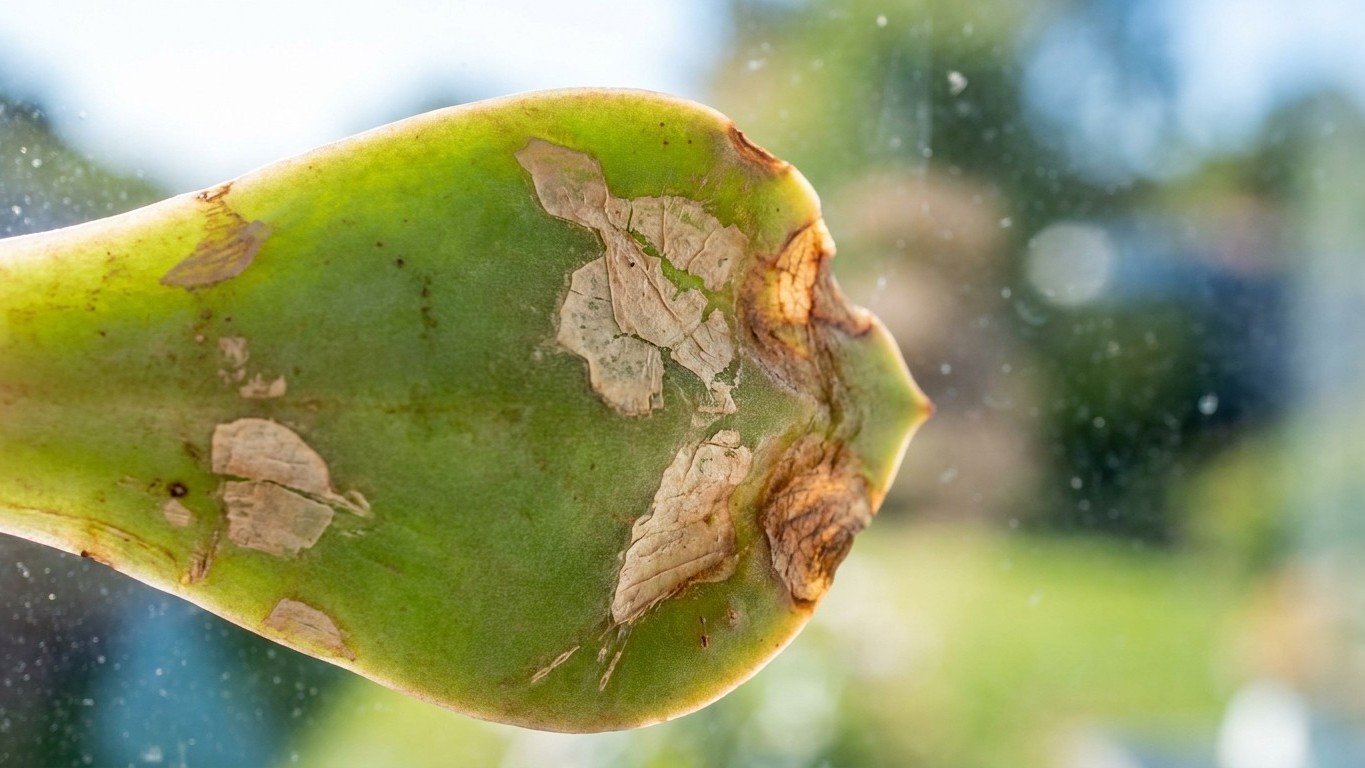
Sunscald on succulents is real, and a single afternoon in direct south-facing window light during late spring can cause damage that takes months to grow out. The leaves don’t wilt. They don’t wilt at all, they develop pale, papery patches that later turn brown or white, and no amount of water or fertilizer will reverse what already happened. The tissue is simply dead.
Key takeaways
- One afternoon in May can cause permanent damage that takes months to grow out
- The UV and heat intensity in May matches Miami in August, even in northern climates
- Glass amplifies both UVA radiation and heat—your plant’s leaves can reach 20-30°F above room temperature
Why May Is the Month That Catches Everyone Off Guard
Most indoor plant guides warn about summer heat, but May is quietly the most dangerous month for succulents on south-facing windowsills. The sun angle shifts dramatically between March and June, by late May, the sun tracks higher in the sky and the UV index in most of the continental US regularly hits 8 or above, which is classified as “very high” by the EPA. That’s the same UV level you’d find in Miami in August, even if you’re in Chicago or Denver.
Glass complicates things further. Standard window glass blocks most UVB radiation but lets UVA through almost entirely. UVA penetrates plant tissue and drives up surface temperature fast. A succulent leaf sitting against a south-facing pane on a clear May afternoon can reach surface temperatures 20 to 30°F above the ambient room temperature. The plant has nowhere to cool down. Unlike a cactus in the Sonoran Desert, which gets airflow, wind, and a natural acclimation process built over its entire outdoor life, your Echeveria or Sedum has been living in your 68°F apartment since October.
The acclimation gap is the real culprit. Succulents grown indoors over winter lose whatever sun tolerance they had built up. Researchers studying plant photoacclimation have found that the protective pigments, anthocyanins, carotenoids, that help succulents handle intense light can diminish significantly when the plant has spent months in lower-light indoor conditions. Then May arrives, the days lengthen, and the window becomes a solar oven.
What Sunscald Actually Looks Like (And What It Isn’t)
The damage pattern can fool you. Many people initially mistake sunscald for overwatering, because both can cause mushy or discolored leaves. The difference is location: overwatering damage tends to start at the base of the plant or at the soil level, working upward. Sunscald hits the top and outer leaves first, the ones most exposed to the glass, and the damage is almost always on one side, the side facing the light source.
Early-stage sunscald shows up as a slightly bleached or yellowish area. Within a day or two, it progresses to a dry, papery white or tan patch. In severe cases, the leaf collapses entirely in that spot. No recovery is possible on the damaged tissue itself. The plant will eventually grow new leaves from the center rosette, but depending on the variety and how many leaves were affected, you could be looking at a full growing season before the plant looks presentable again.
Some succulents, Haworthias and Gasterias in particular, are genuinely shade-tolerant and came from cliff faces and overhangs in South Africa where they almost never get direct sun. Placing those in a south window is a reliable way to destroy them. Aloes, Euphorbias, and most Crassulas can handle more light but still need gradual exposure, not an abrupt spring repositioning.
The Fix Is Simpler Than You’d Think
Moving the plant back from the glass by 12 to 18 inches makes a measurable difference. At that distance, light intensity drops considerably, light follows an inverse square relationship with distance, so even modest pullback reduces the intensity reaching the plant. You still get the bright indirect light that succulents genuinely need, without the amplified heat and direct UV exposure against the pane.
A sheer curtain is the other practical option. A basic white linen or polyester sheer cuts direct solar intensity by roughly 50 to 70% without meaningfully reducing the quality of ambient light. Succulents don’t need harsh direct sun indoors to thrive, they need bright, consistent light for most of the day. That’s a different thing entirely from pressing leaves against hot glass for six hours.
If you want to give your succulents actual sun exposure, the right approach is a slow outdoor transition. Start with one to two hours of morning sun (east-facing, where the sun is lower and cooler), then increase by an hour every few days over two to three weeks. Morning sun is genuinely gentler, the air temperature is lower, the UV index hasn’t peaked, and the angle is less intense. After that gradual process, most Echeverias, Sedums, and hardy cacti can handle full outdoor sun without damage.
A Note on South Windows in Older Homes
Single-pane windows, which are still common in pre-1980s American housing stock, transmit more thermal energy than double-pane insulated glass. If your apartment or home has older windows, the heat buildup against the glass is worse than average, even on a mild May day with outdoor temps in the 60s. Touching the glass on a sunny afternoon tells you everything, if it’s hot to the touch, your plant leaf pressed against it is essentially being slow-cooked.
There’s a useful asymmetry worth knowing here: succulents can recover from being slightly too far from a window (they’ll just etiolate slowly, reaching toward the light in a way you’ll notice over weeks), but they cannot recover from acute heat and UV damage. The stakes are not equal. Erring toward pulling them back is always the lower-risk position, and a grow light on a timer can compensate for any lost intensity if you’re worried about keeping them compact and well-formed through the summer months.