
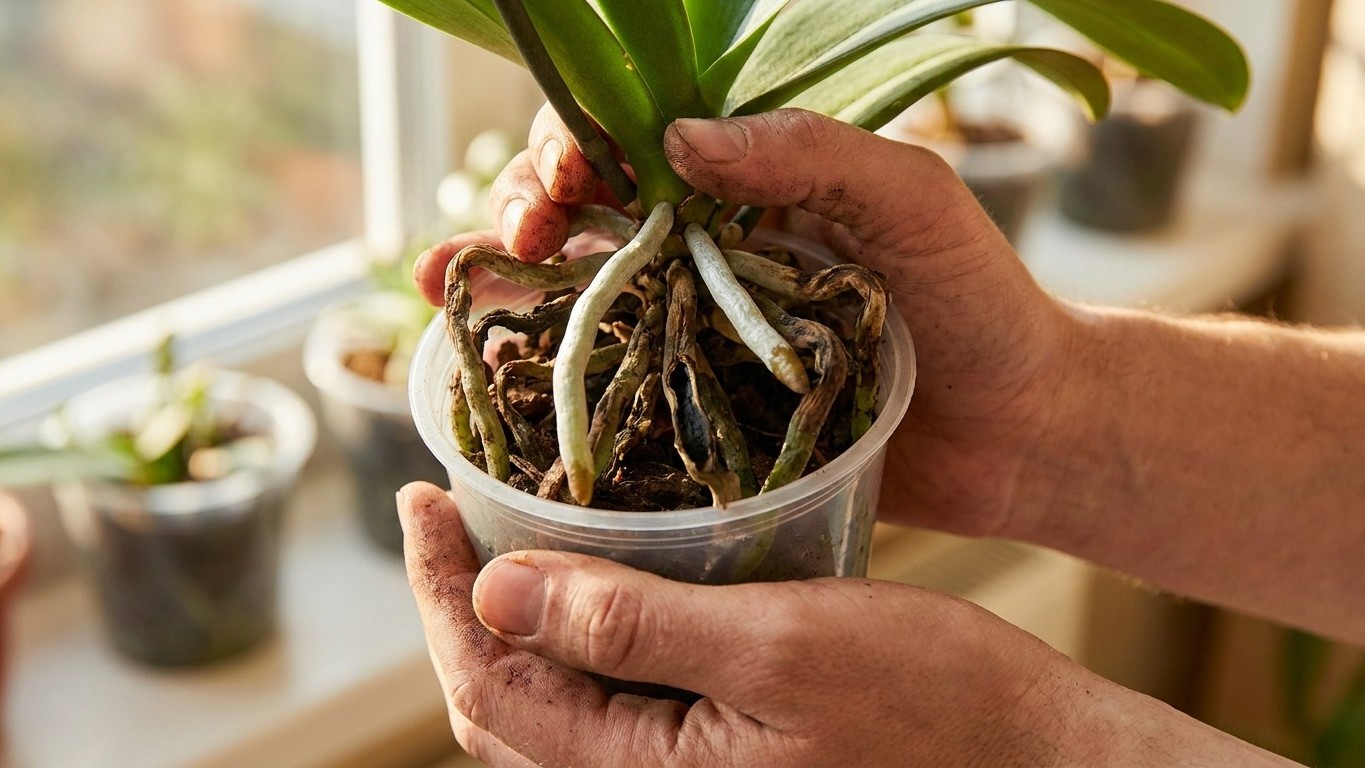
The card that came with the orchid said three ice cubes a week, so that’s exactly what happened, every Sunday morning, for months. When the plant finally slid out of its pot for repotting, the story the roots told didn’t match the tidy instructions on that little plastic tag. Where the cubes had been landing directly on exposed roots near the pot’s edge, the tissue was collapsed, blackened, and hollow. Somewhere between “convenient” and “correct,” something had gone sideways.
Key takeaways
- A trusted care hack left hidden damage invisible until the moment of truth at repotting
- University research blessed ice cubes as safe, but the studies skipped a critical detail
- The difference between thriving and destroyed roots comes down to four inches and one overlooked variable
What the science actually says about ice and orchids
The most-cited research on this comes from a joint study by Ohio State University and the University of Georgia, published in HortScience in 2017. Researchers conducted experiments at The Ohio State University and the University of Georgia, evaluating forty-eight Phalaenopsis orchids at both locations for four to six months, with half receiving ice cube irrigation and the other half receiving the equivalent amount of room temperature water. The results were, on paper, reassuring: the orchids irrigated with ice cubes had the same flower longevity and display life compared to plants irrigated with room temperature water.
The temperature data explains why. The temperature of the bark media during ice cube irrigation dropped to only 51–56°F, then returned to the original pre-irrigation temperature of 70°F five hours after the application of ice cubes, meaning roots in the bark media were never exposed to freezing temperatures. Even for aerial roots that touched the ice directly, internal root temperature dropped to around 40°F, and isolated root segments showed no damage from cold until temperatures reached 20°F, well below what roots experience during 5 or 6 hours of ice cube exposure. On those numbers, the ice tray shouldn’t be the villain.
So why did the roots look wrecked?
The gap between lab results and my own pot comes down to placement, media, and repetition, three variables the tidy headline version of the study tends to skip. One orchid grower who has spent years rehabilitating other people’s neglected plants described the pattern bluntly: ice does damage roots that it touches directly, especially those potted in sphagnum moss, and the top roots and leaves near the top of the media are always terribly damaged, blackened and hollow. That’s almost a photograph of what I found when I lifted the plant out.
Sphagnum moss is the quiet culprit here. Unlike loose bark, which drains fast and lets a cold spot dissipate, moss holds both water and cold against root tissue for far longer. A more recent breakdown of the research flagged exactly this blind spot: the original university study did not test sphagnum moss media, which holds cold longer and keeps roots chilled well after the ice melts, nor genera native to higher elevations, nor aerial roots growing outside the pot that come into direct contact with ice, nor multi-year effects. My plant had been repotted into moss at some point before it reached me, and its aerial roots draped right over the rim, precisely where a distracted Sunday-morning hand tends to drop a cube.
Root biology also punishes repeated small injuries in a way a single bad watering session wouldn’t. Orchid roots don’t self-repair once damaged. As one grower explained, all root growth occurs at the tip of a root, and once formed, an older root won’t fix damage to it, though it might start growing a side branch to make a new root tip. Every cube that landed on the same exposed root, week after week, was another strike against tissue that had no way to heal itself, only to be abandoned and replaced.
Getting the routine right without guessing
None of this means the ice tray deserves to be banned outright. It means the placement matters more than the marketing ever let on. Orchid retailers who’ve studied the method closely are specific about this: always set ice cubes on top of the potting bark or moss, positioning them away from the crown, stem, and any visible aerial roots. That single rule, ignored on a rushed Sunday, is probably what turned a harmless habit into a slow injury.
The American Orchid Society, for its part, hasn’t come around to the ice-cube shortcut. Independent write-ups note that the American Orchid Society, with no ice to sell, still lists cold among the things Phalaenopsis handle poorly. Their preferred alternative is unglamorous but reliable: a genuine soak-and-drain, running room-temperature water through the bark until it flows freely from the drainage holes, then letting every last drop escape so nothing pools around the roots. It solves the same problem the ice cube was invented for, controlling how much water a notoriously overwatering-prone plant actually gets, without introducing a temperature swing at all.
If the ice-cube habit is what keeps a watering schedule on track, it doesn’t have to be abandoned entirely. The fix is smaller than that: check the potting medium (bark, not moss, drains cold faster), rotate where the cubes land instead of hitting the same spot weekly, and keep them well clear of any root that has pushed outside the pot into open air. The difference between a healthy root system and a blackened one, it turns out, isn’t the ice itself. It’s four inches of placement.
Sources : greenhousegrower.com | bloomingexpert.com