
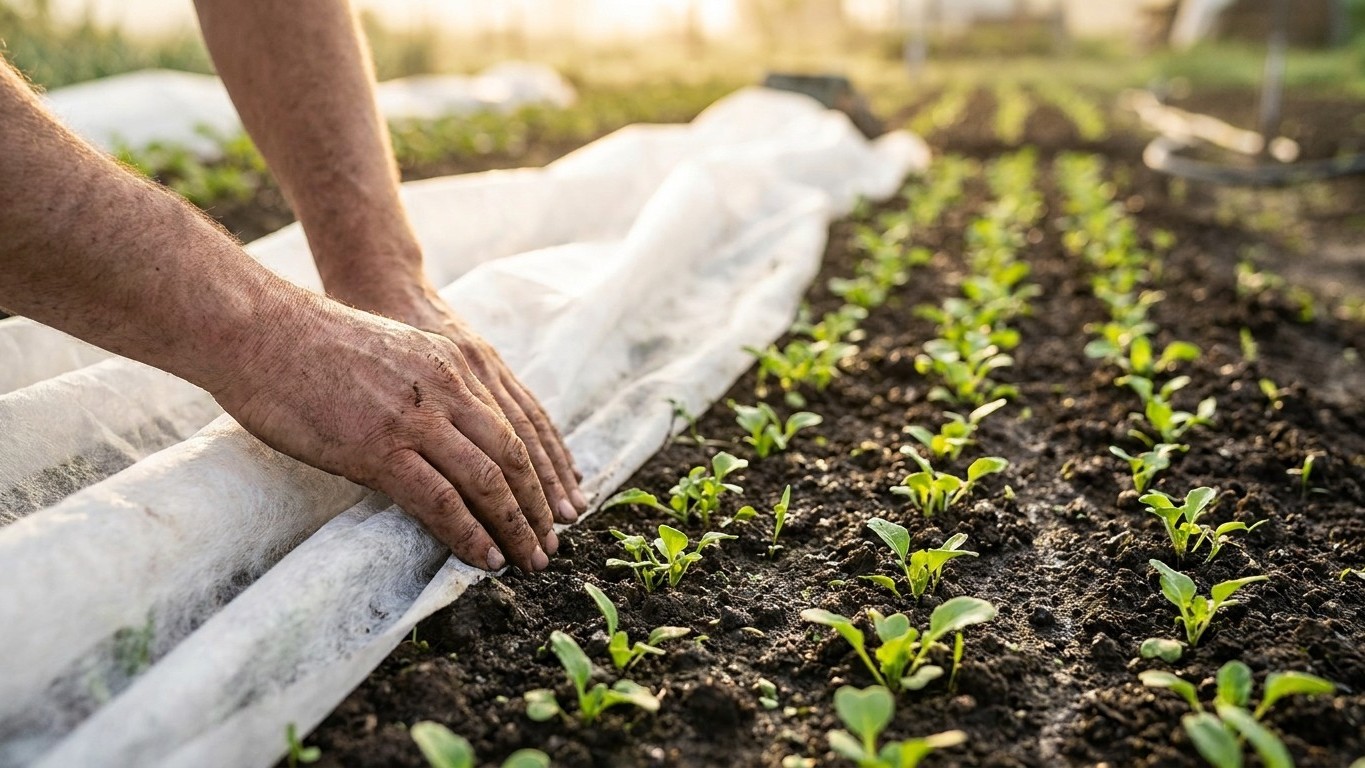
Ask any market gardener why their arugula comes out of the ground clean while a neighbor’s plot looks like it survived a shotgun blast, and the answer is almost always the same: timing. Flea beetles can be controlled by covering the crop with floating row covers from the day of sowing. Not the next morning. Not “sometime this week.” The day the seed hits the soil.
That distinction sounds fussy until you understand what you’re up against. Flea beetles are barely bigger than a poppy seed, but it is critical to seal the edges immediately after seeding or transplanting, because brassica seeds germinate quickly and beetles rapidly find the cotyledons. Arugula is a brassica, and its cotyledons, those first tender seed leaves, are basically a welcome mat for these pests. Miss the window by even a day or two after germination, and you’ve already lost the fight.
Key takeaways
- A single day separates perfect arugula from lace-like leaves riddled with flea beetle holes
- These pests don’t require a distant invasion—they’re already sleeping in your soil, ready to attack
- A gap the width of a pencil in your row cover edge is enough to lose the entire battle
Why the beetles win if you’re late
These insects don’t fly in from far away. They overwinter right in your soil or the leaf litter at the edge of the field, then wake up hungry. They overwinter in soil as adult beetles and emerge early in the spring to lay eggs around plant bases, and eggs mature into adults in three to four weeks, leaving time for as many as three generations per season. That’s the part growers underestimate: this isn’t one wave of pests to dodge, it’s a rolling siege that can hit the same bed three times before summer’s out.
Temperature drives the timing. Flea beetle populations thrive in warm, dry weather, with most activity occurring when daytime temperatures reach above 65°F (18°C); cool, wet conditions can reduce movement and feeding, but a stretch of warm, sunny days quickly boosts their numbers. A single sunny weekend in April can flip a quiet bed into an active feeding ground. And once they’re established, the damage isn’t subtle. These tiny 1.5-3mm shiny black beetles almost exclusively attack cruciferous vegetables and can cause significant stress to well-developed plants, sending them into “survival mode” and limiting growth. Young, freshly sprouted seedlings are even more exposed, since flea beetles may also attack newly sprouted seedlings that have not yet developed their true leaves.
The mechanics of a same-day cover
A floating row cover works because it’s a physical wall, not a repellent. Applying a lightweight floating row cover forms a barrier that physically blocks flea beetles from reaching your crops, and this technique works best when you install the cover directly after sowing or transplanting, and when the edges have a tight seal against the soil. That seal matters more than the fabric itself. Flea beetles can fit through extremely tiny cracks, so edges of the cover must be sealed on all sides using soil, or some other method, to ensure a consistent and complete “bead” of contact with the ground. Sandbags, boards, or a simple trench of soil along the perimeter all do the job, but a gap the width of a pencil is an open door.
Weight and material matter too. Lighter fleece covers offer some frost protection but tear easily and don’t hold up as a long-term insect barrier, while a proper mesh or spun-polyester cover stays intact for weeks. Spun polyester that both light and water can permeate effectively excludes flea beetles from your crops, and you can lay it right over low-growing crops like arugula, or use lightweight hoops to help it float above larger crops so it protects them without inhibiting their growth. Independent field trials back this up: researchers who grew arugula and mizuna mustard greens in replicated experimental plots in the spring and fall found that in most cases, plants within the Agribon and ProtekNet row cover treatments had the least amount of flea beetle damage and the highest yields, while essential oil treatments and organic insecticides did not differ from unsprayed, uncovered control plots. sprays that promise a quick fix mostly don’t outperform doing nothing. The cover is the intervention that actually moves the needle.
What happens after the first cut
Here’s a detail that trips up even experienced growers: the job isn’t finished after the first harvest. On-farm research from Iowa found that re-covering the arugula after first harvest resulted in significantly fewer holes from flea beetle feeding at both farms tested. The team behind that trial concluded that re-covering arugula after first harvest is prudent when flea beetle pressure is heavy but may not be worth the effort when flea beetle pressure is minimal. That’s a useful, unglamorous rule of thumb: watch your pressure levels before deciding whether the extra labor of pulling the cover back on is worth it.
Since arugula doesn’t need pollinators to produce the leaves you’re selling, there’s little downside to leaving the cover on for the entire cropping cycle. Compare that to squash or cucumbers, where vegetables that need to be pollinated to produce their crop require you to remove the covers when the plants begin to flower, allowing pollination to occur. Arugula skips that complication entirely, which is part of why it’s such a forgiving crop for cover-based pest control.
Beyond the fabric
Row cover isn’t the only lever growers pull. Seasoned market farmers have noticed that the first generation of beetles, in spring, tends to be the most damaging, while fall plantings of arugula are often beetle-free. If your spring bed always ends up lace-like no matter what you do, shifting a chunk of your arugula succession to late summer sowings might spare you the headache altogether. Crop rotation and fall tillage also matter, since disturbing the soil where beetles overwinter cuts down next year’s population before it ever emerges. And if some shot-holing does slip through, take heart: in many cases flea beetle damage is cosmetic, and simply cooking greens with a few holes in them makes the blemishes disappear.
One nuance rarely mentioned: a cover left in place too long without rotation can backfire. Exclusion can be worse than ineffective in the absence of crop rotation if larvae of the next generation emerge from the soil under the cover, which now serves to protect them from any predation and restricts their feeding to only that crop. A row cover buys you protection from the outside world, but it can’t fix a bed that’s already hosting the enemy underground.
Sources : practicalfarmers.org | ncbi.nlm.nih.gov