
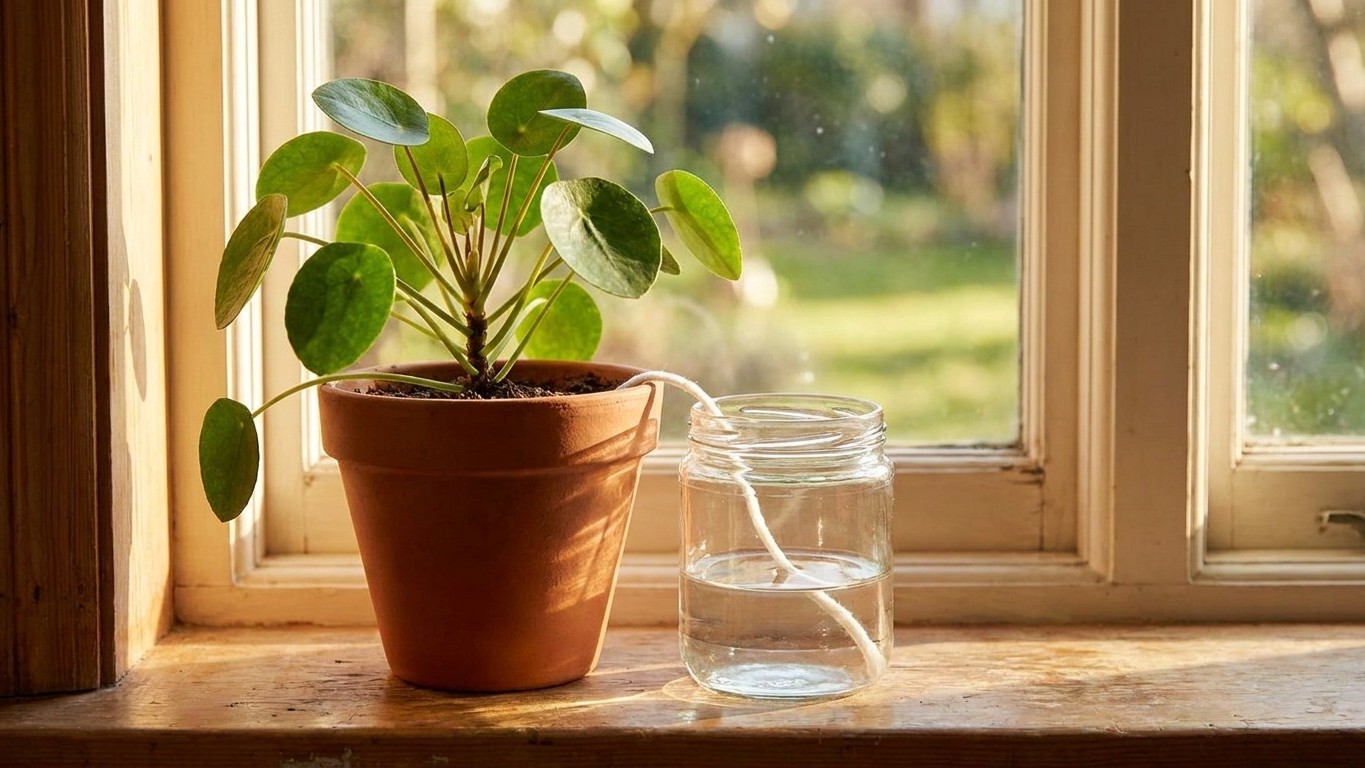
Four days into a trip, the plants back home were still fine. Not “barely surviving” fine, but genuinely turgid, soil still dark with moisture, leaves upright on the sill where the afternoon sun usually turns Everything brittle by day three. The reservoir glasses sat mostly full, wicks disappearing into them like straws into a drink nobody was rushing to finish. That’s when it clicked: the glass wasn’t dispensing water on a timer. It was simply waiting, letting the plant decide how thirsty it actually was.
Key takeaways
- The wick doesn’t follow a timer—it responds to how dry the soil actually gets
- Glass choice and reservoir sizing matter more than how full you fill it
- Most setups fail because the soil composition or wick thickness wasn’t tested before departure
The wick does the thinking, not the glass
A wick system works through capillary action: a porous cord, typically cotton, nylon, or acrylic, draws water from a reservoir upward into dry potting mix, delivering moisture directly to plant roots on demand. The glass, in that setup, has one job: hold still and stay full enough for the cord to keep touching water. Everything else, the pacing, the volume, the timing, gets handled by the interaction between soil dryness and the fibers of the wick itself.
That’s the part that’s easy to miss when you’re prepping for a trip. It feels like you’re the one doing the work, filling every reservoir to the brim the night before, checking wick placement twice. But it doesn’t eliminate watering, it shifts responsibility from frequency to reservoir management. The actual delivery, the moment-to-moment decision of how much water a root zone gets, happens without you. As the potting mix dries and its own capillary pull strengthens, it draws more aggressively from the wick. When the soil is still damp, that pull weakens, and the flow slows down almost to nothing. It’s a feedback loop, not a faucet.
Why the glass matters more than it looks like it does
Container choice isn’t incidental. Comparisons between glass and plastic reservoirs consistently favor glass, and part of that comes down to visibility and stability rather than the water itself. Glass globes perform better than cheap plastic ones, though in sandy or very loose soil, globes drain within a day and are not reliable. A wide-mouthed glass gives you a straightforward visual check, too: you can see the waterline drop over days without disturbing the wick, which matters when you’re gone long enough that a mid-trip refill isn’t an option.
There’s a physical reason the setup keeps working even when the glass sits several inches below the pot. Wick watering can work by capillary flow that goes up and over a rise, resulting in a slow flow, or by gravity flow, where water runs down the wick, producing a fast flow, or by a hybrid of both. A glass on a windowsill, positioned at roughly the same height as the pot or slightly below it, tends to run on that slower capillary flow, which is exactly why the soil doesn’t drown. One documented test found water in a 7/16-inch braided nylon rope rose 10 inches in 100 minutes and 22 inches in 20 hours, which gives a rough sense of how unhurried this process really is. It’s not built for speed. It’s built for consistency.
Setting it up so it actually holds for the length of your trip
The instinct to top off every glass the night before makes sense, but the setup matters more than the fill level. A functional wick system generally needs four things in place: a growing bed that holds the potting soil and plants, potting soil with the right nutrient mix, a water reservoir where the water is stored, and the wicking system that delivers water from one to the other. Skip the reservoir sizing step and even a perfectly placed wick runs dry before you’re back.
A few practical details separate a system that coasts through a week from one that fails on day three:
- Use a wick with enough surface contact, thin ones lag on fast-draining mixes, so pushing the cord only partway into a succulent’s pot, rather than deep, actually keeps the soil drier and safer, according to horticultural advice shared on garden forums.
- Prime the wick first. Running it through water briefly before burying the other end starts the capillary pull immediately instead of leaving the plant to wait for the fibers to saturate.
- Match the reservoir size to the trip. Free methods like string wick watering work well for trips up to 5 days, while a $10 to $15 terracotta spike with a recycled wine bottle handles most medium pots for up to 2 weeks.
Testing before you leave isn’t optional if the trip matters. Test your chosen method two days before leaving, run it while still at home, and fix what fails. That two-day dry run is what catches a wick that’s too thin, a glass positioned wrong, or a plant that drinks faster than the setup can keep up with, long before it becomes a problem you find out about from a suitcase five states away.
Where the glass method runs out of road
None of this means wicks are foolproof. Soil composition still runs the show underneath the mechanics. Compacted or overly fine mix chokes the capillary pathway, while loose, fast-draining mixes can pull water faster than the wick can supply it. Wick diameter, soil composition, pot size, ambient humidity, and plant species all determine performance, and an oversized wick can drown roots while too thin a wick or compacted soil leads to chronic drought stress. A single wick-and-glass setup on a bright windowsill also behaves differently than the same setup in a shaded hallway, since heat and light pull moisture out of soil faster than a slow capillary drip can always replace it.
The plants that tolerate this hands-off approach best tend to be the ones that already prefer even, unfussy moisture rather than a dry-out cycle between waterings. Smaller leafy plants like baby’s tears and coleus, along with larger thin-leaved plants such as Boston ferns, peace lilies, and umbrella palms, are the reliable candidates. Cacti and succulents, which want their soil to dry out fully between drinks, are usually the ones that suffer when a wick keeps them just a little too damp for a little too long. Knowing which category your plants fall into, before you fill a single glass, matters more than how full you make it.
Sources : gardentruth.com | lifetips.alibaba.com