
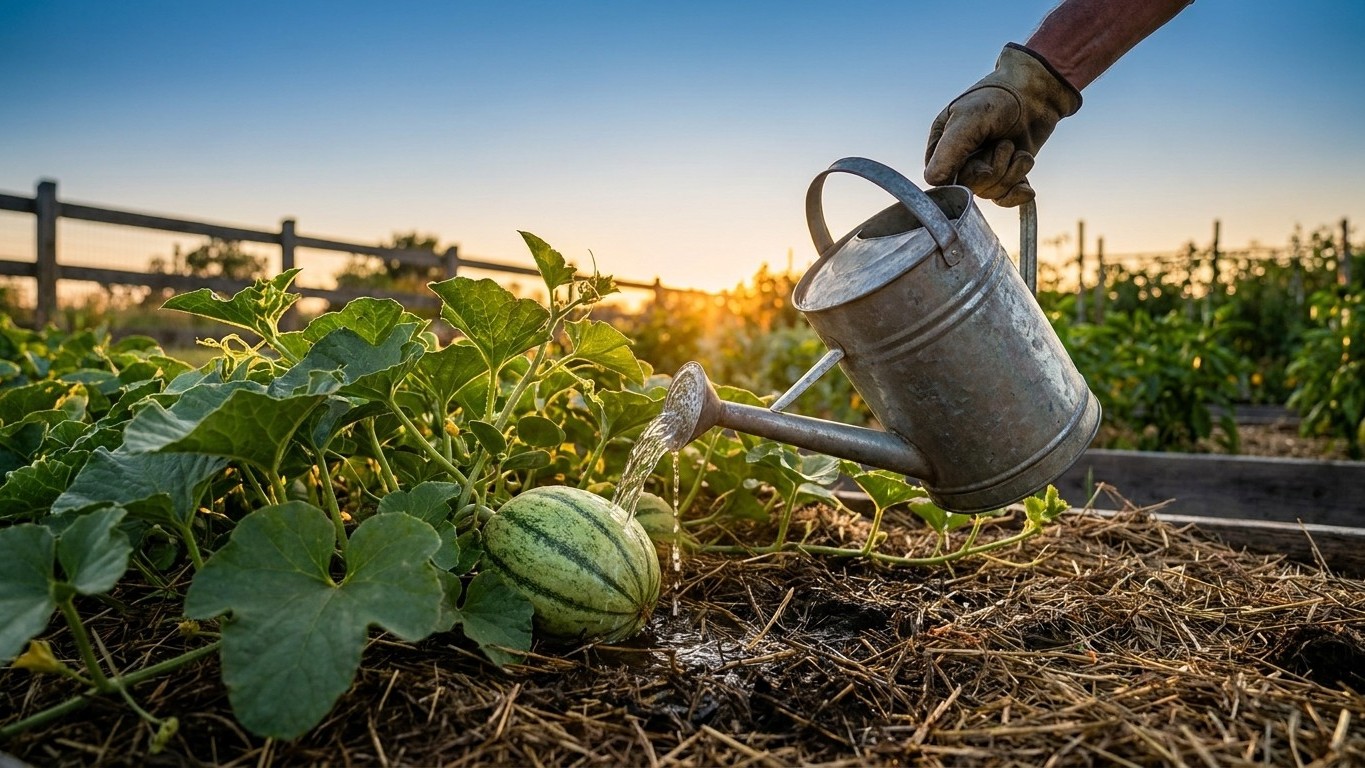
A neighbor who waters his melons every evening, rain or no rain, isn’t wasting water or babying his plants. He’s protecting them from one of the most common and frustrating problems in melon growing: splitting. And once you understand the mechanism behind it, that nightly ritual with the watering can starts to look less like habit and more like precision gardening.
Key takeaways
- Melons split when soil moisture swings from dry to suddenly saturated, not from bad luck
- Evening base watering keeps leaves dry while preventing the fungal diseases that rain triggers
- Consistent moisture trains roots deep and keeps flavor intact, even when storms arrive unexpectedly
The real target isn’t the leaves, it’s the fruit’s skin
Melon splitting happens for a specific reason, not bad luck. It occurs when the fruit absorbs too much water too quickly, often after irregular watering schedules or heavy rainfall. Picture a melon that’s been sitting in slightly dry soil for a week. A sudden downpour hits, and the fruit’s flesh swells faster than its rind can stretch to accommodate it. The result is a crack running across the surface, sometimes deep enough to ruin the whole fruit.
A gardener who waters lightly every single evening never lets the soil swing between dry and saturated. By maintaining a consistent watering routine, the risk of splitting drops and fruit development becomes more uniform. When rain does arrive, the soil is already at a stable moisture level, so the extra water doesn’t trigger the same shock to the fruit. The evening top-up is basically insurance against whatever the sky decides to do next.
This is also why experts specifically flag rainfall as a trigger to watch, not ignore. Overwatering during the fruiting stage can lead to splitting, and general guidance suggests gardeners should monitor rainfall and reduce irrigation if heavy rain is expected to avoid overwatering. A disciplined neighbor who waters a little every evening is threading a needle: keeping soil moisture steady without dumping on excess volume that would compound with a storm.
Why evening, and why at the base
The timing isn’t arbitrary either. Melon vines are notoriously prone to fungal trouble, and how you deliver water changes the odds dramatically. Melons are very vulnerable to downy mildew, a fungus favored by wetting the leaves, which causes brown spots on the foliage. Powdery mildew works almost in reverse: its spores germinate on dry leaf surfaces when humidity is high, but not on wet leaves. That contradiction is exactly why the technique matters so much. The trick isn’t wet versus dry leaves in general, it’s keeping the leaves out of the equation entirely.
That’s the logic behind watering at the base rather than overhead. The recommended approach is to water only at the base of the plant, in the evening, and avoid wetting the leaves. Done this way, evening watering sidesteps both fungal traps at once. The soil absorbs moisture overnight when evaporation is lowest, the roots get what they need, and the canopy stays dry enough to discourage both diseases.
There’s a pest angle too, one that rarely gets mentioned. Wet leaves can attract pests: whiteflies congregate on the undersides of leaves and fly up when disturbed, and leafhoppers are similarly drawn to wet foliage. So a neighbor who’s careful to soak only the soil around the stem isn’t being fussy. He’s running a small-scale integrated pest management program without probably ever using that phrase.
Deep roots matter more than daily drama
Small, frequent watering at the base also trains the root system in a way that sporadic deluges never will. One backyard grower’s method reflects this directly: watering at the base of raised beds or around the mounds, never directly on the crown of the plant, encourages deep roots and prevents sudden temperature drops in the root zone. Shallow, frequent sprinkling with a hose can actually work against you if it never penetrates past the top layer of soil. The goal with a nightly ritual is depth and consistency, not surface dampness.
The stakes are real enough that entire farming regions have been burned by getting this wrong. In Georgia, one particularly wet season pushed the watermelon harvest weeks behind schedule and hurt quality across the board. Due to excess rainfall late in the fruiting stage, watermelons swelled with water faster than they could produce sugar, decreasing flavor. A grower quoted at the time put it bluntly: “If you get a lot of rain, the melons will fill up with water and that makes it hard to sell them because the grade goes down.” That’s the commercial-scale version of exactly what a home gardener is trying to avoid with a modest can of water each evening.
Disease pressure from rain compounds the flavor problem, too. As one University of Georgia extension horticulturist explained about wet vines, “even when we have warm sunny days we get those afternoon thunderstorms, and that’s just as bad because the vines go into the nighttime wet.” Wet foliage overnight is a greenhouse for pathogens, which is one more reason a controlled, base-level watering habit beats leaving everything to chance.
Copying the habit without overdoing it
None of this means dumping gallons on melon plants nightly regardless of conditions. The consensus among growers is to water deeply once a week, keeping soil moist but not soggy, then fine-tune with smaller, targeted amounts as weather shifts. Mulch helps stabilize that baseline too: organic mulch around melon plants helps regulate soil moisture, preventing sudden changes that lead to splitting. Combine a mulched bed with light, base-level evening watering, and the plant almost never experiences the moisture whiplash that causes cracked fruit or fungal outbreaks.
The neighbor’s ritual, then, isn’t superstition or overcaution. It’s a low-effort way of controlling one variable, soil moisture, so that rain becomes a bonus rather than a threat. Next time it looks like he’s out there with a can while storm clouds gather, he’s not fighting the forecast. He’s making sure the forecast doesn’t get the last word on his harvest.