
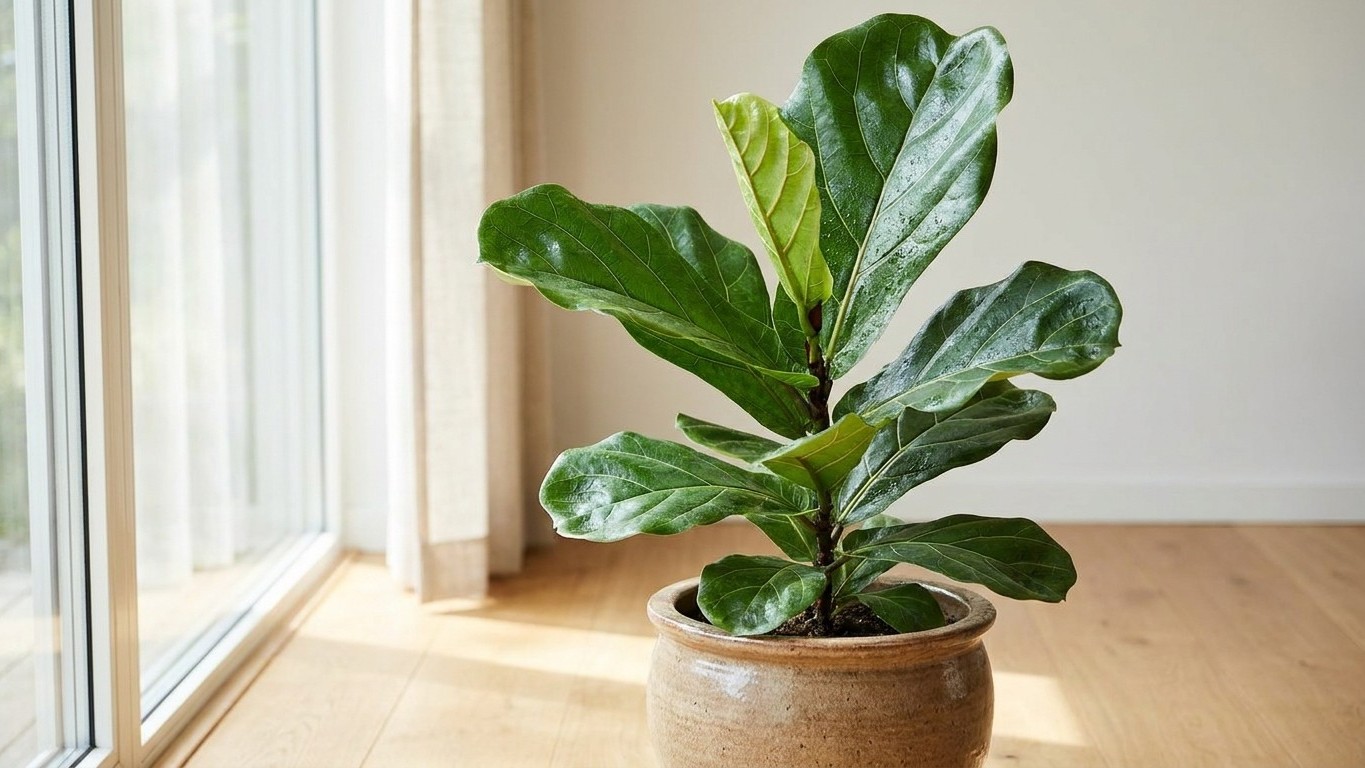
Two years of weekly rotations. A precise quarter-turn every Sunday morning, religiously tracked, because every plant guide on the internet insisted it was necessary for even growth. Then life got busy, the routine slipped, and three weeks passed without touching the pot. That’s when the new leaf appeared, a glossy, perfectly formed fiddle leaf unfurling as if it had been waiting for permission.
This isn’t a fluke. A growing number of fiddle leaf fig owners report the same pattern: obsessive care routines interrupted by neglect, followed by sudden bursts of growth. The explanation, once you understand how Ficus lyrata actually processes its environment, makes complete sense.
Key takeaways
- Weekly rotations create perpetual stress that redirects plant energy away from growth
- Plants enter conservation mode when they detect repeated environmental disruption
- A single large change followed by stability outperforms gradual adjustments over time
The rotation habit that backfires
Fiddle leaf figs are native to the tropical rainforests of West Africa, where they grow as understory trees beneath a relatively stable canopy. The light they receive doesn’t shift dramatically from week to week. Their root systems establish deeply, their orientation to the sun stays consistent for months, sometimes years. Frequent repositioning mimics nothing in their natural habitat.
Here’s what actually happens when you rotate a fiddle leaf fig every week: the plant is perpetually recalibrating. Each leaf has already begun orienting its chloroplasts, the light-capturing structures inside leaf cells, toward the dominant light source. Move the plant, and those leaves are suddenly receiving light from the wrong angle. The plant redirects energy toward reorientation rather than new growth. You’re essentially giving it motion sickness on a weekly cycle.
The rotation advice itself isn’t wrong in principle. A slow, gradual rotation over several months can help prevent a heavily lopsided plant. The problem is the frequency. A quarter-turn every week is far too aggressive for a species that responds to change with stress, not adaptation.
Why stress suppresses new leaf production
Fiddle leaf figs are notoriously sensitive to environmental changes, this is well-documented among horticulturalists and is the primary reason they drop leaves when moved between rooms. That sensitivity extends to subtler disruptions too. Vibrations from being lifted and repositioned, changes in airflow patterns around the leaves, and even the shift in humidity caused by moving a pot away from a wall can register as stressors.
When a plant detects repeated stress signals, it enters a kind of conservation mode. Resources get redirected to maintaining existing leaves rather than producing new ones. The plant isn’t being dramatic; it’s being logical. Growing a new fiddle leaf fig leaf requires significant energy, those large, waxy leaves can span 18 inches or more, which is metabolically expensive to produce. A plant that perceives itself as unstable won’t commit to that investment.
Cortisol is the human equivalent here: chronically elevated stress hormones suppress growth functions in favor of immediate survival. Plants operate on similar triage principles, even if the biochemistry differs. Auxin, the primary growth hormone in plants, distributes unevenly when light direction keeps shifting, which disrupts the apical dominance that drives upward growth and new leaf formation at the growing tip.
What “leaving it alone” actually means
Stopping the rotations is only part of the story. The broader principle is consistency across all variables. Light source, watering schedule, temperature, pot position, when these remain stable, the plant stops spending energy on recalibration and starts spending it on growth.
A fiddle leaf fig placed in a bright, indirect light spot and left completely undisturbed will typically show new growth within four to eight weeks, assuming other conditions are adequate. The key word is undisturbed. This means resisting the urge to move it away from drafts occasionally, or to pull it closer to the window on cloudy days. Every adjustment resets the clock.
Watering frequency matters too, but not in the way most guides suggest. The common advice to water when the top two inches of soil are dry works reasonably well, but the consistency of the schedule often matters more than the precise timing. A plant that receives water every 10 days like clockwork will usually outperform one that gets watered “when it needs it” based on daily soil checks, because the daily touching and tilting adds up to a lot of low-grade disturbance.
Root stability plays a direct role in this. Fiddle leaf figs signal readiness to grow new leaves partly through root health. A pot that gets shifted around develops roots that have to constantly reanchor, which delays the kind of settled, confident root system that supports vigorous top growth. Leaving the pot in one place long enough for roots to establish against the pot walls creates a feedback loop where above-ground growth accelerates.
The counterintuitive lesson for plant care in general
Fiddle leaf figs exposed this logic clearly, but the same principle applies across a surprising range of houseplants. Monstera deliciosa, pothos, and even orchids tend to spike in growth after periods of benign neglect following over-management. The pattern suggests that attentive plant owners often do more harm than good, not from ignorance, but from applying human logic, more effort equals better results, to organisms that evolved without any human involvement at all.
The plant care industry, for its part, has an incentive to sell complexity. Products, accessories, schedules, and gadgets all imply that thriving plants require constant intervention. The fiddle leaf fig, that notoriously difficult diva of the houseplant world, turns out to be mostly asking for one thing: to be left where it is.
One detail worth keeping: if you do eventually need to move your fiddle leaf fig, repotting, a new apartment, a different room, do it all at once rather than in gradual stages. A single large disruption followed by extended stability produces better outcomes than a series of smaller adjustments spread over weeks. The plant recovers from one event. It struggles to recover from an event that never quite ends.