Cinnamon became the internet’s favorite rooting hack somewhere around 2019, and it never really left. Gardening forums, YouTube thumbnails, TikTok reels, the advice spread like wildfire: dust your cutting with cinnamon before sticking it in soil, and watch the roots pour in. Antifungal properties, they said. Natural rooting powder substitute, they said. Except the reality playing out in propagation trays across the country tells a messier story.
Key takeaways
- Cinnamon’s antifungal power targets the wrong tissue at the wrong time—the callus layer that must form before roots can emerge
- A peer-reviewed study showed cinnamon cuttings had zero rooting advantage over plain water, while commercial rooting hormone significantly outperformed both
- Dose matters critically: thin-stemmed cuttings dosed with cinnamon may never root, but the same treatment barely affects woody stems
What Cinnamon Actually Does to a Cutting
Cinnamon does have genuine antifungal properties. That part is true. The active compound, cinnamaldehyde, inhibits fungal growth effectively enough that it’s been studied in agricultural contexts for crop protection. But here’s where the popular advice quietly skips a step: a cutting isn’t a full plant. It’s a wound. And when you apply a potent antimicrobial agent to a fresh wound, you’re not just targeting fungi, you’re hitting the callus tissue that forms first, before any roots can develop.
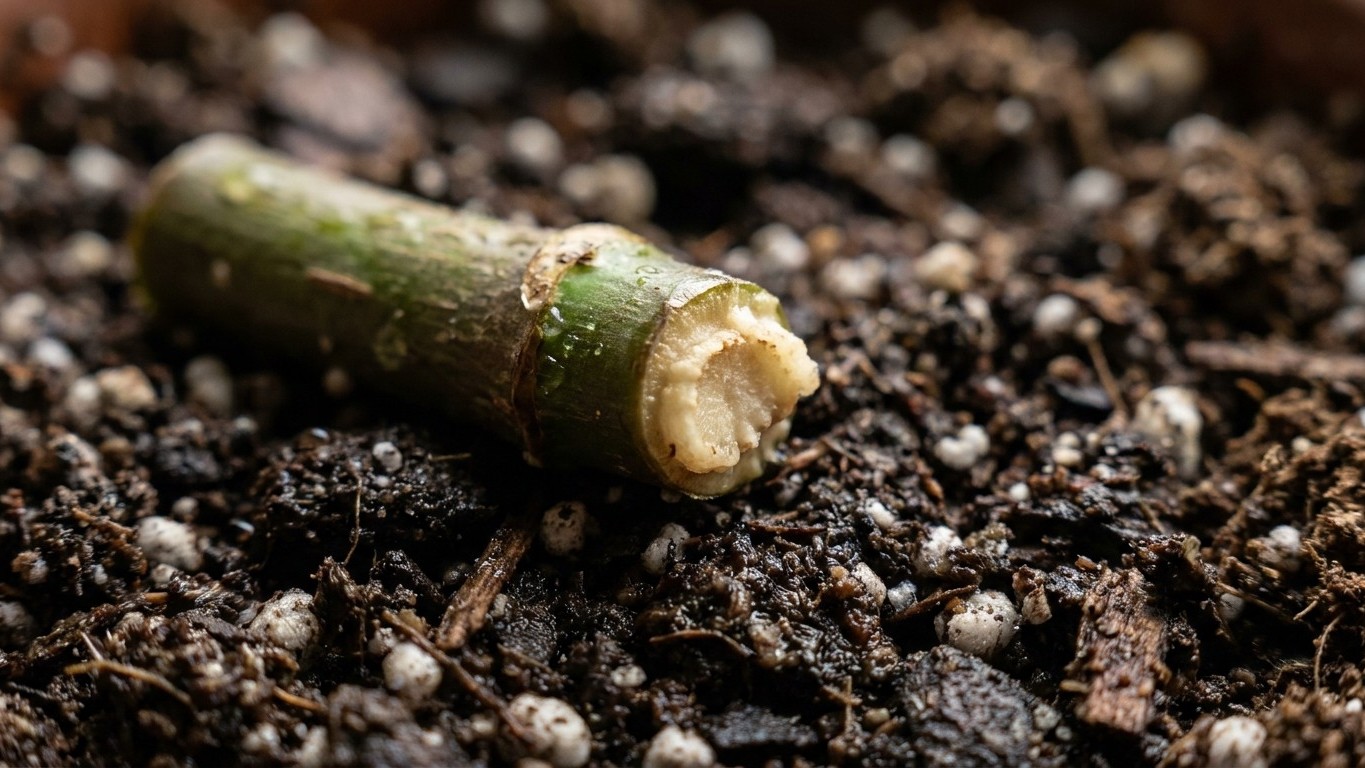
Callus tissue is the unsung hero of vegetative propagation. After a cut, the plant rushes undifferentiated cells to the wound site. Those cells form a pale, often waxy layer that seals the stem and, critically, serves as the launchpad from which root primordia emerge. Suppress the biological activity at that site, and you suppress the root initiation process itself. Cinnamon, applied generously as most tutorials recommend, does exactly that in a meaningful percentage of cuttings.
A 2020 study published in HortScience tested cinnamon powder against commercial rooting hormone (IBA) on woody ornamental cuttings. Rooting rates with cinnamon were not statistically different from the control group, meaning plain water. The commercial hormone outperformed both. The study didn’t frame cinnamon as harmful, but the data quietly showed it offered no benefit. What the study didn’t measure, however, was the effect of heavy application, which most home gardeners use because light dusting feels insufficient.
The Callus Problem Is Dose-Dependent
The dose matters enormously here, and it’s the variable that online tutorials almost never address. A thin dust of cinnamon on a cutting with a robust vascular system, say, a mature pothos or a thick-stemmed begonia, may cause minimal disruption. The callus forms, cinnamon sits on the surface, roots eventually push through. Result? Fine. Unremarkable, but fine.
Thin-stemmed cuttings are a different story. Tradescantia, impatiens, many herbs, delicate succulents propagated from leaves, these rely on a very small wound surface area. Apply even a moderate dusting of cinnamon to a Tradescantia fluminensis node, and the cinnamaldehyde concentration relative to that tiny callus zone is orders of magnitude higher than on a woody rose cutting. The antimicrobial effect doesn’t scale down because the cutting does. Gardeners then wonder why their tradescantia cuttings sit in the substrate for weeks, dry out, and eventually rot anyway, without ever forming a single root.
There’s also the moisture interaction. Many propagators dip wet cuttings into cinnamon powder, creating a paste that coats the node rather than lightly dusting it. That paste physically blocks the wound surface. Callus can’t form properly through a sealed layer of powder and essential oils. The cutting is, for all practical purposes, embalmed at the one end that needed to stay biologically active.
What Actually Promotes Rooting
Indole-3-butyric acid (IBA), the active ingredient in most commercial rooting powders and gels, works because it mimics auxin, the plant hormone that signals root initiation. It directly stimulates the differentiation of callus cells into root primordia. Cinnamon does not contain auxins, does not mimic them, and has no known mechanism for promoting root formation. The reason it became conflated with rooting powder is purely visual: both are powders you dip a cutting into. That’s where the similarity ends.
Willow water is a more defensible DIY alternative. Willow bark contains salicylic acid and indolebutyric acid, naturally occurring compounds with actual rooting activity. Soaking young willow stems in water for 24 hours and using that water as a rooting medium has some legitimate science behind it, though concentrations vary wildly depending on species and stem age. Honey at very low concentrations has shown mild antimicrobial benefit without the aggressive chemistry of cinnamaldehyde, making it a gentler option for protecting the wound without disrupting callus formation.
The most reliable upgrade most home propagators can make has nothing to do with any additive. High humidity around the cutting, achieved with a simple humidity dome or a plastic bag, dramatically reduces transpiration stress and keeps the stem tissue viable long enough for roots to form naturally. Many cuttings that “fail” are actually just dehydrating before root initiation completes. Addressing that variable alone outperforms any powder treatment.
When Cinnamon Does Make Sense
There is a legitimate use case for cinnamon in propagation, just not at the cutting stage. Once a cutting has rooted and is transitioning to soil, the risk of fungal damping-off increases, particularly in high-humidity setups. A light surface application of cinnamon to the soil, not the stem, can help suppress the pythium and fusarium species that cause damping-off. The cutting’s roots are already established and away from the soil surface; the cinnamon stays where it’s useful without interfering with active tissue differentiation.
The same logic applies to seedlings. Cinnamon sprinkled on the soil surface around newly germinated seedlings has a reasonable evidence base as a damping-off preventive, and here, there’s no callus tissue to protect. The plant’s root system is already formed and extending downward, away from any surface application.
Propagation media sold specifically for rooting, like perlite-heavy or bark-based mixes, tend to drain fast enough that fungal pressure stays low anyway. The environments where cinnamon genuinely earns its place are dense, moisture-retentive soils where fungal spores have everything they need to proliferate. That’s a soil management problem, not a cutting problem, and the solution should match the actual diagnosis.