
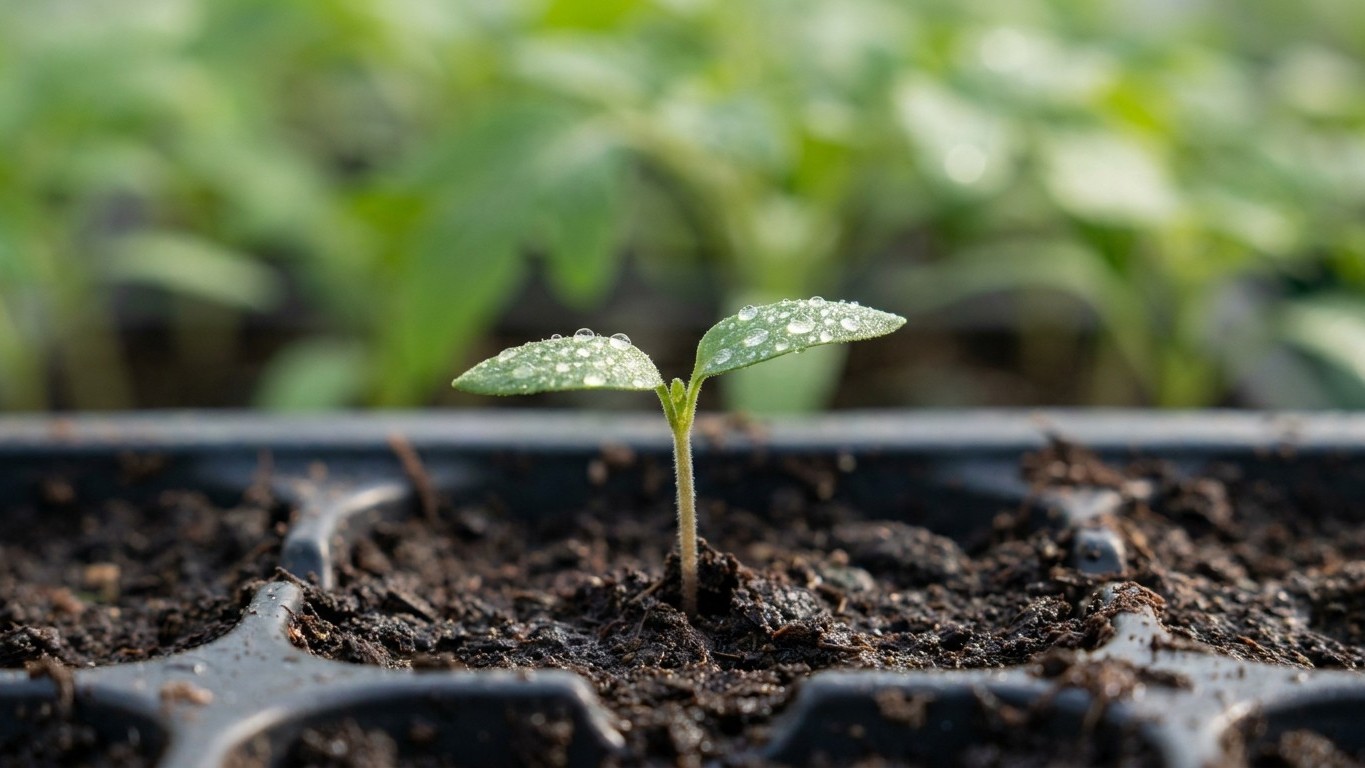
Most gardeners drop a tomato seed into a cell, cover it with a quarter inch of mix, add water, and wait. That’s the standard playbook, and it works, more or less. But a conversation with a commercial nursery grower changes the frame entirely. The real mistakes aren’t about the seed itself. They’re about the conditions surrounding it, and the moment right after it sprouts. Get those two things wrong, and you’ll spend the season wondering why your transplants look like they’ve been through a rough time.
Key takeaways
- Most gardeners obsess over seed orientation, but nature already handles that—so what’s the actual mistake nobody talks about?
- The moment your seedling emerges, one common tool becomes your worst enemy. What happens if you don’t remove it immediately?
- Tomatoes have an unusual superpower that fixes almost every seedling mistake. Does any other garden vegetable offer this second chance?
The Depth Question, and Why Orientation Barely Matters
First, the position debate. Home gardeners often obsess over whether to point the seed up, down, or sideways before burying it. The honest answer: the seed root will always grow downward and the sprout will always grow upward, seed orientation makes little to no difference, since in nature most seeds end up facing any direction and still germinate. Seeds possess a unique ability to detect gravity, known as geotropism, which allows them to determine the direction of “down” as they settle into the soil. Nature already built the compass into the seed. You don’t need to overthink it.
What does matter is depth. Plant tomato seeds approximately 1/4 inch (6 mm) deep in well-draining, moist soil, this depth provides the ideal balance of warmth, moisture retention, and access to oxygen for optimal sprouting. Go too deep and you’ll run into trouble fast: seeds planted too deeply may fail to emerge due to lack of energy reserves, while those sown too shallowly can dry out quickly or be exposed to light. A quarter inch is a real ceiling. If planted deeper than 1/2 inch, tomato seeds may exhaust their energy reserves before reaching the surface, leading to poor emergence or complete germination failure. The seed is tiny, roughly the size of a sesame seed, and it carries a finite food supply for its journey upward.
One subtlety worth noting: a stuck seed coat may be due to the seed not being planted deep enough for it to shed its coat before emerging, or the soil may be too dry, mist it with water to soften it, then gently remove it. A seedling wrestling with its seed coat for days is under real stress. Consistent moisture at the surface prevents this specific, frustrating scenario.
Temperature Is the Variable Most Gardeners Ignore
Here’s where the nursery grower’s insight cuts deepest. Most home gardeners treat the heat mat as a “set it and forget it” tool. That’s the real mistake. Bottom water the tray, then place it on your heat mat set to the ideal temperature for tomatoes: 70° to 80°F (21° to 26°C). For germination, that warmth is non-negotiable, the optimum germination temperature for tomatoes is 85°F, at which tomato seedlings should emerge in about 5 to 6 days.
The catch? Once the green sprout emerges above the soil, the heat mat quickly becomes a problem. Higher temperatures speed growth but also encourage stems to stretch, especially when light is not strong enough. After germination, seedlings grown in constant warmth tend to grow upward too quickly, producing tall, thin plants with little strength. The moment you see sprouts, remove the mat, or at least cut the temperature significantly. Once seeds have germinated and seedlings emerge, remove them from the heat mat or move them to a slightly cooler spot. High temperatures are crucial for germination, but once sprouted, slightly cooler temperatures (65–70°F) with plenty of light will encourage stocky, healthy growth rather than leggy, stretched seedlings.
The Position That Actually Changes Everything: Lights
The “position” that every nursery grower will tell you about isn’t the seed’s orientation in the soil, it’s the grow light’s position relative to your seedlings. This is the detail that separates flat, weak transplants from stocky, vigorous ones.
The most common cause of leggy tomato seedlings is insufficient light, which often surprises new gardeners who believe a sunny, south-facing window will work. A windowsill rarely provides enough light, even if it appears bright to the human eye. The problem isn’t just the total amount of light, it’s the distance. The position of the light is just as important as the type. Many gardeners make the mistake of hanging lights too high above the trays, which does very little. Keep the lights about 2 to 3 inches above the tops of the seedlings and raise them as the plants grow. This close distance provides strong light, telling the seedlings they have enough energy to stop stretching and start forming thicker stems.
Duration is the other lever. Keep grow lights on for a minimum of 14 hours per day, light is not just about the right type and proximity, but also about making sure your tomatoes get enough daylight hours, which for tomatoes is 14 to 16 hours under artificial lighting. A basic plug-in timer handles this automatically. A second factor most people skip entirely: airflow. Without movement, stems do not receive the physical signals that help them thicken and strengthen, a process called thigmomorphogenesis. As a result, seedlings grown with poor airflow focus more on height than strength. Over time, this produces long, weak stems that cannot support the plant’s weight. A small fan running a few hours a day solves this completely.
The Transplant Trick That Fixes Nearly Every Mistake
Even if your seedlings got a little leggy, which happens to almost everyone, tomatoes offer a genuine second chance that no other common vegetable does. Tomatoes are unique because their stems can grow roots. When you plant your tomato deeper, the buried stem develops new roots, increasing root growth and strengthening the plant. A deeper, stronger root system helps plants absorb water and nutrients more efficiently, stay upright, and handle stress from heat or wind.
When you plant your tomato seedlings in the spring and bury them sideways, you give the plant the opportunity to grow a ton of new roots along the portion of the stem you buried, you can also bury them straight down, but much deeper than normal, if your garden setup allows. The biology behind this is genuinely unusual. Because of the extremes in their native territory, from mountains to deserts to jungles in Peru and Ecuador, tomatoes have adapted to grow wherever their seeds land through parenchyma cells — non-descript cells located just below the epidermal layer, all along the plant’s stems, that can morph to serve different purposes. Every little bump you see on a tomato stem is the plant’s root system waiting for contact with soil.
Practically speaking: plant tomatoes deep, right up to the first set of leaves, and they will develop new roots on the lower stem. For a leggy seedling, you can help them along by burying as much of the stem as possible when you transplant from the seedling tray, if your pot is deep enough, you can bury them up to their cotyledons. The plant that looked like a failed experiment in March can still turn into the most productive one in your garden by July. That resilience is one of the things that makes tomatoes genuinely worth growing from seed.
Sources : foodgardenlife.com | sowrightseeds.com