
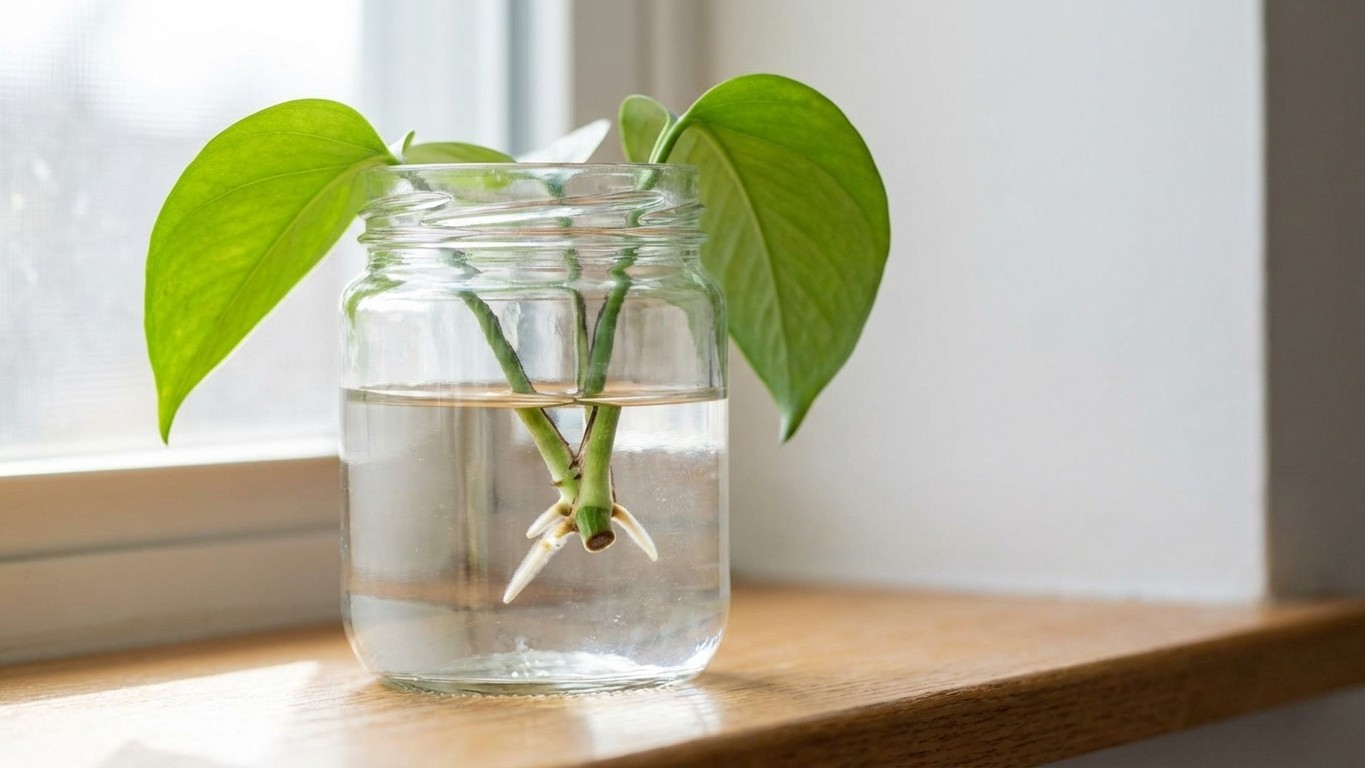
A single pothos or philodendron can multiply into a dozen new plants within a few weeks, no special equipment, no greenhouse, no horticultural degree required. These two plants have become the go-to choice for home propagation precisely because they root so reliably, almost stubbornly. But the method you choose, water versus soil, does affect the outcome more than most guides admit.
Key takeaways
- The cutting itself matters more than you think—one small mistake at the start dooms the entire propagation
- Water-rooted plants face a hidden adaptation crisis that soil-rooted plants never experience
- Season changes the game entirely: a winter cutting fights gravity that a spring cutting never has to face
Taking the Right Cutting: Where Most People Go Wrong
Before the rooting debate even matters, the cutting itself has to be correct. A node is non-negotiable. That small, slightly raised bump on the stem, the point where a leaf attaches, is the only place roots will emerge. Snip a stem without one and you have a beautiful decoration that will simply rot. For pothos, nodes are easy to spot. For heartleaf philodendrons, look for the same structure, plus the papery sheath (the cataphyll) that sometimes wraps the new growth point.
The ideal cutting is 4 to 6 inches long, has at least one or two leaves, and is taken just below a node with clean, sharp scissors or pruning shears. Dull blades crush the tissue instead of slicing it, which invites bacterial rot before rooting even begins. Remove any leaves that would sit below the waterline or under the soil surface, submerged leaves decompose quickly and create the same problem.
Water Rooting: Fast Feedback, One Hidden Cost
Rooting in water is the method most beginners reach for, and there are solid reasons why. You can see the roots developing in real time, which is genuinely useful for learning what healthy root growth looks like. A glass jar on a bright windowsill, changed every few days with fresh room-temperature water, and you’ll typically see white root nubs within one to two weeks on pothos. Philodendrons move at a similar pace.
The hidden cost is what happens at transplant time. Roots that develop in water are structurally different from soil roots, they’re optimized for oxygen-rich, nutrient-poor liquid. When you move a cutting from water to soil, those roots often struggle to adapt, and the plant can go into a visible sulk for two to four weeks. It doesn’t die; it just stalls. To minimize transplant shock, pot the water-rooted cutting into a very light, airy mix — something closer to a seed-starting medium than a dense potting soil, and keep it consistently moist for the first few weeks, easing it toward a normal watering schedule gradually.
One practical tip: don’t wait until water roots are 3 or 4 inches long before potting up. Shorter roots, around half an inch to an inch, adapt to soil far more readily than long, well-established water roots do.
Soil Rooting: Slower to Start, Stronger Finish
Rooting directly in soil skips the transition problem entirely. The roots that form are immediately adapted to the growing medium, and the plant establishes faster once it’s actively pushing new leaves. The trade-off is patience and moisture management, keeping the soil consistently moist without letting it become waterlogged is the narrow margin where success lives.
A mix of standard potting soil with added perlite works well, roughly a 50/50 ratio to ensure drainage. Some propagators swear by straight perlite or a mix of perlite and coarse horticultural sand, arguing the minimal nutrients prevent rot while still providing the physical structure roots need to grip. Dip the cut end in rooting hormone powder, the indole-3-butyric acid (IBA) formulations available at most garden centers — and you’ll typically shave a week off the rooting timeline.
Humidity is the other variable. Since the cutting has no roots to uptake water, it loses moisture through its leaves faster than it can compensate. Enclosing the pot loosely in a clear plastic bag, or placing a clear plastic bottle cut in half over it, creates a micro-humidity chamber. Crack it open for an hour daily to prevent mold. After two to three weeks, the cutting should show enough resistance when gently tugged to confirm roots have anchored, that gentle tug test is the low-tech equivalent of a progress report.
Which Method Actually Produces Better Plants?
Tested side by side over a full growing season, soil-rooted cuttings generally produce more vigorous plants within 60 to 90 days of taking the cutting. Water-rooted cuttings often catch up eventually, but the early weeks of transplant adaptation eat into that head start. For anyone propagating to give away or sell, soil rooting delivers a plant that looks healthier sooner, which matters if you’re potting it up as a gift or moving it to a new home.
Water rooting still wins on convenience and visibility. For teaching children or beginners, watching those white roots emerge from a clear jar is a payoff that no amount of horticultural efficiency can replace. There’s also a middle-ground method worth trying: start in water just until the first root nubs appear (usually 7 to 10 days), then transfer to soil immediately. The roots are young enough to adapt, and you get the visual confirmation without the long water-root conditioning period.
One detail that rarely gets mentioned: the season matters more than the method. Pothos and philodendron cuttings taken in spring or early summer root significantly faster than those taken in winter, even in the same conditions. The longer daylight hours trigger active growth hormones throughout the parent plant, and cuttings taken during this phase simply arrive better primed for root development. A cutting taken in February in a north-facing room is working against itself from the start, move it closer to a light source, or wait a few weeks for the season to shift in its favor.