
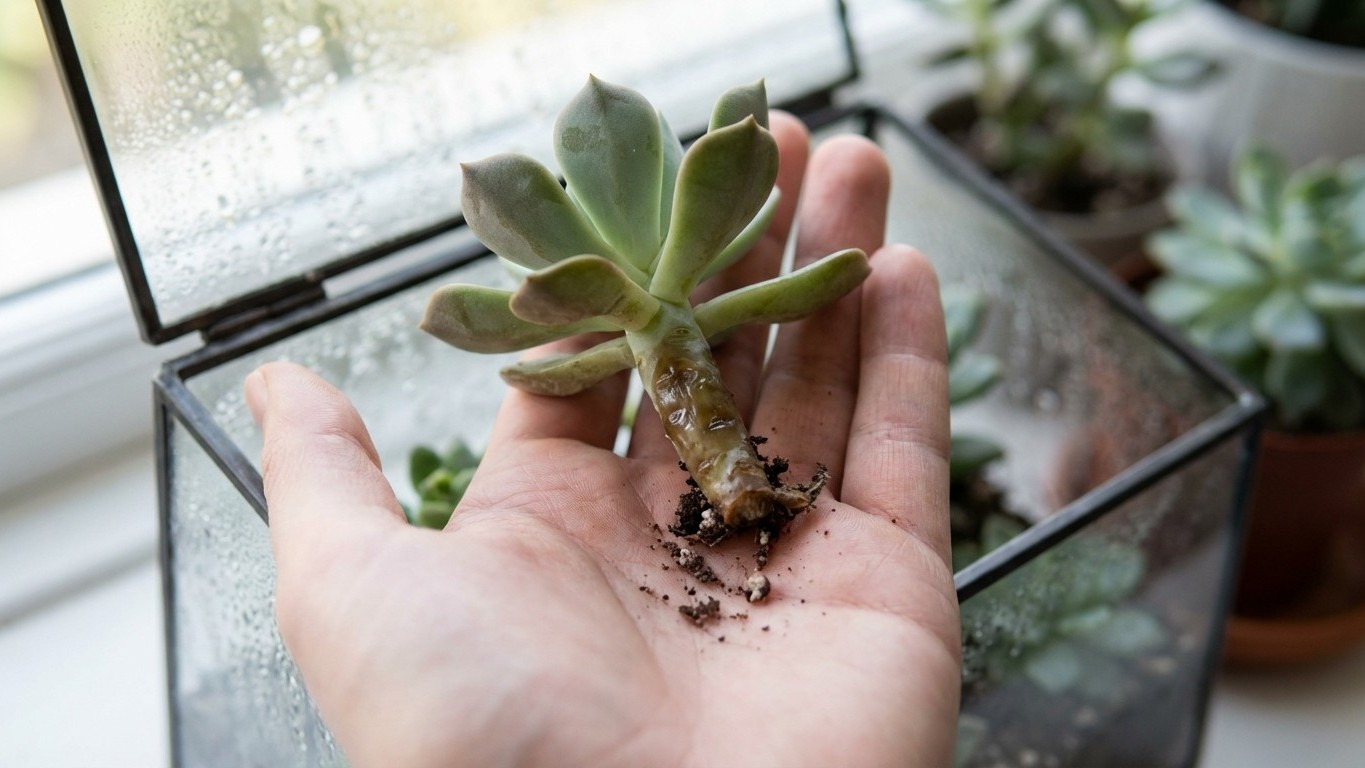
A closed terrarium might look like the perfect home for succulents, tidy, self-contained, a little sculptural on a shelf. The problem is, succulents and sealed glass are fundamentally incompatible, and April accelerates the damage in a way that catches most growers off guard. Before anything else: check the base of each stem right now. If you see soft, discolored tissue, translucent spots, or a faint musty smell when you lift the lid, rot has already started.
Key takeaways
- April’s extended daylight hours wake succulents from dormancy, but sealed terrariums trap the exact conditions that destroy them
- Rot announces itself first at the stem base—translucent patches mean it’s early enough to save, black mushy tissue means it’s critical
- Succulents and sealed glass are fundamentally incompatible; the plants thriving in closed terrariums are completely different species
Why April Makes a Bad Situation Worse
As daylight hours stretch past 13 hours across most of the U.S. in April, succulents wake up from their semi-dormant winter state and begin actively drawing resources. Their water needs tick up slightly, but their sensitivity to standing moisture spikes dramatically. In a closed terrarium, every drop of water you’ve ever added is still in there, cycling between the soil and the glass walls as condensation. There is no evaporation, no airflow, no escape route for excess humidity.
Succulents evolved in environments where soil dries completely between rain events. Their roots are designed for brief saturation followed by extended drought. Persistent moisture at the root zone doesn’t just stress them, it invites Fusarium and Pythium fungi, both of which spread fast in stagnant, humid conditions. A closed terrarium in April, sitting near a south-facing window with increasing sun exposure, becomes a slow-cooker for fungal rot.
The condensation you see on the glass isn’t a minor inconvenience. It’s a symptom of a system that has no mechanism to self-correct. Some terrarium guides suggest “cracking the lid” to vent moisture, but that’s a partial fix at best, the humidity inside a sealed vessel with succulent soil can hover above 80% even with occasional venting, far beyond the 40–60% these plants prefer.
Reading the Stem Base : What You’re Actually Looking For
The stem base is where rot announces itself first, because that’s where the plant meets the soil. Healthy tissue is firm, green or slightly woody, with no give when you gently pinch it. What you don’t want to find: a soft, brown or black section that compresses easily, almost like wet cardboard. That’s basal rot, and once it encircles the stem, the plant above it is effectively cut off from its root system.
Translucent, water-soaked patches are the earlier warning sign, the tissue hasn’t turned black yet, but cell walls are breaking down from prolonged moisture. This stage is salvageable. The fully blackened, squishy base is much harder to recover from, though not always fatal if you act immediately.
Leaves that turn yellow and fall off with almost no resistance are another signal. Healthy succulent leaves snap off cleanly; rot-compromised leaves slide off the stem with barely a touch, leaving behind a wet mark. Check at the soil line specifically, because rot travels upward and the visual damage above ground always lags behind what’s happening underground.
How to Actually Fix This
Remove the plant from the terrarium today. Don’t wait to see if it gets better on its own, in a closed environment, it won’t. Gently brush the soil away from the roots and inspect the entire root system. Healthy succulent roots are white or light tan and slightly firm. Brown, mushy roots with a sour smell have already been compromised by fungal activity and need to come off.
Use clean, sharp scissors or pruning snips to cut away all rotted root material, then let the plant sit bare-root in open air for 24 to 48 hours. This callusing step is non-negotiable, replanting into fresh soil while cut surfaces are still wet just restarts the rot cycle. Some growers dust the cuts with powdered cinnamon or sulfur as a natural antifungal, and there’s reasonable anecdotal support for both, though neither is a substitute for dry conditions.
If the rot has reached the stem base and you can’t cut below it, propagation is your best option. Sever the plant several inches above the rot line, let the cutting callus for two to three days, and root it in dry cactus mix. The original root ball is likely a write-off, but the cutting can establish new roots within three to four weeks.
Replant into a container with a drainage hole. Any container. A terracotta pot the size of a coffee mug will serve these plants better than the most expensive sealed glass vessel on the market. Terracotta wicks moisture away from the root zone passively, which is essentially the opposite of what glass does.
What Actually Thrives in Closed Terrariums
The plants that do well in sealed glass are those that evolved in humid, forest-floor environments: mosses, fittonia, small ferns, miniature peperomia, and nerve plants. These species want the constant moisture that kills succulents. The closed terrarium isn’t a flawed concept, it’s just been wildly misapplied by plant retailers who photograph succulents in sealed glass because it photographs well.
Open terrariums (no lid, or a vessel with a wide, uncovered opening) are a reasonable compromise for succulents, provided the container still has drainage or a thick layer of gravel with activated charcoal to prevent water from pooling around the roots. Even then, succulents in any glass container need significantly less water than you think, for many hobbyists, once every three weeks in spring is plenty.
One thing worth knowing: succulents sold in closed terrariums at garden centers and grocery stores in spring are often juvenile plants with shallow root systems that haven’t yet developed the rot resistance of a more established plant. They’re more vulnerable, not less, which makes the timing of April’s humidity spike even more consequential. A two-inch echeveria in sealed glass is not a long-term setup, it’s a countdown.