
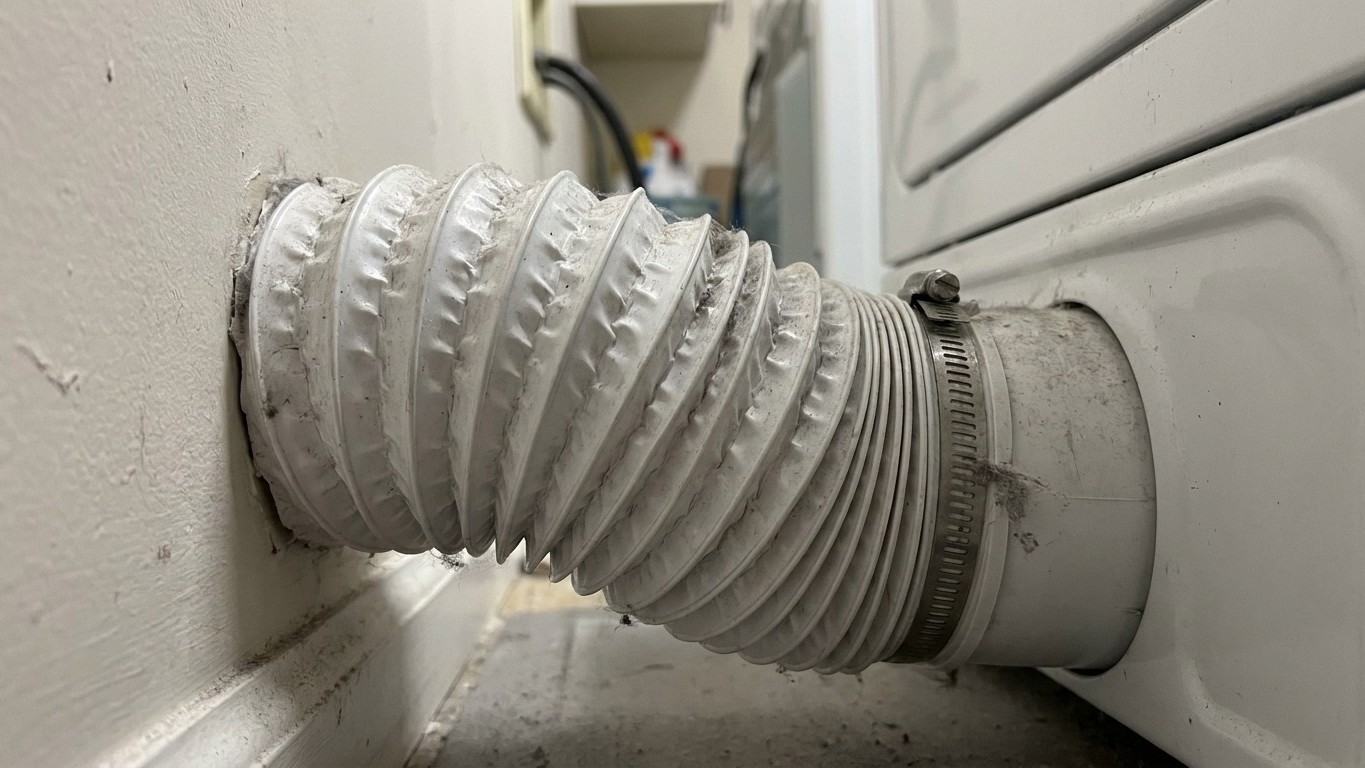
Clean the lint trap after every load, and you’ve only handled half the job. The real fire risk hides three feet behind the machine, coiled in that flexible tube connecting the dryer to the wall. Dryer fire hazards typically originate from two places, dryer venting and the lint trap. Yet most households treat the second one as an afterthought, if they think about it at all.
The numbers explain why that’s a mistake. There are approximately 15,600 structure fires, 400 injuries and 15 deaths reported annually as a result of dryer fires, and clothes dryer fires account for over $100 million in property losses every year. The lint screen catches most of what comes off your clothes, but not everything makes it that far. While the lint filter catches a lot of this debris, it doesn’t capture it all. Lint builds up in the dryer vent over time, gradually obstructing airflow. When airflow is restricted, hot air has nowhere to go, causing the dryer to overheat. Combine that excessive heat with flammable lint, and the conditions for a fire are set. That’s the mechanical reality nobody sees until the machine starts acting strange.
Key takeaways
- The lint screen catches only part of the problem—most households ignore the real danger lurking behind the machine
- Your dryer is already sending warning signals you’ve probably dismissed as normal quirks
- One simple two-minute test reveals whether your vent is secretly becoming a fire hazard
Why the Hose Matters More Than the Filter
Think of the vent hose as the dryer’s exhaust pipe. If it’s crushed against the wall, sagging in loops, or made from the wrong material, the appliance can’t breathe properly, no matter how diligently you empty the lint screen. Dryer vents are often made from flexible plastic or metal duct, which may be easily kinked or crushed where they exit the dryer and enter the wall or floor. That’s a common scenario since most laundry closets weren’t designed with airflow in mind. This is often a problem since dryers tend to be tucked away into small areas with little room to work.
The material itself carries real consequences. Plastic accordion-style ducts, once standard in older homes, are now flagged by manufacturers and fire officials alike. According to the NFPA, all dryer manufacturers clearly state in their manuals to not use plastic or flexible dryer ducts between the vent and the clothes dryer, as they can be a fire hazard. Though, many homes continue to use plastic and flexible ducts. The problem isn’t just the material burning. It’s what happens inside it. Flexible vents can twist, allowing lint to build up and catch on fire if it meets a sufficient amount of heat. Every ridge and fold in that accordion tubing is a shelf where lint settles, undisturbed, cycle after cycle.
If you’re shopping for a replacement, skip the white plastic coil entirely. Only flexible transition ducts that are listed by UL or another approved product safety testing agency should be used. A short, smooth, rigid metal connector between the dryer and the wall outlet moves air far more efficiently than anything with corrugated ridges, and it can’t collapse under its own weight the way a loose accordion tube does over time.
The Warning Signs Your Dryer Is Already Sending
Dryers don’t fail silently. Long before smoke appears, the machine tells you something’s wrong through small, easy-to-dismiss changes in behavior. A load that used to take 40 minutes now needs a second cycle. Clothes come out scorching instead of warm. The laundry room feels muggier than it should, or carries a faint scorched smell that wasn’t there last month.
Each of those is a direct signal from a restricted vent, not a random appliance quirk. A burning odor coming from your dryer is a serious warning sign, and this smell could mean lint has built up to dangerous levels and is potentially overheating. When clogged, heat can build up inside the dryer and the laundry room, so if you notice that your laundry room feels unusually warm or that clothes are very hot to the touch after drying, it’s time to clean your vent. Musty-smelling laundry after a full drying cycle points the same direction. Musty clothes after a drying cycle mean the dryer isn’t fully removing moisture from them.
There’s a simple two-minute test that beats guessing. Step outside while a load is running and check the exterior vent hood. Step outside and locate the dryer vent outlet while the dryer is running. Strong airflow should push warm air out steadily. Weak airflow or barely noticeable movement suggests a blockage somewhere in the vent system. A flap that barely flutters means lint has already narrowed that pipeline somewhere between the machine and the outside wall. Some newer models remove the guesswork entirely. Maytag® dryers will also display an error code to alert you if there is an issue with the vent.
How Often the Hose Actually Needs Attention
Emptying the lint screen is a per-load habit. The vent hose runs on a completely different calendar, and most guidance converges on roughly the same window. Your dryer vent system should be cleaned no less than once every two years, depending on how often it’s used and what kinds of loads you’re drying. Other appliance makers and cleaning professionals push for a shorter interval as a baseline. Even without obvious warning signs, dryer vents should be professionally cleaned at least once a year.
Household size and habits shift that number considerably. Heavy dryer use, such as towels or bedding, calls for cleaning every 3-6 months, pet owners should aim for every 6 months to avoid lint buildup caused by pet hair, and large families or frequent laundry loads should clean every 6 months. A household running one or two loads a week with no pets sits comfortably at the longer end of that range. A family of five with a dog and a habit of washing towels daily should treat the vent hose like a filter, not a fixture, and check it seasonally.
One detail worth remembering before you reach for the vacuum yourself: compacting lint deeper into a long or elbow-filled duct run can make the blockage worse rather than better. There are do-it-yourself options, but unless you’re a trained specialist, you probably won’t get rid of all the lint; worse, you could actually compact some of the lint, thus creating a worse problem. For a straight, short run behind an easily accessible machine, disconnecting the hose and brushing it out yourself is manageable. For anything routed through walls, ceilings, or multiple bends, a professional sweep with the right brush length is worth the cost, precisely because that’s the section of the system doing the real work every time you press start.
Sources : aol.com | hvac.filterbuy.com