
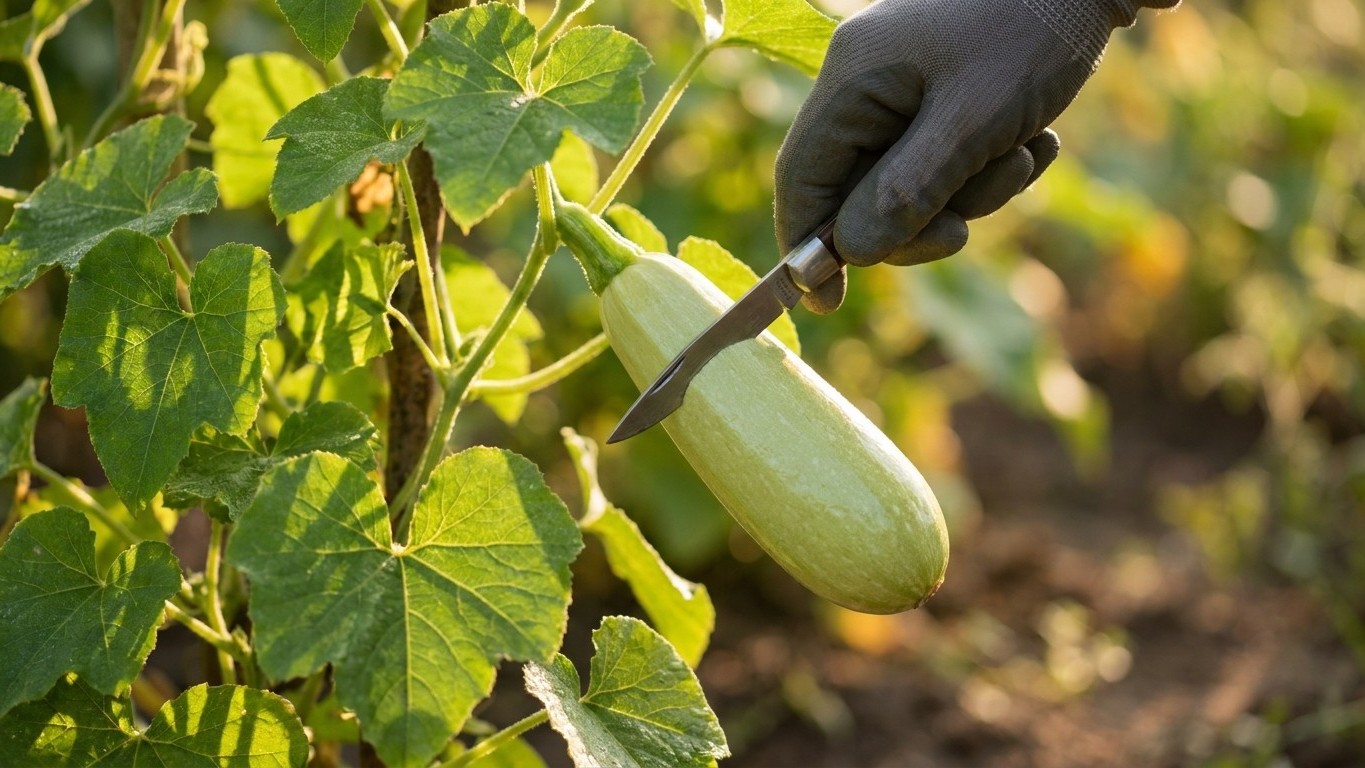
He’s out there every single morning, coffee in one hand, paring knife in the other, slicing off courgettes that are barely bigger than his thumb. Neighbors assume he’s chasing that buttery, seedless texture chefs rave about. He isn’t. He’s manipulating the plant’s biology to keep it producing for months instead of weeks.
The truth is almost mechanical. A courgette plant doesn’t grow fruit because it wants to feed you. It grows fruit to make seeds. Once a single squash on the vine is allowed to swell and harden, the plant reads that as mission accomplished.
Key takeaways
- One oversized courgette left on the vine can shut down an entire plant’s flower production for weeks
- Harvesting tiny fruits keeps plants in reproductive overdrive, producing continuously until frost
- The math is counterintuitive: fewer pounds per fruit, but exponentially more fruits overall across the season
The plant thinks its job is done
When a fruit is left on the vine to become a “baseball bat,” the plant receives a hormonal signal that its reproductive mission is complete, leading to a shutdown of new flower production. That’s not a metaphor gardeners invented to sound clever. It’s a documented physiological response. The second you let a zucchini mature on the plant, that fruit with the mature seeds inside it signals to the plant that it has done its job.
A university extension bulletin from the University of Washington puts it just as bluntly: keep harvesting all those beans, zucchini, cucumbers and other summer vegetables to keep the production going, because any fruit left to mature on the plant will cause flowering to slow and reduce the harvest. One overlooked squash hiding under a leaf, forgotten for a week, is enough to throttle the whole plant’s output.
Your neighbor’s ruthless harvesting schedule isn’t obsession. It’s damage control. By consistently picking immature fruits, you keep the plant in a perpetual state of “reproductive panic,” and it will continue to pump out female flowers in an attempt to finally produce mature seeds. He’s essentially gaslighting a vegetable into thinking it still has work to do.
Small cuts, bigger totals
Here’s the part that surprises most home gardeners: picking early doesn’t just delay the inevitable slowdown, it actually raises the season’s total yield. Regular harvesting of smaller fruit keeps the plant in the reproductive mode, and you will quickly find the more you pick the more the plant will produce. Fewer pounds per fruit, but far more fruit overall.
Think about what that single oversized zucchini actually costs. It isn’t just one missed harvest. If the fruits are picked regularly, once they start producing, they can keep going all the way up until the first frost kills the plants. That’s the difference between three good weeks of squash in July and a steady trickle running clear into October.
There’s a size problem too, separate from the hormonal one. As they grow larger, zucchini get more seedy. Past a certain point the skin toughens and the flesh turns spongy and waterlogged, which is exactly why grocery store zucchini rarely looks like the pale green torpedoes people find hiding in their gardens after a vacation.
What the ideal cut actually looks like
Kew Gardens’ advice, cited by home-improvement outlet Tom’s Guide, backs the same logic from the institutional side: if you leave the zucchinis on the plant for too long, they will strip the plant of its nutrients and inhibit the production of more flowers that produce the fruits. The plant is essentially borrowing against its own future to finish one fruit.
Most growing guides converge on a similar window. Harvest zucchini when fruits are 6–8 inches long, firm, glossy, and uniformly green (or varietal color), with tender skin you can easily pierce with a thumbnail, typically 45–55 days after planting. Your neighbor is clearly cutting on the aggressive end of that range, closer to four inches than eight, which trades a bit of size for an even stronger signal to the plant to keep flowering.
Technique matters almost as much as timing. Use a sharp knife or clippers and cut the stem one or two inches from the fruit, rather than grabbing the fruit with your hands and twisting it off the vine, which could damage both the vines and the fruit. A torn stem is an open wound, and an open wound near the crown is an invitation for rot and squash vine borers, the two things most likely to end a productive plant early.
Checking daily isn’t paranoia either, it’s basic math against a fast-growing vegetable. Zucchini doesn’t grow by inches per week, it grows by inches per night when the weather’s right. Skip two days during peak summer heat and that hand-sized courgette you were planning to pick for dinner has already ballooned past the point of no return.
When the plant finally does slow down
Even the most disciplined harvester eventually loses the race. Heat waves above roughly 90°F can knock pollen viability down regardless of how fast anyone cuts, and by late summer the plant has usually exhausted the nitrogen and potassium in its immediate root zone, which is why a mid-season feeding often revives flowering when nothing else changes. Frost, of course, ends the conversation entirely.
So next time you spot him out there at dawn with that knife, resist the urge to tell him he’s missing out on the “good size” zucchini. He already knows exactly what he’s doing. He’s not optimizing for a recipe. He’s keeping a plant convinced, week after week, that it still hasn’t finished the job.
Sources : migardener.com | creativevegetablegardener.com