
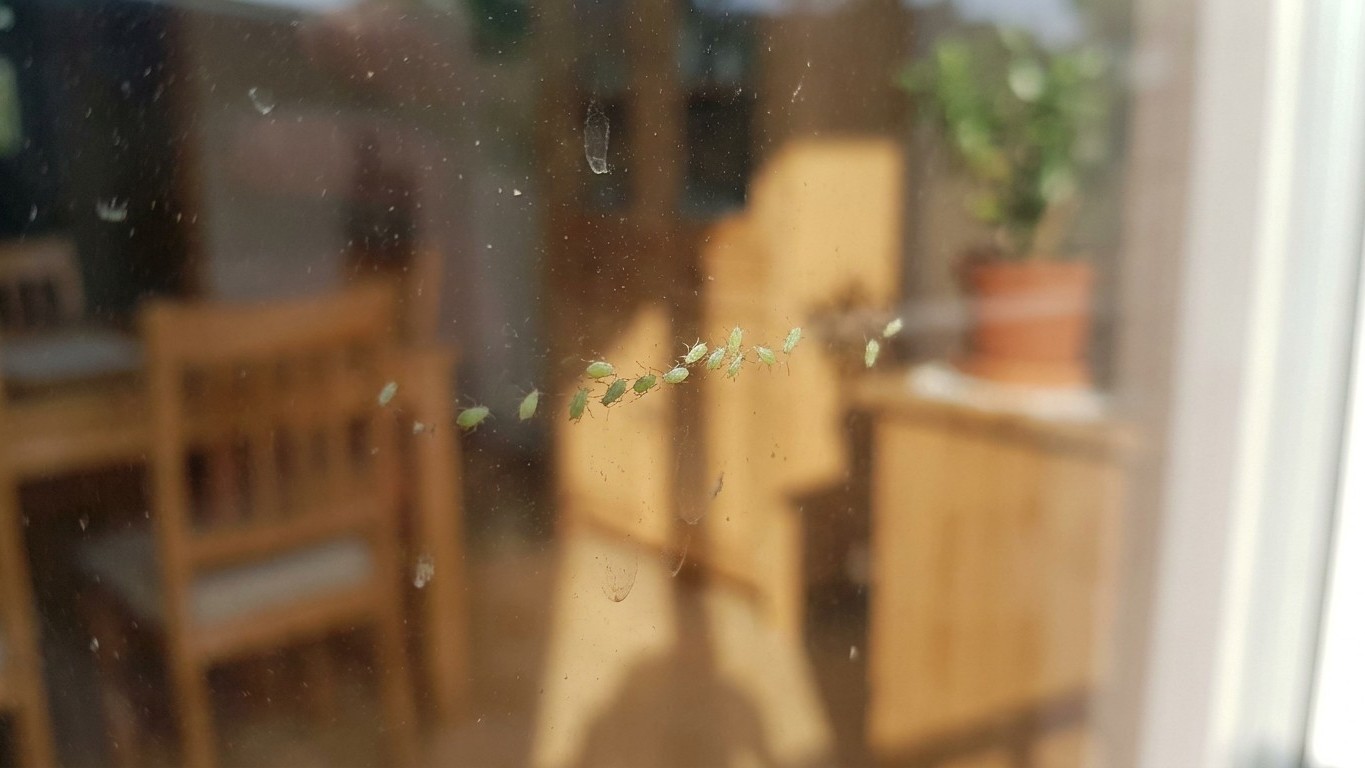
Three days. That’s all it took for a single squashed aphid on a south-facing window to become a small colony of green dots lined up on the same pane. No new bug got in. No door was left open. The math simply caught up with a decision that felt logical in the moment: kill the one, solve the problem.
What actually happened is a lesson in entomology that most people never get taught until it’s staring back at them from the glass. Aphids are, hands down, one of the fastest-breeding insects found in American homes, and squashing a lone scout does almost nothing to stop what’s already underway on a nearby houseplant.
Key takeaways
- One squashed bug led to dozens in 72 hours, but the real population was never on the window
- Female aphids clone themselves without needing mates, and newborns are already pregnant with the next generation
- Crushing an aphid triggers a chemical alarm that scatters the colony and produces winged offspring built to invade new plants
Why One Squashed Aphid Never Stays One
The bug on the window was never traveling alone. Aphids climb toward light and warmth, which is exactly why they show up clustered on sunny panes rather than scattered across a dark wall. Insects move toward the light, then remain on the sill because the glass blocks their way out, and crawling pests may follow warmth, condensation, or food sources around the frame. The window isn’t the source. It’s a dead end where wandering individuals from a nearby plant get stuck.
That’s the part that changes Everything. Aphids, thrips, and other plant pests may also appear around windows, so checking any houseplants nearby, along with outdoor vines, shrubs, or tree branches that touch the home, matters. Kill the one that reached the glass, and the actual population, the one feeding on stems and new growth just a few feet away, keeps growing untouched.
The Reproduction Trick Behind the Three-Day Explosion
Here’s where the biology gets genuinely strange. Aphids don’t need a mate to reproduce during spring and summer. What aphids are doing is called parthenogenesis, a form of asexual reproduction where an organism produces offspring without fertilization, no male required, and during spring and summer, female aphids use this method to clone themselves, with these clones born live, not from eggs.
It gets stranger still. In many cases, these newborns are themselves pregnant, a phenomenon known as telescoping generations, meaning one aphid can contain multiple generations within its body. A female aphid isn’t just producing daughters. She’s producing daughters who are already carrying granddaughters before they’re even born. Aphid parthenogenetic ovaries contain embryos that, at advanced stages, themselves already have ovaries with newly developing embryos, ensuring rapid and efficient reproduction.
The speed numbers back up the window count. Each female reproduces over 20 to 30 days, birthing 60 to 100 live nymphs, and under optimal conditions, nymphs can mature and reproduce within a week, a process that frequently leads to multiple generations, up to 20 per year. Indoors, where central heating mimics an endless spring, that clock doesn’t even slow down for winter. Three days is plenty of time for a handful of overlooked nymphs to mature and start their own broods, which explains why a windowsill that looked clear on Monday can look colonized by Thursday.
Does Squishing One Actually Call in Reinforcements?
This is the part gardeners argue about online, and the science is more nuanced than a simple yes or no. Crushed aphids do release a chemical signal. Crushed aphids will emit EBF, but unstressed aphids do not emit EBF unless they are disturbed by handling. That compound, (E)-β-farnesene, is the insect world’s version of a scream.
What that scream triggers isn’t a dinner bell for other aphids, though. The sesquiterpene, (E)-β-farnesene, is the principal component of the alarm pheromone of many aphid species, and released when aphids are attacked by enemies, it leads aphids to undertake predator avoidance behaviors and to produce more winged offspring that can leave the plant. squishing one doesn’t summon a horde. It scatters nearby aphids and can nudge the colony toward producing winged offspring, the ones built for dispersal rather than sitting still. Ironically, that response can spread the problem to more leaves, or more windows, rather than concentrating it.
There’s an upside buried in that same chemical, at least outdoors. Aphid alarm pheromone not only repels aphids, but it can also act as a kairomone to attract natural enemies, and EBF slow-release formulations have significantly attracted parasitoid wasps in crop fields. Indoors, though, there are no lacewings or ladybugs waiting in the wings, so that natural check simply doesn’t exist.
What Actually Stops the Colony on the Glass
Squashing individual bugs treats a symptom while ignoring the source, which is almost always a houseplant a few feet from that sunny pane. The fix starts there, not on the windowsill.
- A strong stream of water can dislodge many of the aphids from your plants, or for delicate plants, a spray bottle or a soft cloth dipped in water works to gently wipe them away.
- A homemade insecticidal soap made from a few teaspoons of mild liquid dish soap mixed with 1 quart of water, sprayed or wiped onto leaves, stems, and buds, will desiccate aphids’ soft bodies.
- Insecticidal soaps and oils kill primarily by smothering the aphid, so thorough coverage of infested foliage is required, applied with a high volume of water targeting the underside of leaves as well as the top.
None of this is a one-and-done fix, and that’s the part worth accepting upfront. Soaps, neem oil, and horticultural oil kill only aphids present on the day they are sprayed, so applications may need to be repeated. Given a reproductive cycle that can complete in about a week under warm indoor conditions, one treatment simply can’t outrun the next batch of nymphs already developing inside their mothers.
What’s easy to miss is that not every infestation demands a chemical response at all. Most aphids cause only superficial damage, and unless aphid-infested plants are failing or honeydew is causing a problem, control of aphids is not necessary. The windowsill count that looked alarming after three days might just be a signal to check the ficus in the corner, not a reason to panic about the glass itself.
Sources : resjournals.onlinelibrary.wiley.com | bmcecol.biomedcentral.com