
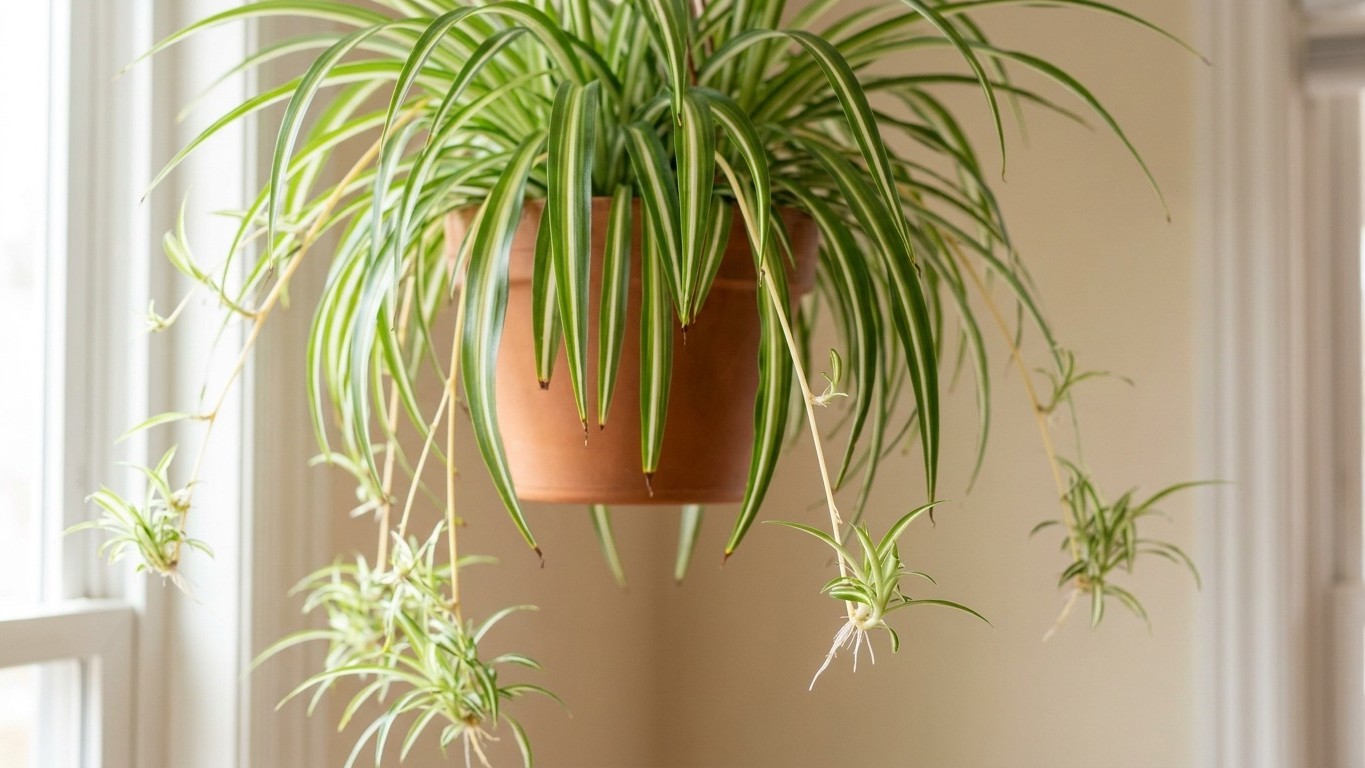
For years, the routine felt logical: spider plant sends out a runner, a baby appears, you snip it off and pot it up. Propagation is the whole point, right? Except that constant, early harvesting of those little plantlets, called spiderettes or pups, quietly works against the mother plant in ways that aren’t immediately obvious. Once you understand the biology, the scissors suddenly feel a lot less innocent.
Key takeaways
- Those thin stolons aren’t just baby delivery systems—they’re actively feeding energy back to the mother plant
- Chronic early harvesting doesn’t kill spider plants, but it slowly degrades their vigor, leaf quality, and cascading beauty over months
- There’s a specific maturity threshold when spiderettes become energetically independent and safe to remove
What those runners are actually doing
A spider plant (Chlorophytum comosum) produces its long arching stems, called stolons, as part of a deliberate reproductive strategy. The stolon itself isn’t just a delivery vehicle for the baby plant, it’s an active photosynthetic structure. Those thin green or white-striped stems are capturing light and sending energy back to the mother plant throughout their lifespan. Cutting them early doesn’t just remove the baby; it cuts off that energy loop before it completes its cycle.
The spiderettes, before they develop visible roots, are still drawing nutrients and moisture directly from the mother through the stolon. Think of it as an umbilical cord that flows both ways. A baby plantlet with even a few tiny aerial roots has already begun to photosynthesize independently and is starting to contribute to the system rather than purely drain it. Harvest too early, and the mother absorbs none of that return energy, she’s spent resources producing a stolon and a plantlet and received nothing back.
There’s a threshold worth knowing: once a spiderette has developed a small rosette of leaves roughly an inch or two across, and shows visible white root nubs, it’s reached a point of relative energetic independence. That’s the window when removal is genuinely neutral for the mother. Before that point, you’re essentially collecting an invoice the plant hasn’t finished paying.
What chronic early harvesting does over time
A spider plant that has its runners cut repeatedly and early doesn’t crash dramatically, that’s what makes the problem invisible for so long. The decline is slow. The leaves lose a bit of their luminosity. New growth becomes marginally thinner. The plant keeps going, because Chlorophytum comosum is famously resilient, but it operates below its potential energy budget.
Research on stolon-bearing plants more broadly shows that the repeated severing of stolons before plantlet establishment redirects the parent plant’s hormonal signaling. The plant often responds by producing more stolons in compensation, which looks productive but is actually metabolically expensive. You end up with a mother plant running in circles, constantly initiating reproductive cycles it never completes. Over months, this taxes the root system and can lead to a plant that looks busy but grows slowly and rarely reaches the lush, cascading density that makes spider plants genuinely beautiful hanging specimens.
The other factor is light and season. Spider plants send out the most stolons in late spring and summer when day length increases, this is their natural reproductive push. Stripping runners the moment they appear during this peak period is a bit like pulling fruit off a tree in early June and wondering why you never get a good harvest. The timing of when you cut matters nearly as much as whether you cut.
The method that actually works better for everyone
Leave the runner. Let the spiderette develop until it has a visible root cluster, usually three to six weeks after it first appears. At that point, you have two options that are both kinder to the mother plant.
The first: place a small pot of moist soil directly under the dangling spiderette while it’s still attached to the stolon, and pin the baby lightly against the soil surface. Within two to three weeks, it roots into the new pot on its own, the mother plant continues receiving whatever the stolon is exchanging, and the baby establishes a genuine root system before being severed. This method produces dramatically stronger, faster-growing propagations than cutting and hoping.
The second option, if you don’t want a tethered setup: wait until the spiderette has root nubs at least half an inch long, then cut and pot it into a propagation mix kept consistently moist. Success rates with rooted spiderettes are substantially higher than with tiny, barely-formed cuttings, which often rot or stall before establishing.
As for the mother plant itself, once you stop the compulsive early harvesting, something shifts within a growing season. The leaves on established plants typically thicken slightly, the white striping on variegated varieties becomes more defined, and the plant begins producing stolons that arc further and more gracefully, the visual effect that makes a well-grown spider plant look like it’s floating. That’s not coincidence. It’s a plant operating with an intact energy economy.
One thing most guides don’t mention
Spider plants that are allowed to carry their runners through a full reproductive cycle, baby rooted, connection severed naturally or at maturity, often enter a brief rest phase afterward. Fewer stolons, slower growth for four to six weeks. This alarms people who then interpret it as a problem and start fertilizing aggressively, which can cause tip burn and worsen the stress. That quiet period is recovery, not failure. It mirrors what happens in many stoloniferous plants after a successful propagation cycle, and it resolves on its own with nothing more than consistent watering and moderate indirect light.
One more thing: spider plants grown slightly root-bound are more likely to initiate stolon production in the first place. A plant in a pot two sizes too large spends its energy on root expansion rather than reproduction. If your spider plant has been slow to send out runners, the pot size may be doing more than your propagation habits to suppress that behavior.