
Leaf shine sprays promise a lot: glossy, showroom-worthy foliage that looks like it belongs in an interior design catalog. For a few weeks, the Monstera deliciosa sitting in the corner of a living room can look genuinely stunning. Then the new growth slows. Then it stops. The connection between those two facts took longer to make than it should have.
This is a common story among plant enthusiasts, and the science behind it is straightforward once you know where to look. Those broad, fenestrated Monstera leaves are not just decorative surfaces. They are working organs, and coating them with a petroleum-based or silicone-based shine product is roughly equivalent to wrapping a person’s skin in plastic wrap and expecting them to sweat normally. The plant cannot, because the product seals the stomata.
Key takeaways
- A popular plant care product was secretly suffocating the plant’s ability to breathe and absorb nutrients
- The evidence was hiding under a layer of waxy buildup that appeared during a routine cleaning
- The solution has been available the whole time, and it costs almost nothing
What stomata actually do, and why blocking them matters
Stomata are microscopic pores distributed across leaf surfaces, predominantly on the undersides but present on the upper surface too, depending on the species. In Monstera, these pores handle two of the most critical biological functions the plant performs: gas exchange (taking in carbon dioxide for photosynthesis, releasing oxygen) and transpiration, the process by which the plant moves water from roots to leaves and regulates its internal temperature.
A healthy Monstera transpires constantly. That movement of water through the plant is what creates the negative pressure drawing nutrients up from the soil. Block enough stomata with a film-forming product, and that system slows. The plant is still alive, but it is operating at a fraction of its capacity. Photosynthesis drops. Nutrient uptake drops. Growth, predictably, stalls. Three months of no new leaves is not a coincidence if those three months happen to overlap with regular leaf shine applications.
The moment of clarity often comes during a routine cleaning session. When a damp cloth passes across a leaf that has received multiple coats of shine spray, the cloth picks up a yellowish, waxy residue that does not look like dust. It is the product itself, layered over weeks of application, sitting over the very pores the plant needs to breathe. The leaf beneath is paler than it should be, almost matte compared to the adjacent untreated leaves.
The myth of the “natural” leaf shine
The marketing around commercial leaf shine products leans heavily on words like “natural” and “plant-safe.” Some formulations use neem oil or coconut oil derivatives rather than mineral oil. The problem is that any occlusive substance, regardless of its origin, will reduce gas exchange if applied in sufficient quantity to the leaf surface. Neem oil has legitimate uses as a diluted pest treatment applied sparingly, but a saturated leaf coated in neem for cosmetic purposes faces the same basic problem as one coated in petroleum.
There is also a humidity angle that rarely gets discussed. Monstera are native to tropical rainforests in southern Mexico and Central America, environments where leaves are regularly rinsed by rain. That rinsing keeps stomata clear. In a dry apartment, the plant already has to work harder to regulate moisture. Adding a coating that interferes with transpiration compounds the stress. The plant is not dramatic about it. There is no visible wilting, no yellowing that screams “leaf shine.” The response is quieter: a gradual reluctance to push out new growth, a general lack of vigor that gets attributed to insufficient light or wrong pot size.
Some growers also report an increased susceptibility to spider mites after consistent leaf shine use. The logic tracks: mites thrive in dry, still conditions, and a plant with impaired transpiration creates a slightly drier microenvironment around its own foliage than a plant breathing freely.
What actually works for glossy Monstera leaves
The natural gloss of a Monstera leaf, when the plant is healthy and well-hydrated, is genuinely striking. The waxy cuticle layer produces a shine that no spray can realistically improve without causing the problems described above. The issue is usually not a lack of gloss but a layer of dust, mineral deposits from tap water, and airborne debris that dull the surface over time.
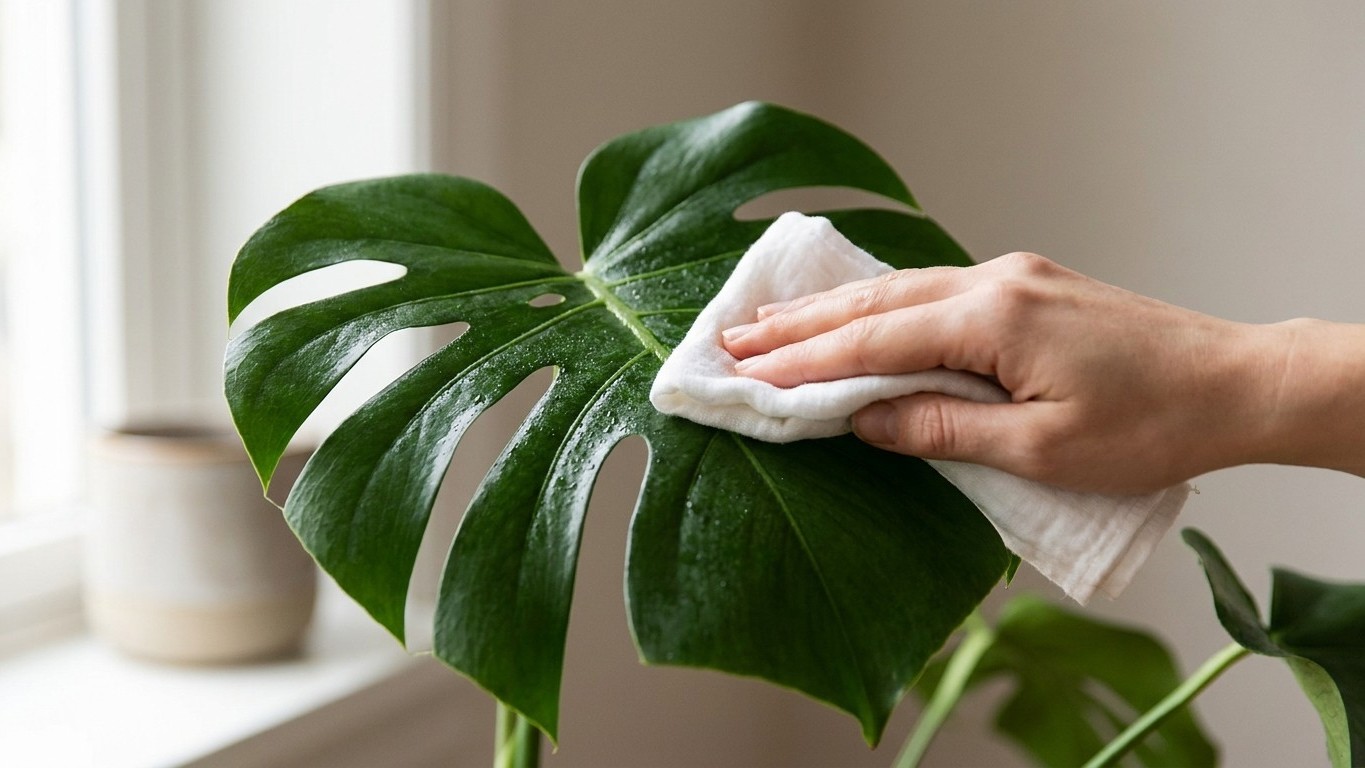
A soft, damp cloth, used gently on the upper surface of each leaf, removes that buildup and allows the natural shine to come through. Distilled or filtered water prevents the white residue that hard tap water leaves behind as it evaporates. Some growers add a tiny amount of diluted liquid soap to the cloth for leaves with stubborn grime, then wipe again with plain water. That is genuinely all that is needed.
Milk, another popular home remedy, creates a brief shine from the fats in the liquid, but it also leaves a residue that can attract fungal growth if the leaf surface stays damp. Banana peel, occasionally recommended in gardening circles, deposits sugars on the leaf surface. Both carry more risk than reward compared to plain water and a cloth.
Frequency matters too. Cleaning leaves once a month is reasonable for a typical indoor environment. Wiping every leaf every week risks mechanical damage to the surface cells of the leaf, which can cause microscopic scarring that, ironically, makes the leaf look less glossy over time.
After stopping the spray
Once leaf shine application stops and the leaves are cleaned properly, Monstera typically resume normal growth within four to eight weeks, assuming other conditions (light, watering, soil health) are adequate. The existing leaves that received the spray do not fully recover their original stomatal function, but new growth emerges unimpaired. The first new leaf after a period of stalled growth is always satisfying in a disproportionate way, a confirmation that the plant was never struggling from some mysterious deficiency but from something entirely preventable.
One detail worth knowing: Monstera with very large, mature leaves that have been coated repeatedly over many months may show permanent changes to the cuticle texture on those specific leaves. The new leaves will be fine. But those older leaves carry a record of what was applied to them, visible under close inspection as a slightly uneven sheen that does not respond to cleaning. Plants, as it turns out, have a longer memory than their owners.