
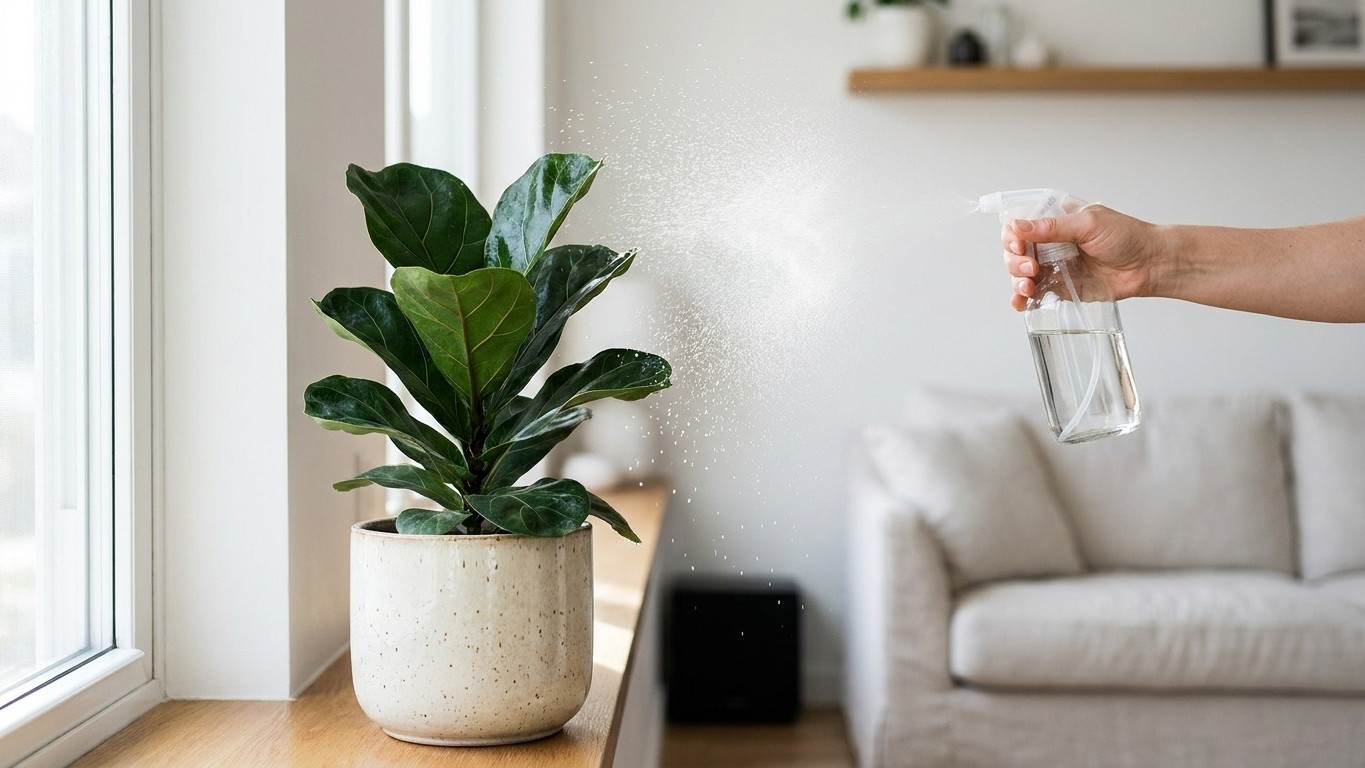
Spray bottles are everywhere in plant care. They’re stacked next to registers at garden centers, bundled with starter kits, recommended in beginner guides. They feel so right, a little mist, a happy plant. The problem is that for certain plants, that fine spray of water is actively doing damage, and no one explains this when you buy your first fiddle leaf fig.
Rachel Nguyen has been running a boutique plant shop in Portland for eight years. When she does home consultations, she says the spray bottle is the first thing she removes from the windowsill. Not because she’s dramatic about it. Because she’s watched too many fiddle leaf figs — Ficus lyrata, one of the most temperamental indoor plants on the market, develop brown spots and root decline that trace directly back to misting habits the owner thought were helpful.
Key takeaways
- A boutique plant shop owner removes spray bottles from windowsills on sight—here’s what she’s seen happen to fiddle leaf figs
- Tropical plants don’t want wet leaves, even though they come from rainforests—the science behind this counterintuitive truth
- There’s a $10 solution that works better than misting, and it has nothing to do with spray bottles
The misting myth, explained
Fiddle leaf figs are native to the rainforest understory of western Africa, which is where the confusion starts. People hear “tropical origin” and assume the plant craves constant moisture on its leaves. That’s a misreading of the ecosystem. In its natural habitat, the fiddle leaf fig grows beneath a thick canopy that catches most of the rainfall. The humidity around the plant is high, yes, but the leaves themselves stay relatively dry. Water doesn’t sit on them, it moves through the system quickly.
A spray bottle in a living room does the opposite. It deposits water directly on the leaf surface, where it sits. In low-light indoor conditions with limited air circulation, that moisture doesn’t evaporate quickly. Fungal spores, which are present in any indoor environment, use that film of water as an entry point. The result is leaf spot disease, which shows up as brown patches with yellow halos. Most owners diagnose this as underwatering and respond by misting more. The cycle accelerates.
There’s also the issue of mineral deposits. Tap water in most American cities contains calcium, magnesium, and chlorine. When you mist leaves and the water evaporates, those minerals stay behind. Over weeks and months, they accumulate as white residue that clogs the stomata, the tiny pores through which the plant breathes and exchanges gases. A plant with clogged stomata struggles to photosynthesize efficiently, which compounds whatever other stress it’s already dealing with.
What the plant actually needs instead
The fiddle leaf fig’s real humidity requirement is about 30 to 65 percent relative humidity in the surrounding air, not water on its leaves. These are two completely different things, and conflating them is the root of the misting problem. A hygrometer (a $10 device most serious plant owners eventually buy) will tell you where your room actually sits. Most centrally heated American homes drop to 20 to 30 percent in winter, which is genuinely stressful for tropical plants.
The fix isn’t a spray bottle. A room humidifier running a few hours a day raises ambient humidity without ever touching the foliage. Grouping plants together also helps, plants release moisture through transpiration, and a cluster of three or four will create a slightly more humid microclimate between them. Neither solution is expensive, and both address the actual problem rather than creating a new one.
For the leaves themselves, the better practice is a damp cloth wipe-down once a month. This removes the dust that accumulates on the large, flat surface of fiddle leaf fig leaves (which genuinely does block light and reduce photosynthesis), without the prolonged moisture contact that invites fungal problems. Nguyen recommends doing this in the morning so any residual moisture evaporates before cooler evening temperatures arrive.
The plants where misting actually helps
To be fair to the spray bottle, it’s not universally useless. Certain plants genuinely benefit from leaf misting, and understanding which ones explains why the advice became so widespread in the first place.
Ferns, for instance, evolved in environments where their fronds are frequently wet. Maidenhair ferns (Adiantum) are notoriously hard to keep alive indoors, and one reason is that standard indoor air is far too dry for them. Misting helps, within limits. Calathea and Maranta species, popular for their patterned leaves, also tolerate and sometimes appreciate light misting, their leaf surfaces dry faster due to their texture, reducing fungal risk. Orchids in bark medium can benefit from misting around their aerial roots, though the flowers themselves should stay dry.
The pattern is worth noting: plants that evolved in open, breezy, or frequently-wetted environments handle misting better than plants from shaded, still understory conditions. Matching the method to the plant’s actual evolutionary context is the underlying logic that most generic plant care advice skips entirely.
The broader lesson about plant care defaults
The spray bottle problem is a useful case study in how plant care advice spreads. A practice that works well for one species gets generalized into a universal recommendation, packaged into starter kits, repeated across social media, and eventually calcifies into received wisdom. By the time someone’s fiddle leaf fig is developing brown spots, they’re already three layers removed from any accurate information about their specific plant.
Nguyen’s rule is simple: before adding any care practice, identify what the plant’s native habitat actually looks like. Not just “tropical” or “desert”, specific conditions. How much canopy cover? How much wind? Does rain sit on the leaves or run off quickly? That level of specificity changes the recommendations dramatically. A fiddle leaf fig and a bird of paradise are both “tropical houseplants,” but they respond very differently to the same care routines.
One detail that often surprises new plant owners: fiddle leaf figs are actually more drought-tolerant than their reputation suggests. In the wild, the dry season in western Africa can last four to five months. The plant has adapted to store water and wait. Overwatering, whether through the soil or through repeated misting, is a far more common cause of death than underwatering, which is the opposite of what most people assume when they buy one.