
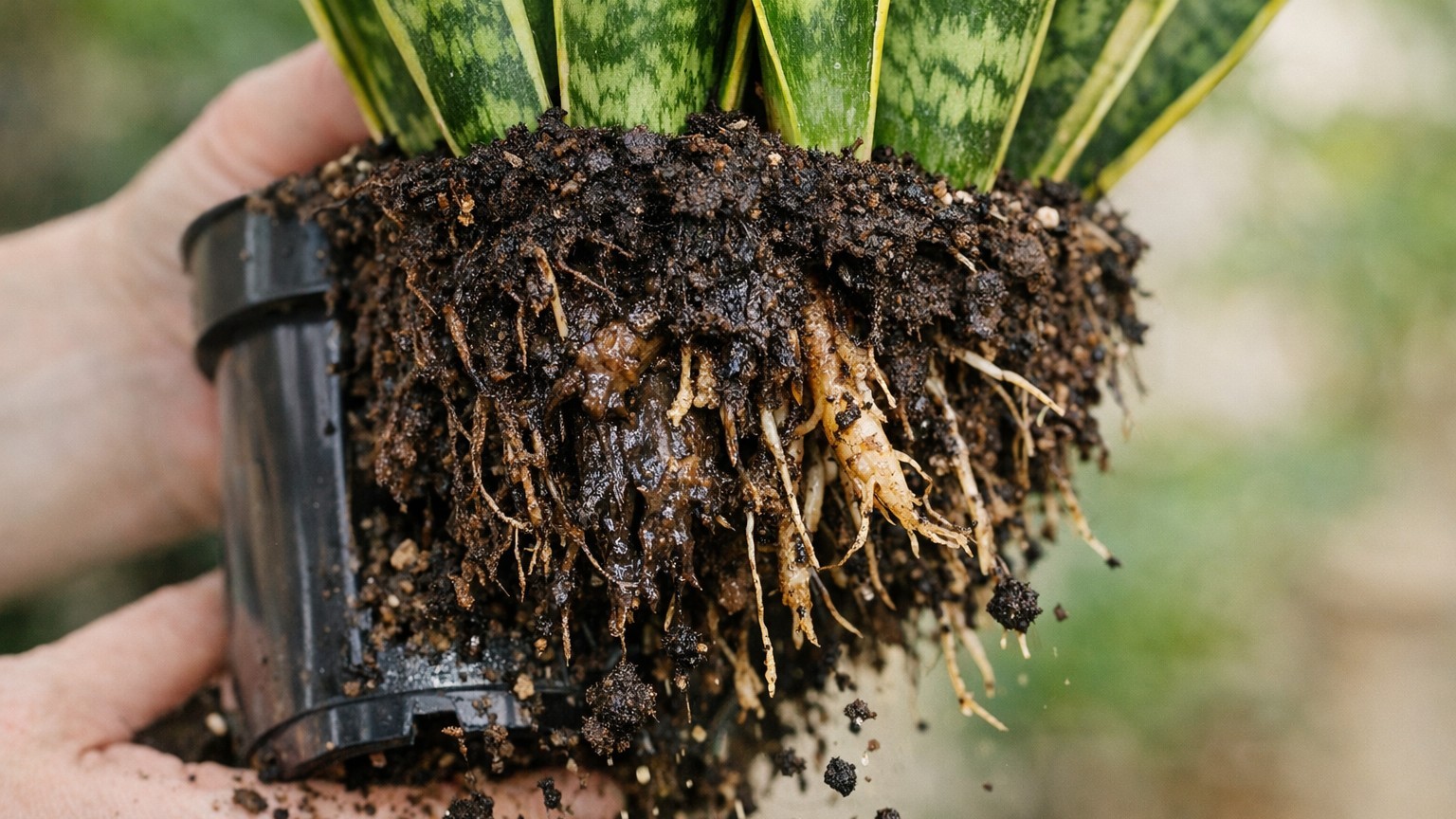
Snake plants are nearly indestructible. That’s the whole pitch. You neglect them, forget them in a dark corner, water them once a month, and they survive. So when a perfectly healthy Dravit trifasciata starts rotting from the roots up inside what looks like a respectable pot, the problem isn’t the plant. The problem is what that pot is doing underground, out of sight, where nobody checks until it’s too late.
The glossy plastic nursery container is where most snake plants spend their entire lives. You buy the plant, admire it, set it on a shelf, and leave it in whatever vessel it arrived in. That works, for a while. The real damage is slow, invisible, and almost always misread as underwatering or a draft from a window.
Key takeaways
- Glossy plastic pots trap moisture and suffocate roots in ways terracotta never does
- Root rot can progress for 6-8 weeks completely unnoticed while your plant looks fine above soil
- A single plastic shipping disc left on the drainage hole can turn any pot into a sealed death trap
What Actually Happens Inside a Sealed Plastic Pot
Plastic nursery pots were designed for one thing: getting a plant from a greenhouse to a store shelf in good condition. They’re cheap, lightweight, and retain moisture efficiently, which is exactly what a commercial grower needs to minimize watering labor across thousands of plants. That same moisture retention becomes a liability the moment the plant moves into your living room, where ambient humidity is higher, evaporation is slower, and nobody is watering on a greenhouse schedule.
Snake plants store water in their thick, waxy leaves. When the soil is consistently damp and the roots have no oxygen, because waterlogged soil pushes air out of the pore spaces, the roots begin to suffocate. Dracaena trifasciata is especially sensitive to this because it evolved in well-drained, rocky soils in West Africa. The roots aren’t built for prolonged wetness. They’ll tolerate drought far longer than they’ll tolerate sitting in stagnant moisture.
The glossy exterior of a plastic pot also matters more than it looks. Unlike terracotta, which is porous and allows a small but constant exchange of air and moisture through the pot walls, plastic is completely sealed. Every drop of water that enters the pot can only exit through the drainage hole at the bottom, or through the plant itself. If the drainage hole is partially blocked by roots, a pebble, or a pot liner, that water has nowhere to go. A month of this is enough to turn healthy white roots into brown mush.
The Repotting Moment That Changes How You See It
Tipping a snake plant out of its pot after months of apparent stability is genuinely surprising. The soil holds the shape of the container for a second, then collapses. What should be a network of firm, pale rhizomes and root strands sometimes looks more like wet newspaper. The smell confirms it before your eyes do, a faint but distinct sour odor that signals anaerobic bacterial activity in the soil.
Root rot in snake plants is caused primarily by Pythium and Phytophthora species, water molds (not true fungi) that thrive in saturated, oxygen-depleted conditions. By the time the leaves start yellowing or going soft at the base, the rot has often been progressing for six to eight weeks underground. The plant’s ability to store water in its leaves buys it time, which is why it can look completely fine right up until it doesn’t.
The fix after the fact involves removing every rotted root section cleanly with sterilized scissors, dusting the cuts with powdered cinnamon (a natural antifungal), letting the plant dry out for 24 to 48 hours before replanting, and using a fast-draining mix, typically one part potting soil to one part perlite, or a dedicated succulent and cactus blend. But prevention is far less stressful than rescue surgery on a half-rotted root ball.
The Simple Swap That Prevents Most of This
Terracotta pots have been the standard for centuries for a reason that has nothing to do with aesthetics. The unglazed clay pulls moisture outward through the walls via evaporation, which means the soil dries out from all sides, not just from the top. For a snake plant, or any succulent-type plant that prefers a dry-out period between waterings — this passive moisture management is genuinely protective. Studies on container horticulture consistently show lower incidence of root disease in porous-walled containers compared to sealed plastic ones, particularly in low-light indoor environments where evaporation from the soil surface is limited.
The sizing matters too. A pot that’s significantly larger than the root ball holds more soil, which holds more water, which stays wet longer. With snake plants, the rule of thumb is to choose a container only one to two inches wider in diameter than the current root mass. Overpotting is one of the most common silent killers in houseplant care, the plant looks fine above soil while drowning below it.
If aesthetics require a specific planter that happens to be glazed or plastic, the practical solution is a simple one: use the decorative pot as a cache-pot (a sleeve around a smaller terracotta or plastic drainage pot), and always lift the inner pot out to water, letting it drain fully before returning it to the sleeve. Never let the decorative outer pot accumulate standing water at the bottom.
There’s one detail worth knowing about the nursery pots themselves: many come with drainage holes partially covered by a small plastic disc during shipping to prevent soil spillage. That disc is meant to be removed before use. A surprisingly large number of plant owners never notice it, and it effectively turns a pot with drainage into a sealed container. A quick check before potting up, or before leaving a plant in its original container, takes ten seconds and can save the root system entirely.