
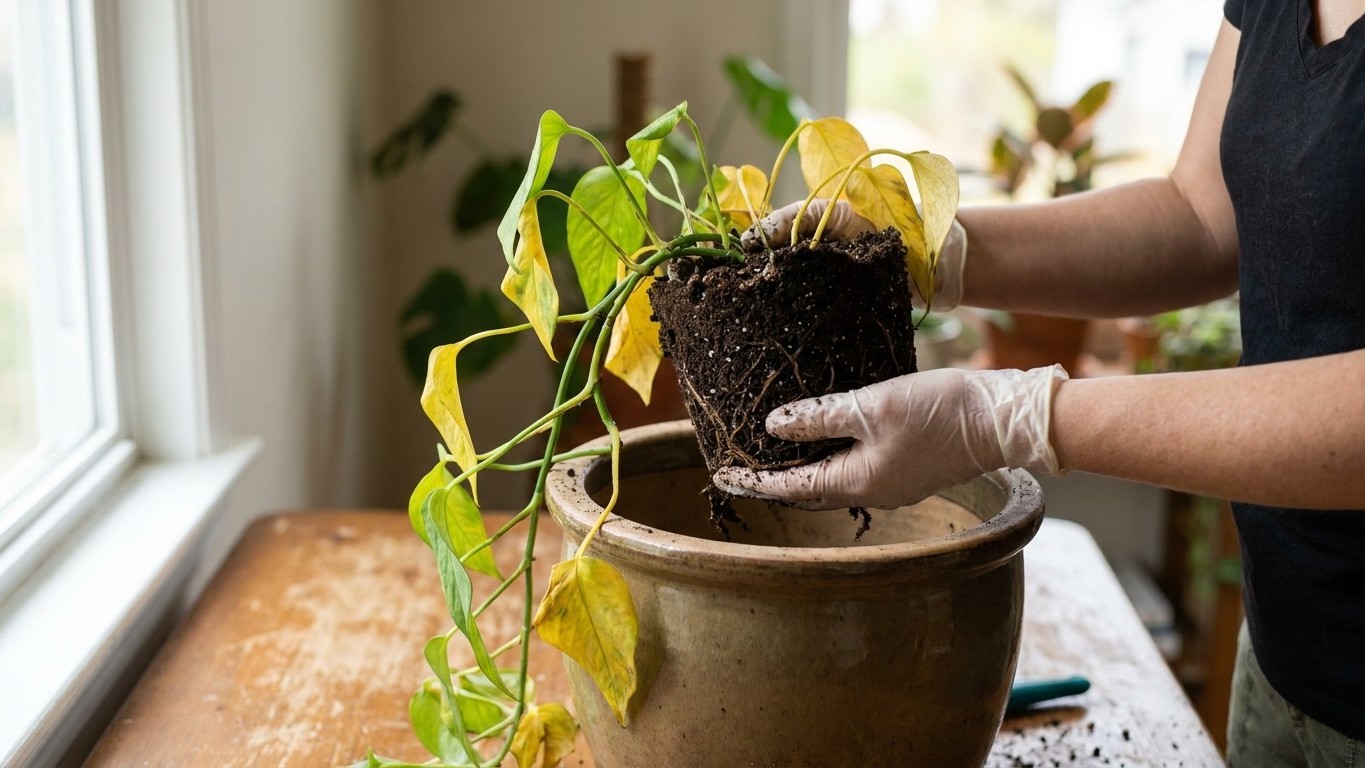
Pothos are supposed to be unkillable. That’s their whole reputation. So when mine started looking limp and yellowed a few weeks after what I thought was a generous upgrade, a new pot nearly twice the size of the old one, I genuinely couldn’t figure out what had gone wrong. Pulling the plant out to investigate was the moment Everything clicked.
Key takeaways
- A soggy outer ring of unused soil is slowly suffocating your pothos roots without any obvious warning signs
- The extra soil isn’t passive—it actively breeds fungus gnats, mold, and concentrates toxic fertilizer salts in your pot
- There’s a specific pot-sizing rule horticulturalists have known for decades that prevents this problem entirely
The “bigger is better” trap that catches almost every plant parent
The logic feels airtight: a larger pot means more room for roots to spread, more soil to hold nutrients, more space to grow. So why not just go big from the start? The problem is soil physics. A large volume of potting mix around a small root system stays wet for a very long time, because the roots aren’t drawing moisture out of it at any meaningful rate. For a pothos, whose roots prefer to dry out slightly between waterings, that excess damp soil becomes a slow trap.
What I found when I pulled out my plant was a dense, soggy outer ring of soil that had been sitting wet for weeks, barely touched by the root system, which had only colonized the center of the pot. The smell was the tell, that faintly sour, almost musty odor that signals anaerobic bacterial activity. The soil wasn’t just wet; it was oxygen-deprived. And roots, like most living tissue, need oxygen to function. Without it, they suffocate and begin to rot from the tips inward.
Root rot doesn’t announce itself dramatically. No sudden wilt, no overnight collapse. The plant just looks tired, slightly yellow at the older leaves, a little less perky in the morning, slower to bounce back after a watering. By the time those symptoms are visible, the damage has usually been developing for weeks underground.
What the extra soil actually does (and it’s not what you’d hope)
Unused potting mix doesn’t just sit there passively. It actively competes with your plant’s health in a few ways. Wet, compacted soil at the perimeter of a pot creates the perfect conditions for fungus gnats, whose larvae feed on organic matter and, when populations spike, on young root hairs. It also encourages certain molds and bacterial colonies that can migrate inward toward the root zone over time.
There’s a secondary issue that rarely gets mentioned: fertilizer salt buildup. When you feed a potted plant, the salts from the fertilizer accumulate in the soil. A plant with a small root system in a large pot isn’t drinking evenly from the whole volume, salts concentrate in the outer, undisturbed zones and can eventually reach levels that chemically burn roots when they finally reach that territory. It’s a slow-motion problem, but a real one.
The correct approach, which horticulturalists have been recommending for decades, is to size up in modest increments: typically no more than 1 to 2 inches larger in diameter than the current pot. For most pothos in a 4-inch pot, that means going to a 6-inch pot, not a 10-inch one. The root system fills the new soil volume relatively quickly, moisture levels stay consistent, and the plant doesn’t spend its energy trying to survive rather than grow.
Rescuing a pothos that’s already been over-potted
If you’ve made the same mistake and suspect your plant is struggling because of excess soil rather than underwatering or pests, the fix is straightforward, though it requires a bit of nerve, because you’re essentially undoing a repot. Gently remove the plant, shake off as much of the wet, unused soil as possible from the outer edges, and repot into a container that actually fits the root ball with just an inch or so of breathing room on all sides.
Trim any roots that look brown, mushy, or hollow, healthy pothos roots are white to pale tan and firm. A clean pair of scissors dipped in rubbing alcohol does the job without spreading potential rot. After repotting, hold off on watering for two to three days to let any cut surfaces callous slightly, then resume a normal schedule based on soil moisture rather than a fixed calendar.
One thing worth doing while the plant is out of its pot: check the drainage hole. A pot that holds excess soil also tends to drain slowly, and sometimes roots or compacted soil partially block the exit. A clogged drainage hole compounds every other problem significantly, it turns a merely oversized pot into a genuine standing-water situation.
The broader lesson pothos teach about container gardening
Pothos are forgiving plants, but they’re not forgiving of this specific mistake because their tolerance for wet conditions is lower than most houseplant guides suggest. They’re native to the forest floors of Southeast Asia, where they grow in fast-draining, leaf-litter-rich soil that rarely stays saturated. A heavy, oversized pot mimics the opposite of those conditions entirely.
The experience reshaped how I think about repotting in general. A plant doesn’t need more soil, it needs the right amount of soil relative to its current root mass. Faster growth comes from a healthy root system in the right-sized container, not from giving it extra space to eventually reach. Nurseries actually use this principle deliberately: young plants are grown in tight pots to encourage dense root development before being moved to something larger. The commercial greenhouse industry calls this “pot cycling,” and it produces stronger plants faster than the intuitive generous-pot approach almost every home gardener reaches for first.
A 4-inch pothos moved to a 10-inch pot isn’t getting a head start. It’s getting a challenge its root system wasn’t ready for.