
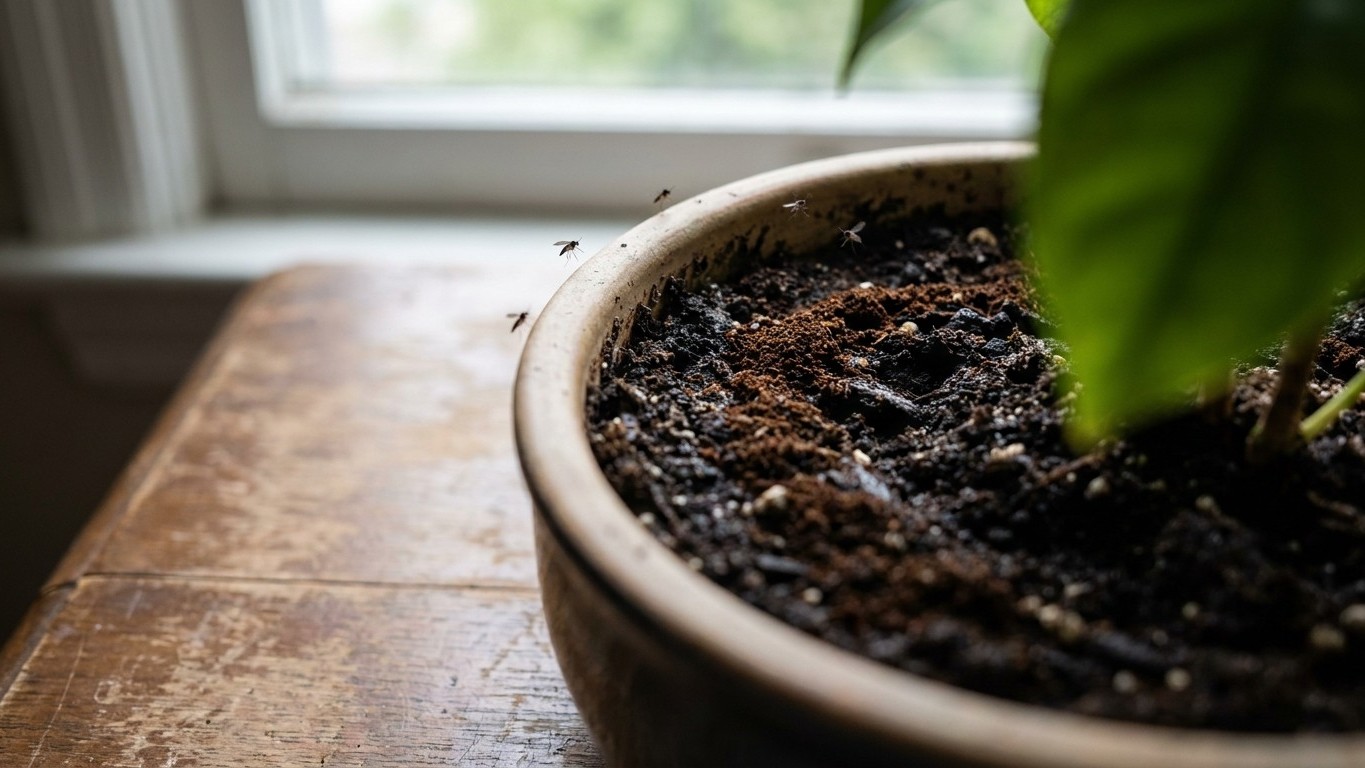
Coffee grounds seem like the perfect plant food. Free, abundant, rich in nitrogen, every gardening blog has championed them as a zero-waste fertilizer hack. So when the idea of sprinkling used grounds directly on top of houseplant soil took hold a few years ago, millions of people tried it. The results, for many, were not what they expected.
A month after spreading a thin layer of grounds on a beloved pothos and a peace lily, a cloud of tiny flies greeted every morning. Not just one or two. Dozens, hovering at soil level, launching off the pot rims whenever a hand came close. The culprit wasn’t immediately obvious, but scraping back that layer of coffee grounds told the whole story.
Key takeaways
- A common gardening hack turns into a pest disaster within weeks of application
- The moist, carbon-rich layer becomes a fungus gnat nursery under the soil surface
- The nitrogen benefits are overstated—and the damage happens much faster than nutrient breakdown
What was actually happening under the surface
Coffee grounds, when applied as a top dressing on potting mix, stay moist. That’s the problem. Unlike the mineral surface of most potting soils, which dries out between waterings, the fine texture of used grounds retains water exceptionally well and compacts into a thin, damp crust. That crust becomes the ideal breeding ground for fungus gnats, those tiny, dark-winged flies from the family Sciaridae that plague indoor gardeners everywhere.
Fungus gnats don’t eat plants directly. Their larvae do, feeding on decomposing organic matter in the top inch or two of soil, and sometimes on fine root hairs when organic matter runs low. A moist, carbon-rich layer sitting on top of potting mix is essentially a fungus gnat nursery. The adult females lay eggs in the top layer of soil; with coffee grounds keeping that layer perpetually damp, the hatch rate skyrockets. One female can lay up to 200 eggs in her short lifespan, according to University of California agriculture extension resources — and with prime conditions, the population compounds fast.
The scraping-back moment reveals this visually: the underside of the grounds layer is often white with fungal threads, and in bad infestations, tiny white larvae (about 1/4 inch long, with shiny black heads) are visible in the soil just beneath. This is not a slow, gradual problem. Under warm indoor conditions, the entire gnat life cycle from egg to adult takes roughly three to four weeks, almost exactly the timeframe when the fly explosion becomes undeniable.
The nitrogen promise versus the reality
Coffee grounds do contain nitrogen, potassium, and phosphorus, legitimate plant nutrients. The issue is that the nitrogen in grounds is bound in organic form, meaning it only becomes available to plants after microbial activity breaks it down. That process works beautifully in an outdoor compost pile, where temperature fluctuations, moisture cycling, and a diverse microbial population handle decomposition efficiently. In a sealed houseplant pot at 68°F, the breakdown is slow, incomplete, and creates anaerobic pockets that smell and invite pests.
There’s also the pH question. Contrary to widespread belief, brewed coffee grounds are closer to pH neutral (around 6.5 to 6.8) than they are acidic, most of the acidity goes into the coffee you drink. So the idea that they’re ideal for acid-loving plants like ferns or gardenias is largely overstated. They won’t dramatically shift soil pH in a pot the way adding sulfur would.
And then there’s caffeine, which gets less attention. Research has shown that caffeine can inhibit seed germination and suppress the growth of some competing plants. In houseplant pots, particularly with seedlings or younger specimens, this could be working against you even as you think you’re helping.
What to do instead, and how to fix the gnat problem
Removing the grounds layer immediately is step one. Scrape away the top inch of soil along with the grounds, discard it in a sealed bag (not the compost bin), and let the pot dry significantly before the next watering. Fungus gnats thrive in moisture; letting soil dry out between waterings is the most effective long-term deterrent. This doesn’t mean stressing the plant, it means watering deeply and then waiting until the top two inches are genuinely dry.
Yellow sticky traps placed near the pot surface catch adults and break the reproductive cycle. For serious infestations, a biological control — Bacillus thuringiensis var. israelensis (Bti), sold commercially as a soil drench, kills larvae without harming plants, earthworms, or pets. It’s derived from a naturally occurring soil bacterium and has a strong track record in horticultural use.
For those who still want to use coffee grounds in their plant care routine, compost is the right vehicle. Mixed into a compost pile and fully broken down, grounds contribute meaningfully to nutrient-rich finished compost. Diluted into water at roughly one part grounds to three parts water, strained, and applied as a liquid feed once a month, they can deliver a mild nitrogen boost without creating the surface moisture problem. The key word is diluted, and the key practice is never leaving wet organic matter sitting on top of indoor soil.
One detail that often surprises people: the same gnat problem can appear even without coffee grounds, simply from overwatering or from potting mixes that contain high amounts of peat or coir, which hold moisture aggressively. Coffee grounds accelerate and intensify the conditions, but they’re part of a broader pattern of keeping indoor soil too wet. The grounds just make a pre-existing vulnerability very visible, very fast, which, in a roundabout way, is useful information about how your watering habits were already trending.