
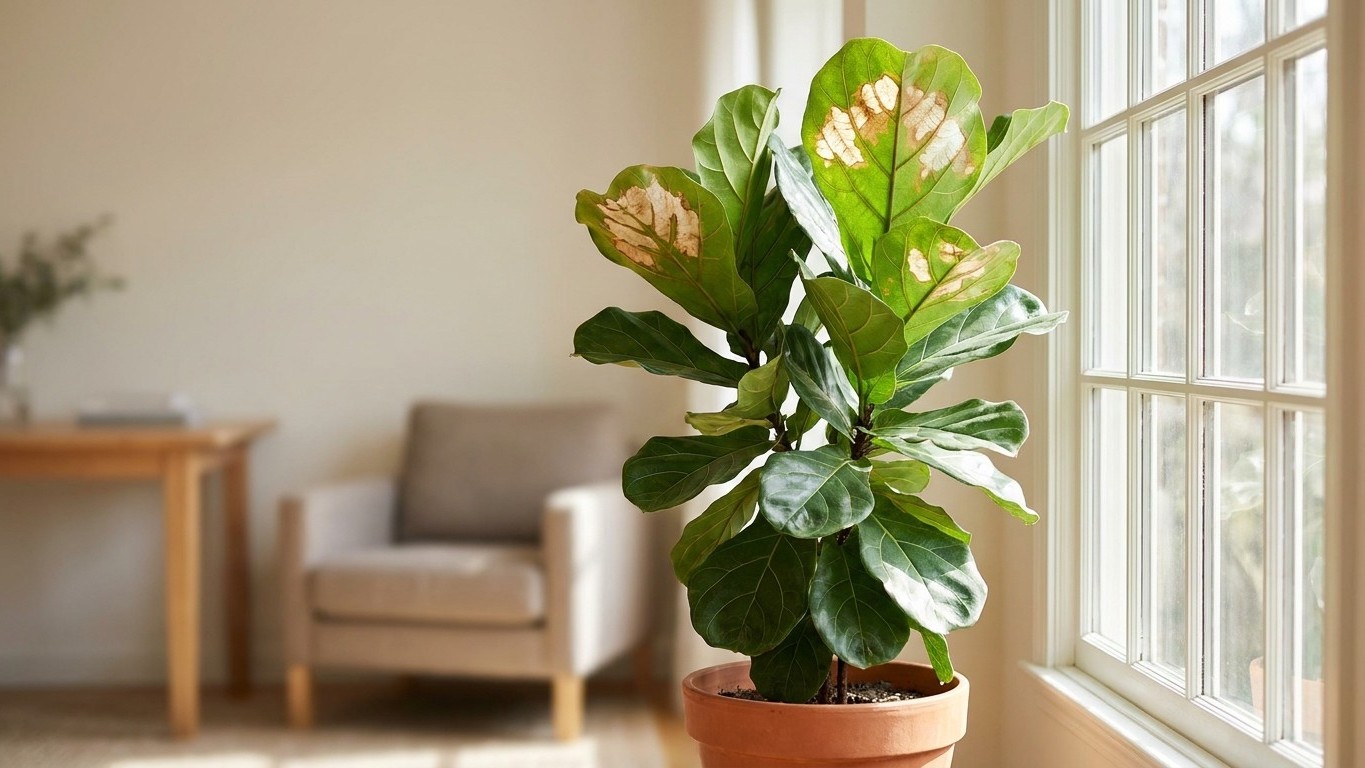
Those crispy tan patches spreading across the top leaves of your pothos or fiddle-leaf fig probably have nothing to do with mold, mildew, or any living pathogen at all. In most cases, what you’re looking at is sunburn, a permanent injury caused by light and heat overwhelming the leaf’s tissue right where it sits closest to the glass.
The confusion makes sense. A brown, dry patch on a leaf looks a lot like the aftermath of a fungal infection, and plenty of plant owners reach for a fungicide spray before considering the window is the actual culprit. Brown spots on plant leaves are among the most searched garden symptoms and among the least specific, since a single brown dot might mean fungal leaf spot disease, bacterial infection, insect stippling, sun scorch, edema from irregular watering, or fertilizer burn. US gardeners often reach for fungicide first; sometimes that makes the plant worse.
Key takeaways
- Window glass magnifies UV rays, creating a lens effect that burns leaves in hours, not days
- Brown spots from sunburn only appear on sun-facing leaves—but fungal diseases spread everywhere
- One simple trick separates sun damage from infection: watch if the spots keep growing
What Sun Damage Actually Looks Like
Leaf scorch doesn’t creep in slowly. Plant sunburn can happen very quickly, in a matter of hours, and the first sign will be large white areas on the leaves. Those pale, washed-out patches aren’t a separate problem. They’re the opening act. Chlorophyll molecules are destroyed faster than the plant can replace them, which causes the bleached or faded yellow look, and the intense light also generates a lot of heat, which can literally cook the leaf tissue. Give it a day or two under harsh light and that bleached zone dries out into the crunchy brown patch most people mistake for disease.
The location of the damage is the giveaway. Discoloring will only appear on the top leaves of your plant, and if it is sunburn and not something else, it will only be on the top leaves or leaves that are most exposed to the sun, while the leaves underneath will not be affected. A fungus doesn’t care which side of the plant faces the glass. Light does.
Why Your Window Glass Is Part of the Problem
Here’s the detail most people miss: it’s rarely the sun alone doing the damage. When light from the sun shines through the windows of your home or office, the glass can actually magnify the rays like a mini magnifying glass, and it’s not actually the sun being harsher, it’s the glass making the sun rays stronger. A plant sitting six inches from a south-facing pane in July is essentially sitting under a lens, even if the room itself doesn’t feel unusually hot.
Shifting seasons make this worse without you ever moving the pot. Houseplants kept indoors can develop sunburn too, whether it’s a new plant put near a sunny window or a plant suddenly getting more sun as the days get longer and the angle of the sun shifts. The plant that thrived on your windowsill all winter can scorch by midsummer for no reason other than the sun climbing higher in the sky. And the plants most at risk aren’t necessarily the ones you’d expect: prayer plants, ferns, Begonias, white-variegated plants, jungle cacti, and thin-leaved aroids scorch more easily than tougher, thick-leaved species.
How to Tell Scorch From a Real Infection
Texture and pattern separate the two conditions more reliably than color alone. Real fungal disease tends to announce itself with company. Several fungi can cause leaf spots, with symptoms including small brown spots with yellowish margins on the leaves, and spots may have a concentric ring or target pattern. Bacterial trouble reads differently again: plants infected with bacteria have water-soaked spots, sometimes with a yellow halo, usually uniform in size, and sometimes with a sticky ooze. Sunburn produces neither ooze nor rings. Spots look dry, bleached, or scorched, appearing whitish, yellow, or light brown, they appear on the parts of the plant most exposed to the sun, and the spots will not spread like a disease but will remain in the sun-damaged areas.
Contagion is the other tell. If the spots are from a cultural issue like sunburn, overwatering, or nutrient deficiency, they are not contagious, but if they are caused by a fungal disease, bacterial infection, or a pest infestation, they can absolutely spread to nearby plants. Watch a scorched leaf for a week. If the brown patch stays exactly the size it was, sunlight is almost certainly the cause. If it keeps growing, or new spots pop up on leaves that never touched direct sun, you’re dealing with something biological, and it’s worth isolating the plant from its neighbors immediately.
What To Actually Do About It
The disappointing truth first: there’s no fixing burned tissue. There’s no aloe vera to put on your plant’s sunburn, and it won’t eventually fade into a tan; the best move is to move your plant into a less bright area, choosing filtered light over direct sun, and resume proper care. Trim the damaged leaves if they bother you, but don’t rush to cut Everything back. If a leaf is only slightly scorched, you can leave it be as the green parts are still photosynthesizing.
Prevention is simpler than most people expect. A few feet of distance from the glass, or a sheer curtain, does most of the work. For very sunny windows, a sheer curtain is your best friend, providing the brightness plants love without the harsh, burning rays. If you’re introducing a plant to a brighter spot on purpose, go slow. Harden off plants before moving them to a sunnier location, letting them have longer and longer exposure to the sun over the course of about 5 to 10 days.
One detail worth remembering before your next repotting session: wet leaves and direct sun are a bad combination on their own, separate from the glass-lens effect. Water only hits the soil when a plant sits in a bright spot, not the foliage, since droplets sitting on a leaf under strong light can concentrate heat on that exact spot, adding a second burn risk to a problem that already had nothing to do with fungus in the first place.
Sources : plantdiseaseapp.com | houseplant101.com