
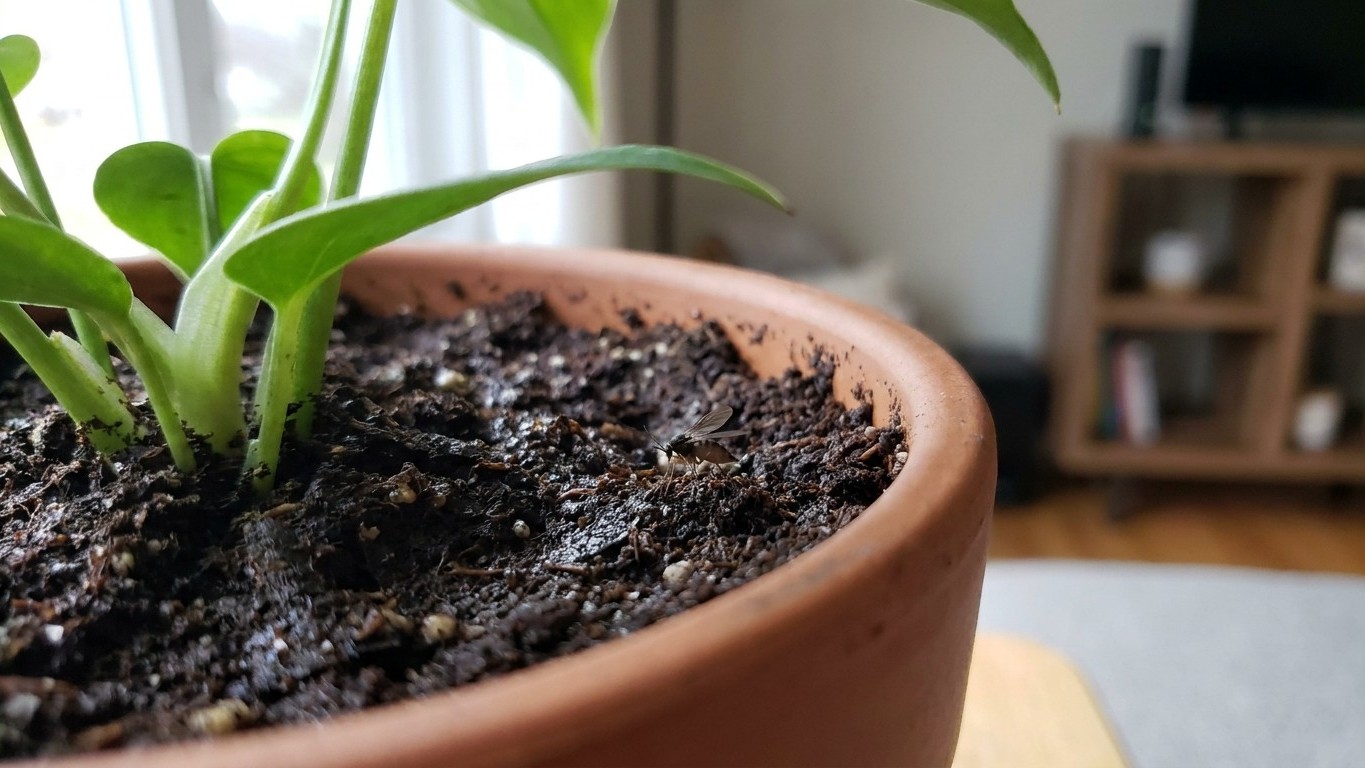
Those tiny black flies bouncing off your face every time you fill the watering can aren’t random visitors. They’re fungus gnats, and their presence is a direct readout of what’s happening a few inches below the soil surface. Fungus gnat larvae usually reside in the top 5-8 cm of the growing medium, depending on moisture level, where they primarily feed on fungi, algae, and decaying plant matter. That damp band of soil you keep “topping off” isn’t just uncomfortable for roots. It’s a nursery.
Key takeaways
- A complete fungus gnat generation hatches every 17 days in moist soil—here’s why swatting adults never solves the problem
- The larvae don’t just annoy you; they tunnel into roots and open wounds that let rot fungi colonize your plant
- One overlooked watering habit is creating the perfect breeding ground in the top 5cm of every pot
The moisture trap you didn’t know you built
Here’s the uncomfortable math: a single female gnat lives barely a week, yet dark-winged fungus gnats lay up to 200 eggs during their seven to 10-day life span, tucking them into cracks and crevices right at the soil surface. Moist-growing media containing high amounts of peat moss are particularly attractive to adult females. That’s exactly what most bagged potting mixes are made of. So when you water on a schedule instead of by feel, keeping the surface perpetually damp “just in case,” you’re rolling out the welcome mat.
The eggs hatch fast. At 75ºF, eggs hatch in about 3 days, the larvae take approximately 10 days to develop into pupae, and about 4 days later the adults emerge. That’s a complete generation in roughly two and a half weeks, indoors, in the same pot, over and over. The entire life cycle can be completed in 17 days, depending on temperature. Warmer rooms accelerate it further. There’s no single “infestation” with fungus gnats. There’s a rolling population, with eggs, larvae, pupae, and adults all present in the same pot at once, which is why swatting the flies never actually solves anything.
What’s really chewing on your roots
The adults are harmless nuisances. Adult fungus gnats are harmless and do not feed on plant tissue; however, the presence of large numbers of gnats in the home constitutes a nuisance that the average homeowner will not tolerate. The larvae are a different story. Larvae usually feed on roots and algae within 1 inch of the soil surface, and root feeding can allow entry of plant pathogens. Translation: even modest larval feeding opens wounds that let rot-causing fungi walk right in.
Most of the time, in a healthy houseplant, the damage stays cosmetic. Wisconsin Extension notes plainly that if larval numbers are high, they may damage roots by feeding on root hairs or tunneling into the roots themselves, though this sort of damage is rare in home settings. But seedlings, fresh cuttings, and anything with delicate, still-forming roots don’t get that luxury. Fungus gnat larvae damage plants by feeding directly on roots, which interferes with water and nutrient uptake, and young plants, cuttings, and seedlings are especially vulnerable. In severe, sustained infestations, the outcome escalates fast: direct damage is when the larvae damage the roots and can slow tissue development (stunting), discolored foliage and in severe cases can cause a canopy wilt and leaf drop. A plant that’s wilting despite being watered religiously isn’t thirsty. It might be root-starved because the roots themselves are compromised, and adding more water only feeds the next generation.
Breaking the cycle at the source
Every extension office, from Minnesota to Colorado, converges on the same core fix, and it isn’t a spray. Drying out the soil, letting the top 1–2 inches of soil dry completely before watering again, disrupts their life cycle, as larvae can’t survive in dry soil. Oklahoma State frames it as the single biggest lever a plant owner has: altering environmental conditions of houseplants is the single most important step in managing this insect in a non-chemical manner, keeping the soil surface dry to eliminate favorable egg-laying sites by allowing the top inch of the soil to dry out before watering.
Bottom-watering solves the contradiction between “the plant needs moisture” and “the surface needs to stay dry.” Watering from the bottom provides moisture for the roots while keeping the soil surface dry. A cheap moisture meter removes the guesswork entirely, since overwatering creates ideal conditions for fungus gnats, and a moisture meter ensures you water only when needed, with a dry surface meaning fewer gnats. Topping the pot with a thin layer of coarse sand or gravel adds another physical barrier: covering the soil with about an inch layer of coarse sand or fine gravel helps keep the surface drier and makes the soil less attractive for egg-laying.
If the population is already established, drying alone won’t clear it overnight, since eggs and pupae already in the soil will keep emerging. This is where a biological insecticide earns its reputation as safe and targeted. Products containing Bacillus thuringiensis subsp. israelensis (Bti), sold as Gnatrol or Mosquito Bits, are available to homeowners and can be used to control fungus gnat larvae in soil. Note the limitation, though: these treatments do not affect eggs, pupae or adult fungus gnats, so apply them with adequate water to help the Bti filter through the soil, using several applications spaced five to seven days apart to control newly hatched larvae until the infestation is under control. Yellow sticky traps won’t cure anything either, but they’re useful diagnostics: you can monitor for fungus gnat adults using yellow sticky traps placed near a plant’s leaves, and these inexpensive traps often include small stakes making them easy to use with potted plants.
An old trick worth knowing if you suspect an infestation but haven’t seen adults yet: press a raw potato slice into the soil surface. If fungus gnat larvae are present in the soil, they’ll come to the surface to feed on the potato tissue, and you check the slices for maggots after three to four days. It costs nothing, takes days rather than weeks, and tells you exactly what’s living in that stubbornly damp top layer before you decide how hard to fight it.
Sources : extension.colostate.edu | extension.okstate.edu