
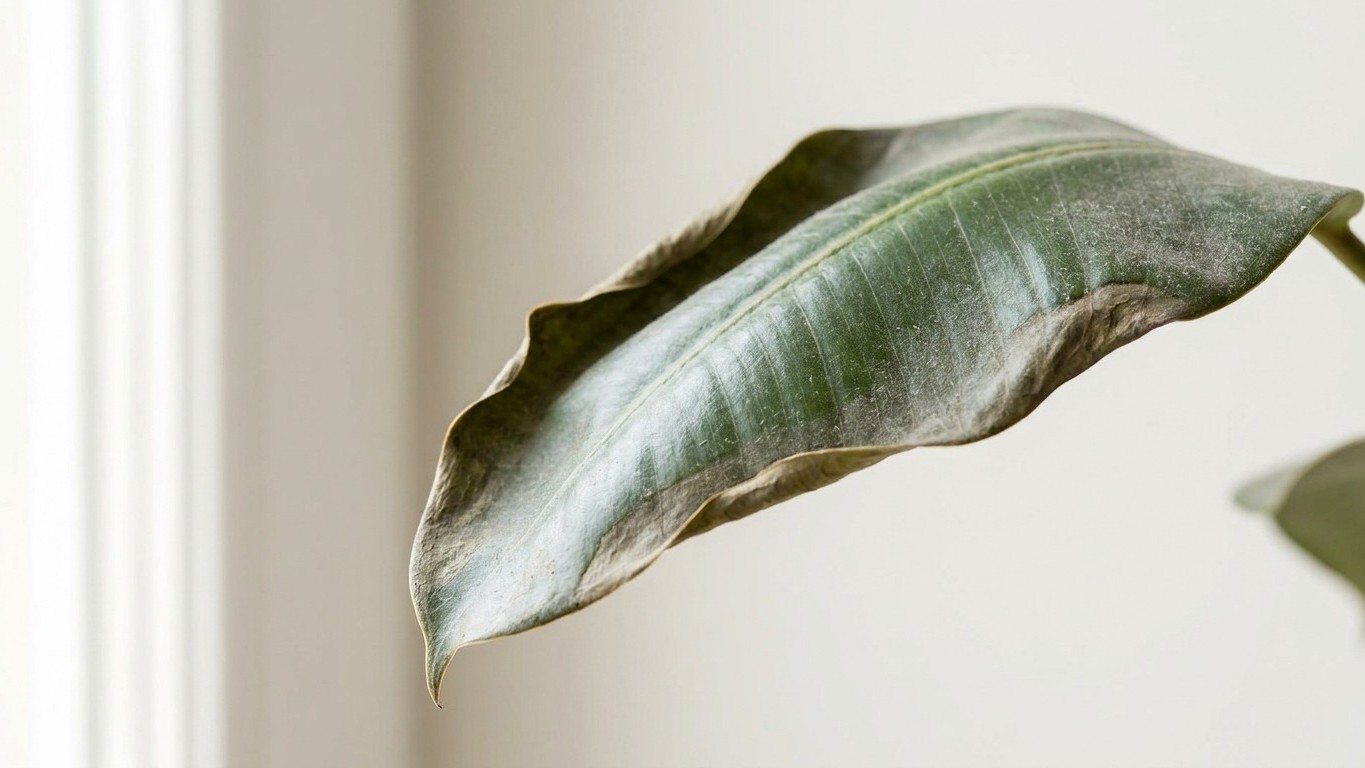
Ficus leaves are supposed to gleam on their own, that deep, rubbery green that looks almost lacquered under a good lamp. So the logic seemed sound: dab a little olive oil on a paper towel, wipe down every leaf, and watch the plant go from dusty houseplant to glossy showpiece in ten minutes flat. It worked, too, for about a week. Then the newer leaves started curling at the edges, the older ones dulled instead of shining, and a fine gray film began settling on the surface no amount of wiping seemed to remove. What looked like a harmless kitchen hack turned out to be a slow-motion way to strangle the plant.
Key takeaways
- A seemingly innocent kitchen hack creates an invisible barrier that blocks the plant’s ability to breathe
- The damage unfolds gradually—which is why you don’t notice the problem until it’s nearly too late
- The very thing you’re trying to remove (dust) actually multiplies when oil is involved
Why oil on a leaf is not the same as oil on skin
The comparison to moisturizing your own skin feels intuitive, but a ficus leaf isn’t skin. It’s covered in thousands of microscopic pores called stomata, mostly clustered on the underside, that the plant uses to breathe. Plants absorb air through their leaves to utilize carbon dioxide and produce oxygen, and olive oil can block the stomata that allow air to enter the leaf and cause your plant to wither and turn brown. That’s the mechanism nobody mentions in the “5 shiny plant hacks” posts that circulate every spring.
The damage isn’t cosmetic, it’s metabolic. When you use olive oil to clean leaves, it creates a thin layer on the leaves’ surface that clogs the tiny pores, and once these pores are clogged, the transport of carbon dioxide and oxygen is affected, disrupting photosynthesis and leading to stunted growth. A ficus doesn’t collapse overnight from this. It suffocates gradually, leaf by leaf, which explains why the first two weeks looked fine and the real damage only became obvious a month in.
There’s a second problem hiding in the oil itself. Using an excessive amount of olive oil on plant leaves can clog up plant pores and hinder their ability to perform vital processes, like photosynthesis and transpiration. And if the plant happens to sit near a window, which most ficus trees do because they crave bright indirect light, the oil turns into a magnifying problem rather than just a blocking one. Olive oil on leaves exposed to the sun may also make plants susceptible to leaf scorch because it traps heat on the plant leaves. Every sunny afternoon was quietly cooking the foliage from the outside in.
The dust trap nobody warns you about
Here’s the part that felt like the final insult. The whole point of the olive oil wipe-down was to get rid of dust and grime. Instead, it built more of it. Olive oil can cause more dust and dirt to stick to the plant’s leaves, because when olive oil is applied to the leaves, it creates a greasy film to which dust and dirt can adhere. Within two weeks the leaves that once looked polished were tackier than before treatment, catching lint, pet hair, and airborne dust like tiny flypaper strips.
This isn’t unique to olive oil, either. Traditional leaf shine products don’t just cover the pores of the leaves but also provide a sticky surface, and the shiny substance tends to catch and attract dust and dirt particles from the surroundings, which over time build up and form a hard-to-remove, dark crust. The irony is almost comic: a treatment meant to make a plant look cleaner ends up making it dirtier, and the dirt itself then blocks light. The oil or wax in leaf shine can attract and trap dust, making the leaves appear dirty and reducing their ability to absorb sunlight. That grayish crust I kept scrubbing at? It was the plant’s own defense system getting buried under exactly the residue I’d created.
Commercial leaf-shine sprays aren’t automatically safer, for what it’s worth. Several contain the same category of problem ingredients. Some leaf shine products contain harmful chemicals like oils, waxes, and silicone that are not plant-friendly chemicals. Reading the label doesn’t always help, since many products don’t disclose all their ingredients, and although it may seem safe, it isn’t, because it closes the pores. Store-bought or homemade, the mechanism of harm is identical: a physical barrier where the plant needs an open exchange with the air.
What actually makes a ficus shine
The frustrating truth is that a healthy ficus shines on its own without any additive. Chlorophyll-rich, well-lit foliage has a natural sheen that no oil rub can replicate convincingly, and forcing it artificially tends to look plastic-y rather than lush. Oily buildup can clog the pores and block respiration, hindering plant growth, and ultra-shiny leaves can look fake, and few people want a plastic-looking plant when they paid for a real one. A slightly matte, evenly green leaf is a better health signal than an oil-slicked one.
If dust is the actual issue, plain water solves it. A soft, damp microfiber cloth wiped gently from the base of the leaf toward the tip, undersides included since that’s where most stomata sit, removes grime without leaving any film behind. For plants that genuinely need a light sheen boost, a heavily diluted neem oil spray on the cloth, not directly on the leaf, is the closer thing to a safe middle ground, since a natural leaf shine spray made by spritzing a damp microfiber cloth with heavily diluted neem oil is a natural way to help ward off pests and give leaves a nice pick-me-up. The operative word is heavily diluted; a few spritzes on the cloth, never a pour straight onto foliage.
A useful habit worth stealing from professional growers: treat leaf cleaning as inspection time, not just a beauty routine. Wiping each leaf by hand is also the moment to catch early signs of spider mites, scale, or fungal spots before they spread, something no amount of olive-oil polish will ever reveal, since that oily coating actively hides the leaf surface under a glare instead of letting you see it clearly.
Sources : outsideinco.com | bybrittanygoldwyn.com