
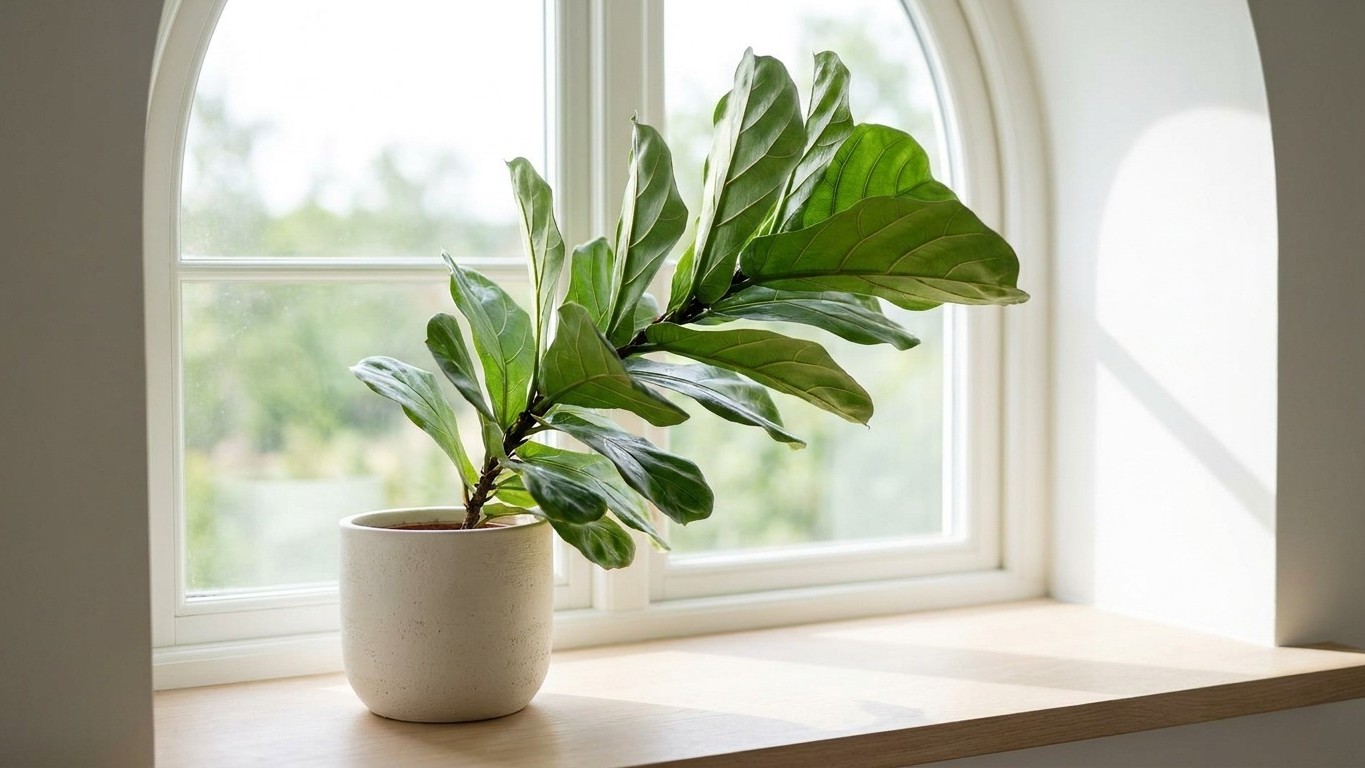
Every part of your grandmother’s plant grew toward the same window, year after year, until she started giving the pot a small twist every time she filled the watering can. That habit wasn’t decoration or superstition. It was a direct response to phototropism, the process by which plants bend toward the strongest light by elongating the cells of the stem on the side that is farthest from the light. Rotate the pot, and you rotate which side gets to stretch. Skip it for months, and the plant tells on you.
Home gardening forums and plant-care blogs have been re-litigating this old habit throughout 2026, partly because so many people bought their first fiddle-leaf fig or monstera during the pandemic Houseplant boom and are now watching those plants develop a permanent lean. The science behind the fix hasn’t changed since your grandmother’s time. What has changed is how precisely botanists can explain it, and how many indoor growers are rediscovering a habit their parents never bothered to pass down.
Key takeaways
- A growth hormone called auxin causes plants to bend toward light, creating a permanent lean if the pot stays in one position
- A quarter turn every watering day gradually corrects the lean without shocking the plant’s hormonal system
- Ignoring rotation long enough causes structural stress that affects root stability and nutrient uptake—it’s not just about looks
The hormone that bends your ficus toward the glass
The mechanism has a name: auxin. This growth hormone redistributes toward the shaded side of shoots, which causes cells on that side to elongate faster and bends the shoot toward the light. Left alone, a plant sitting in a single fixed orientation will keep funneling auxin to its dark side indefinitely, because as far as the plant is concerned, that’s a perfectly sensible survival strategy. Outdoors, sunlight moves across the sky all day. Indoors, it doesn’t. A windowsill delivers light from exactly one direction, hour after hour, and the plant has no way of knowing it’s sitting in a pot rather than rooted in open ground.
The visible result builds slowly. Over weeks and months, a plant kept consistently facing one direction develops a clear lean, with leaves on the window side being larger and more numerous, while stems on the side away from the window may be shorter or carry fewer leaves. Snake plants and rubber plants show this especially clearly. Gardening references note that snake plants often lean heavily toward windows if not turned, and that rubber plants show strong phototropic behavior and can become crooked if left unrotated. Give it long enough, and a plant that started out perfectly upright ends up looking like it’s trying to escape the pot sideways.
Why the quarter turn, specifically
A full 180-degree spin sounds like the more thorough fix, but it isn’t gentler. Botanical references recommend the smaller move precisely because it’s less of a shock: for a dramatic lean, a full 180-degree rotation may cause some leaf reorientation and minor stress, while a gradual correction over three or four quarter turns is more gentle. A quarter turn nudges the plant’s orientation without asking it to reprocess its entire hormonal map at once. Tie that turn to watering day, and you get a built-in reminder system. As one gardening resource puts it, giving your plant a quarter turn every time you water it is an easy way to add the rotation of houseplants to your routine without adding too much strain on your memory. No app, no calendar alert, no sticky note on the fridge. Just muscle memory attached to a task you’re already doing.
Frequency does depend on how much light a plant is getting. A specimen baking in a south-facing window responds faster and needs attention sooner than one tucked in a dim hallway corner. Current guidance breaks down roughly like this:
- Bright light near a southern window: a half turn once every one to two weeks
- Moderate light near an eastern window: a quarter turn once a week
- Low light near a northern window: a quarter turn once a week or every three to five days
The common thread across nearly every source is that rotation should track the watering schedule for most people, since it’s the one moment you’re already handling the pot anyway.
What happens when you skip it (and when you shouldn’t rotate at all)
Ignore rotation long enough and the fix stops being cosmetic. A severely lopsided plant redistributes its weight, which stresses stems and can eventually affect root stability, since the root system also responds to uneven light levels in the above-ground parts of the plant, with roots developing asymmetrically to compensate for bent shoots, an adaptation that can impact overall health and nutrient uptake. That’s the unglamorous reason this “old wives’ habit” earns a second look: it’s not really about symmetry for its own sake, it’s about preventing a slow-motion structural problem.
There are exceptions worth knowing, though. Newly repotted plants, anything freshly pruned, or soil that’s bone dry are all bad candidates for a rotation session, since rotation works best when plants are not actively stressed, and you should avoid rotating right after repotting, heavy pruning, or when the soil is bone dry. And no, spinning the pot doesn’t harm the roots themselves. Rotating a pot in place does not disturb the root system at all; only repotting, moving the plant significantly, or placing it in a completely different light environment disturbs the roots.
One quirk worth knowing before you reach for every pot on the sill: prayer plants and a handful of other species actively track light with their leaves throughout the day, and constant repositioning can actually work against them rather than for them, since prayer plants, which move their leaves toward light, can show stress if constantly adjusted to one direction, and rotating helps prevent this stress by evening out light exposure rather than fighting their natural rhythm. The grandmother-approved quarter turn still applies to most of the greenery on a typical sill. It just isn’t a one-size-fits-every-leaf rule, which is probably the one nuance that got lost somewhere between her generation and ours.
Sources : sciencedaily.com | gardentabs.com